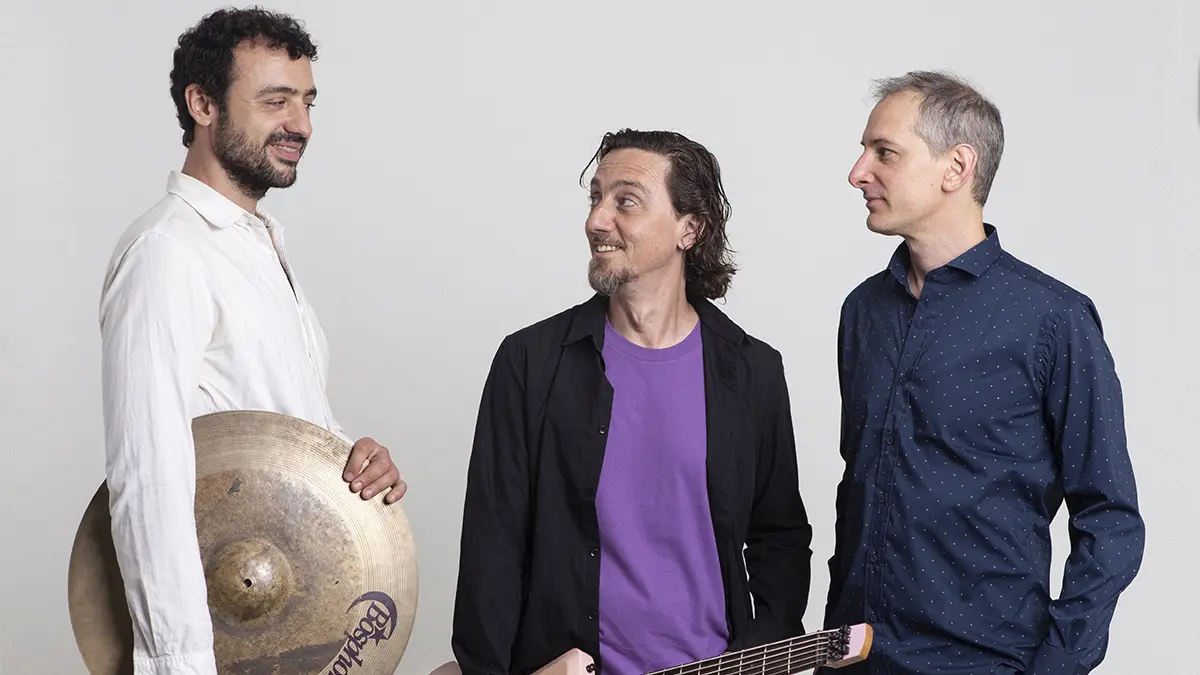
They are called TRES Latin Jazz, and they are a trio—quite fittingly—that, since its formation in 2008, has sought to fuse its Latin American identity with the sounds of contemporary jazz. For this reason, they champion the idea that Latin jazz does not belong solely to a sector or region traditionally associated with what we understand as Latin culture.
We spoke with the band about their new album, the Milei factor in Argentine cultural life, and their 2026 tour, which will take them to China and several European countries.
The phrase “Big in Japan” —artists who are very successful outside their home country, another way of saying that “no one is a prophet in their own land”—does that apply to you, or why do you think you attract attention outside Argentina?
It has to do with the fact that we preserve Argentine and Latin American musical roots within the language of jazz. Although we’ve moved away from traditional music, each piece is infused with elements of candomblé, milonga, and son, combined with modern rhythmic variations and improvisation.
“We don’t deny or downplay the importance of tango in our music, but we put a new spin on it,” TRES Latin Jazz
In a country with a rich musical heritage, when playing Latin music, are you always in the shadow of tango?
That twist is meant to make it sound “strange,” even though the roots are still present in a folk-inspired way. Our albums feature songs by Astor Piazzolla—who revolutionized traditional tango in the 1950s by fusing the tango tradition with elements of classical music and jazz—that bear little resemblance to the original versions and are interwoven with chacareras or guaguancó.
Have you ever been tempted to try your hand at neo-tango?
No. We always make it clear that we don’t perform tango or nuevo tango. Nor do we perform milonga, because otherwise we would be misleading the audience, who think they’re going to see one thing but end up seeing something else.
Beyond the labels
Are you comfortable with the label “jazz fusion”?
That’s exactly what we’re trying to do: break free from labels. As for the “Latin jazz” label, a great musician once told me that this category is usually applied only to Cuba or Central America, but that’s wrong: it belongs to all of us Latinos, as if it were only their music.
So, what word would they never use to describe themselves?
In reality, any Latin American folk music that intersects, blends, and interacts with jazz becomes, in a way, Latin jazz. Personally, I don’t feel that there’s a label that truly captures us.
If you don’t believe in labels, why are they still necessary in the cultural industry? World music is another somewhat misunderstood classification, because it was dictated by the Western industry…
Yes, when we talk about world music, we think of other genres that place greater emphasis on preserving their roots and traditions.
Contemporary Fusion: Trap, Jazz, and Emerging Scenes
Do genres like trap and other urban sounds feel foreign to them given their jazz background?
These days, in Argentina, artists working within that genre are making quite a name for themselves. They also experiment with blending it with folk music and jazz.
Is there anything about trap music that interests you beyond the sound?
We haven’t really explored that, but at some point we’ve wondered: why not add a bit of trap to a certain section of a song? Along those lines, we played with Sylvain Luc in France; Luc passed away a year ago.
Jazz Niche, Scenes, and Regions
After all, there are still niches in music, and jazz has a bit of a cult-like quality to it, doesn’t it?
We also have to accept that some genres of music are more mainstream than others. The goal is to connect with people who appreciate what you do as an artist. That’s something Europe makes much easier: because it’s so interconnected, every city and town allows for smoother touring routes.
Is there currently a significant jazz scene in Argentina?
Due to the continent’s vast size, long distances, and the concentration of activity in just a few cities, it is much more difficult to organize continuous itineraries. Unlike in China, where it is feasible to plan itineraries of up to 7,000 km in 15 days thanks to the high connectivity between cities and the bullet train, such logistics would not be possible in many parts of Latin America.
Virtuosity, purism, and cultural biases
The jazz musician Duke Ellington once said, “There are only two kinds of music: good music and everything else.” However, many jazz musicians display a technical superiority that can sometimes come across as a bit snobbish, even by modern standards. Can virtuosity become a barrier to listening?
Classical music is often considered superior to trap, or placed on a higher pedestal than other genres. Personally, I don’t rank music. Urban music is, after all, a form of cultural expression.

In Argentina, does that purism still exist when traditional music comes into contact with contemporary music—in this case, jazz fusion?
That happens in many genres. When Charly García recorded the Argentine national anthem on *Filosofía barata y zapatos de goma* in the early 1990s, it caused a scandal: people said it was an insult.
There is an urban legend in Mexico that claims Pérez Prado was expelled from the country for performing a mambo version of the Mexican national anthem…
Yes, a bit like in García’s case. It was a cultural moment marked by repetition and a certain superficiality in the offerings. Years later, the Argentine government itself promoted updated versions of patriotic songs, with a folk feel or performed by popular artists. Today, in Argentina, what I see is a strong presence of tributes and homages. A friend from Spain recently told us that jazz tribute bands are in high demand in Valencia.
Culture, Politics, and the Milei Factor
Has Milei’s administration affected you as artists—for better or for worse?
I don’t think the government currently has any real interest in promoting culture. It isn’t treated as a policy priority, nor is there a clear vision of culture as an industry. The prevailing view is that everything should be self-regulated: if there’s someone who wants to buy and someone who wants to sell, the government steps aside.
If the government withdraws and only entertainment remains, is jazz doomed to the margins?
By that logic, when the government withdraws from the cultural sphere, entertainment ends up dominating. This opens up the philosophical debate over whether culture is entertainment or whether entertainment is culture.

Odyssey on the Slope : Creating in an Adverse Context
The title of his new album, Odisea del talud , what does it refer to?
In 2025, CONICET— Argentina’s National Scientific and Technical Research Council— conducted a study of Slope 4 of the Argentine continental shelf in collaboration with an oceanographic vessel. The news garnered enormous national and international attention, with millions of people following the discovery.
So, is the concept a little ironic?
Paradoxically, this occurred at the very same time that the government was undermining CONICET’s legitimacy, viewing it as an unnecessary expense despite its global recognition. From this contradiction emerges the idea of an “odyssey”: the productive, symbolic, and material effort involved in creating and representing from within this country. The concept of a slope is redefined as that which supports, is useful, and allows passage, in dialogue with the political and cultural context of the moment.
Odisea del talud will be available in February 2026 on vinyl LP and in digital format. If you’re in China, where CDs remain a widely consumed format, the album will be released in that format, coinciding with the tour that TRES Latin Jazz will undertake there during the month of March.
To keep exploring this thread, visit our cultural perspectives section.