In 1965, Salvador Elizondo (1932–2006) published his most terrifying and legendary work, *Farabeuf, or The Chronicle of a Moment*.
Farabeuf, by Salvador Elizondo, is one of the most mysterious, complex, and enigmatic books to have entered the canon of Mexican literature. It is not the telling of a story, nor the journey of a character, but rather the obsessive interweaving of certain scenes, all of them beautiful and aberrant. His writing is inexhaustible because it always offers something new and vibrant.
More than 60 years after its publication, what can we learn from Farabeuf as a framework for understanding reality?
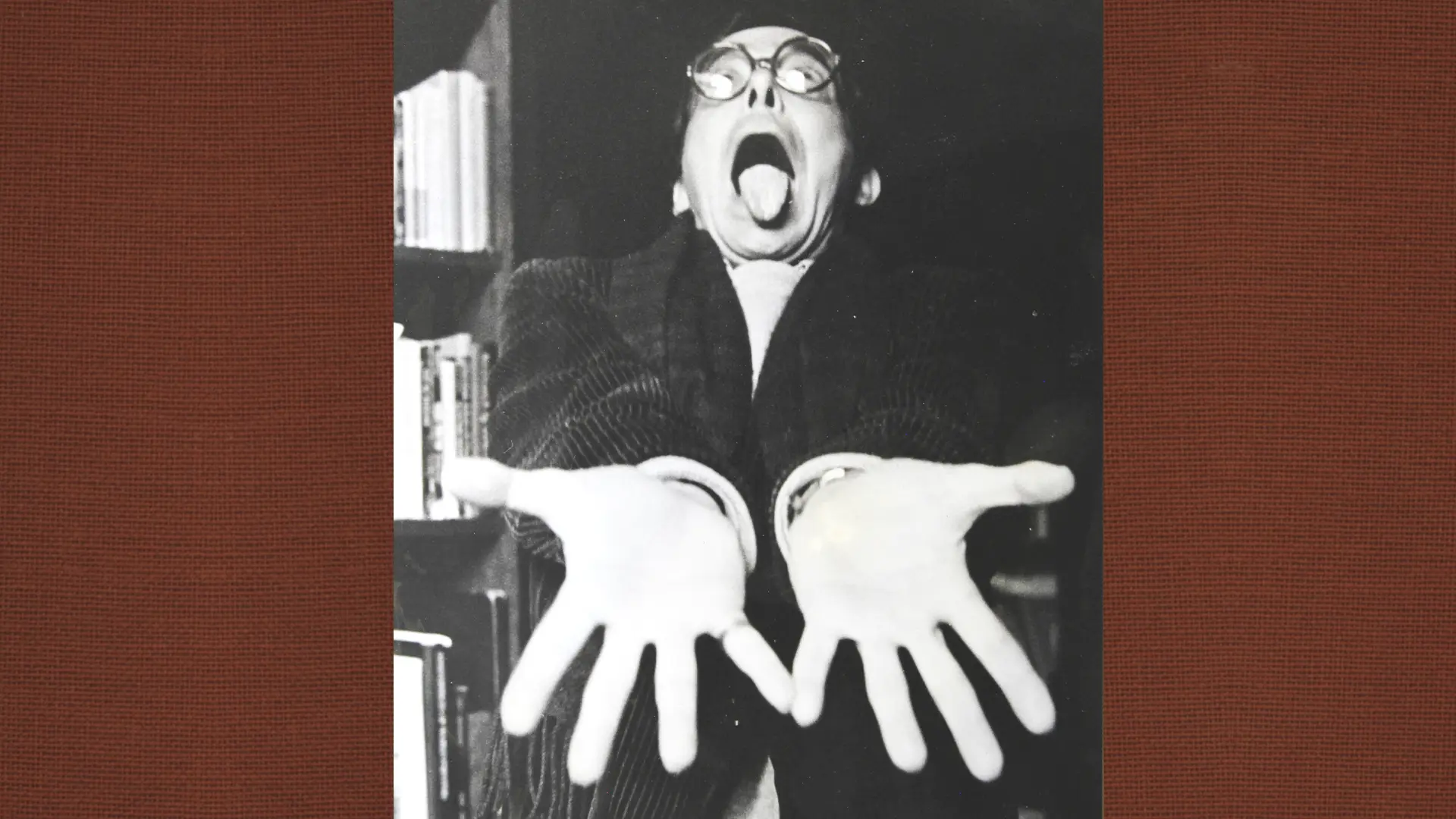
Salvador Elizondo: Early Maturity, Image, and Literature
Elizondo was born in Mexico City in 1932. He spent his early years in Germany during the early days of the Third Reich. He later returned to Mexico. His father, Salvador Elizondo Pani, was the director of Estudios CLASA, one of the largest film production companies in Mexican cinema during the Golden Age. Young Salvador spent his childhood surrounded by cameras, stars, and the legendary images of a past that would never return.
As World War II was drawing to a close and Elizondo was entering puberty, he was sent to Elsinore, a military school in the United States. Later, in his early youth, he traveled through Europe and studied painting and film. He soon hung up his paintbrushes, but still wanted to make movies. He wrote a few screenplays and managed to make Apocalypse 1900, an experimental film made using scientific illustrations from the journal Nature.

He then devoted himself entirely to writing. Since the publication of *Farabeuf*, his entire body of work can be found in the pages of his books and journals.
Salvador Elizondo belongs to the “Generation of the Mid-Century,” which includes authors such as Carlos Fuentes, Rosario Castellanos, Sergio Pitol, José Emilio Pacheco, Juan García Ponce, and Elena Poniatowska, among others. These writers have a complex relationship with the tradition that preceded them: for them, Mexican identity extends beyond ruralism and propaganda.
In terms of poetics and form, Salvador Elizondo was one of the most radical writers of his generation.
Farabeuf by SalvadorElizondo: the staging, the contagion
Following the publication of Farabeuf, Elizondo was frequently asked how he had written the book. He didn’t even know himself. What did that incomprehensible, plotless, yet so evocative piece mean? What was the secret behind prose so brilliant, complex, and yet, at the same time, devoid of a story?

In 1992, nearly 30 years after the book’s publication, the author gave a lecture in which he claimed to have found the definitive explanation for how and why he wrote the book—that is, he established the visual origins of *Farabeuf*. At its core lies a cinematic mechanism.
““The entire book consists of small, seemingly unconnected images, including images that clash with one another. […] That compositional principle, known as montage, or the principle of montage […] in which the clash of two things produces athird”
And later…
“where they use expressions of concrete things that, together, produce a third abstract image in the viewer’s mind”
Consider, for example, the shower scene in *Psycho* (Alfred Hitchcock, 1960). When Norman Bates stabs Marion with the knife, we never see the blade piercing the victim’s flesh or the blood spurting from her skin. Specifically, we see the body and the terrified face of a naked woman, as well as the weapon in the murderer’s hand, which enters and exits the frame. The carnage isn’t on the screen, but in our heads.
Images are contagious. Their juxtaposition gives rise to new meanings, new images. That mechanism lies at the heart of Farabeuf. The book is a juxtaposition of diverse scenes, perhaps dissimilar, but all beautiful: a dark room in which a nurse and two lovers await a surgeon, Dr. Farabeuf, who will perform an amputation on the living woman in front of everyone present; a beach where a man and a woman walk, flee from one another, watch a child building a sandcastle, and touch a starfish; an act of intercourse; a Chinese assassin being tortured before an audience eager for his pain and in front of Farabeuf’s camera.
The book also explores the connections between certain ideas: death and orgasm, pleasure and pain, and—the one that interests us most right now—the link between torture, surgery, sexual intercourse, and photography. More than 60 years after its publication, and among all the possible ways to approach Farabeuf, we will focus on the image—or rather, on the image of violence and horror as an open wound.
The image, the horror
In 2006, Mexico entered a regime of visibility that was imposed by force. The images circulating became horrifying. The war on drug trafficking produced scenes of beheadings, videos of torture, bodies hanging from bridges or dismembered in the sunlight. Their release was intended to instill collective panic and, with it, a new model of reality built upon horror.
In 2009, the Italian feminist philosopher Adriana Cavarero published *Horrorism: Naming Contemporary Violence*. A new enemy had emerged after the Cold War. With it came another form of political violence. Killing the other is no longer enough; military aggression is not satisfied with murder.
The current model demands cruelty toward the vulnerability of the defenseless, the destruction of the uniqueness of their bodies, and the exercise of a type of violence that leads to paralysis and revulsion. The images circulating in Mexico—produced by the state and organized crime—follow this logic of fostering horror, complete with its effects of power.
Herein lies one of the possible contemporary interpretations of Farabeuf: it is a book about the image—or rather, about the effect that the clash of images has on the witness’s gaze and body.
“Then, very close to us, a pelican fell into the water and you got scared
Yes, he was frightened when he saw Farabeuf holding that incredibly sharp blade before his nearsighted eyes, in the twilight.”
In the first line of the quote above, we are with the couple on the beach. In the second, we look at the dark room that will be the scene of the woman’s dismemberment. There is nothing—no sign—to connect the two. One is next to the other.
“She was sitting, her body tense against the gleaming steel of that gynecological table. […] She had taken the precaution of spreading her long legs, tanned by the summer sun by the sea […] Fixed on that face held within the stainless steel headrest, only her eyes were able to follow that bloody image which, held in his trembling hands, eager for her body, approached her face, placing before her eyes—held open by two gleaming Collin eyelid holders— that image whose sight was inescapable»
In *Farabeuf*, the doctor and the man force the woman to look, to accept an image as a hypnotic and all-encompassing reality. In Mexico, too. In the book, the way images spread—and then infect the woman who looks at them—is analogous to how we view images of political and criminal horror. They subjugate us, dominate us, terrify us. In both cases, the gaze is subjected to the emergence of a third mental image.
The scene of Chinese torture—public dismemberment before a crowd—evokes both ecstasy and horror. *Farabeuf* is a treatise on the visual representation of violence.

Photography, the scalpel
Elizondo draws a parallel between the camera and the scalpel.
“All right, I’ll try to keep it brief. It was a rainy day. Beijing. 1901. January 1901. Evening was beginning to fall. Back then, there were only two things that interested me: field surgery and instant photography. »
In Farabeuf’s work, photography is a surgical incision. The camera and the scalpel function as instruments of amputation. The body and the scene endure the cut. The image, as it emerges and comes alive anew each time we look at it, is a wound that refuses to heal.
“You have fallen into the trap set by the miracle worker. The image of that torment has taken shape in your mind. That ecstatic face has been etched into your memory. Like a flash of lightning, that age-old agony materialized before your eyes […] You forgot yourself”
An image can completely captivate us. In the clash of scenes, or in the obscene display of a painting, we can subject our reality to the coordinates of what we are looking at.
Here lies the ultimate effect of the image. Perhaps of propaganda, or of all the scenes staged to instill fear in us: the war on drugs, the genocide in Palestine, Abu Ghraib. We might surrender to these terrifying idols. Farabeuf unwittingly anticipates the all-encompassing nature of the political image that imposes meanings, transforms bodies and realities.
But there’s more to Elizondo than that.
Eros Beyond Tears
There is widespread and legitimate criticism regarding the dissemination of images of political horror. Their mass circulation will eventually have a numbing effect. The tragedy of the painting will eventually lull us into apathy, making us indifferent, and its subversive potential will have been neutralized. But there is a side we haven’t discussed that is present in Farabeuf: the dimension of desire.

It is impossible to understand the connection between photography and amputation without considering the dimension of sexual intercourse. *Farabeuf* is an erotic book, in the most raw sense of the word and also in the most innocent.
“As a token of my love, I’ve decided to give you a little time to relax today. You and I are celebrating a secret anniversary. […] Because I love you, you must let me give you thisgift”
The man is addressing the woman here. They are waiting for Dr. Farabeuf. The gift is a ceremony of mutilation on living flesh. It is a ritual of love. In Elizondo, as far-fetched as it may seem today, the image and experience of horror can be viewed with pleasure and ecstasy. It is not the content of the image that matters, but the angle of the gaze.
In real life, where almost everything hurts, we form different relationships with the images around us. The bond we forge with propaganda is not the same as the one we have with the memory of our grandparents. We don’t relate to a photo of a politician the same way we do to one of a musician we like. Even in the vast realm of desire and love, there are variations. The image of the person we love doesn’t have the same effect as the scene we use to touch ourselves.
That is the secret of Farabeuf. The repetition of the image is not driven by horror, but by desire—that is, by what compels us to look at the image and our memories in order to be moved.
Perhaps, through that vital impulse, we can overcome the horror.

Discover other iconic works in AW Magazine.
To keep exploring this thread, visit cultural perspectives from Latin America; you can also continue through cultural agenda across Latin America and Spain.