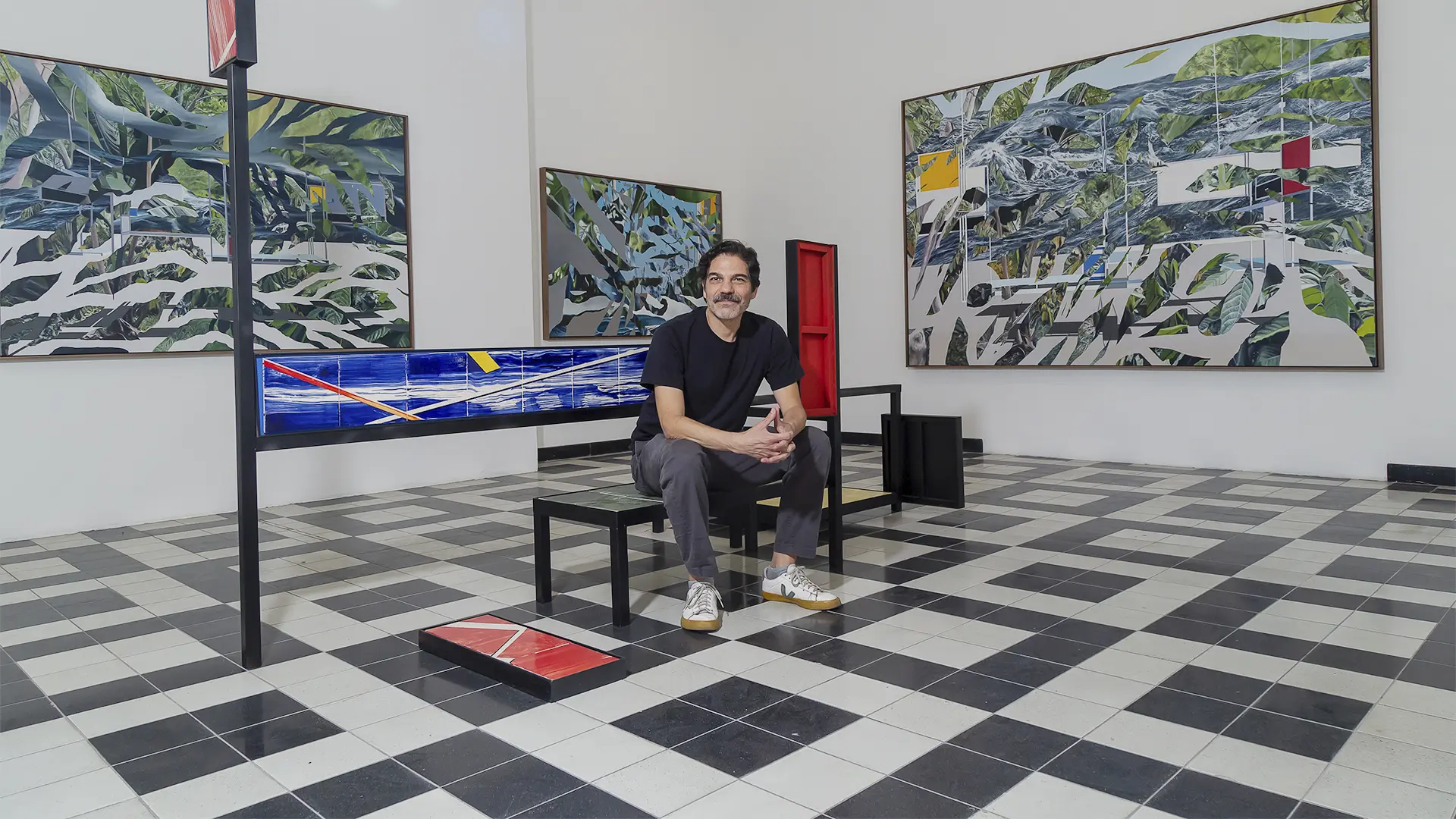

Some artists document their times, while others deconstruct them. Luis Alfonso Villalobos belongs to the latter group. Between painting, idyllic gardens, fragmented architecture, and suspended landscapes, his work—which extends into installation—constructs scenarios far removed from nostalgia, where we still do not know if everything is crumbling or reconfiguring. His pieces function as multi-layered visual puzzles—material, symbolic, historical—where the image is not merely contemplative, but a form of thought.

With exhibitions at the Cabañas Museum, the Scottsdale Museum of Contemporary Art, and projects in Europe and Latin America—in addition to having been a member of the National System of Creators, a winner of the October Salon in the Lifetime Achievement category, and a grantee of the Andy Warhol Foundation—his career has been firmly established in both institutional and independent circles.
In this talk, Villalobos discusses moving away from cultural management, appropriation as a method, the tensions of the art market, and a question that runs through all of his work: whether art can truly influence the contemporary collapse or merely depict it on a gallery wall.
The Role of Contemporary Art: Catharsis or Transformation?
Why are you focusing solely on your own work and have kind of put that management aspect on the back burner?
Well, I think that’s kind of the trend for a lot of people—you start by collaborating, working on projects with friends to begin creating these spaces that don’t exist for younger artists. Collaborating, so to speak, with the scene, which at that time was also quite small, so to speak, in terms of participants and the venues that could host these creators.
Do you think, then, that art in general is more of a cathartic or contemplative experience than something that actually brings about change?
Obviously, there are different types of artists—some who might lean more toward the activist side, right? Their work is more performance-based or has more direct implications, such as a practice that can take place in a public space, for example, involving more participants, perhaps more spectators. Therefore, there are different fields of action and ways they are articulated.
I don’t think everything is just contemplative and meant for observing and experiencing pleasure; rather, there are different strategies, and they’re all very interesting. My work does lean more toward the visual arts, strictly speaking, even though it involves all these reflections, but it’s very visual and encompasses everything that comes with this kind of decision-making.

Gardens, the Sacred, and the Image in Contemporary Art
In your work, you depict idyllic gardens and images like that—is there a theological aspect to it, or is that just my perception?
That’s a good point. I do think a lot about the concept of something untouched, of a place that hasn’t been touched when it could be something paradisiacal, to understand the image of the most sacred, as a space, as an ideal of the world, and well, it leans more toward what hasn’t been desecrated, what is intact. But still, someone might be looking at it from a functional perspective.
And besides, I don’t know if you agree that in art nothing is off-limits or sacred, right? Not at all.
It seems to me that everything should be questioned, used, and reworked—let’s call it—first as a form of use and then as a reuse of images or concepts.
And what do you think about cultural appropriation?
I’m definitely someone who advocates for appropriation—for example, I want my work to draw more heavily on architecture or the work of other creators, not necessarily painters or writers’ quotes, or whatever.
Like what Jorge Méndez Blake does, right? The thing with quotes from writers.
Yeah, sure, but there are all kinds of appropriation strategies, and I really love how the material is used.

Art, Crisis, and Collapse: A Contemporary Interpretation
In that sense, I notice that your work contains both idyllic images, as I was saying, and shattered utopias—it’s as if you’re exploring both sides of the coin.
Well, beyond the fact that they’re destroyed, in my view they’re in a state of collapse where there’s still a gap regarding what will happen if this natural scene is reassembled. That kind of floating dimension. The canvas is like a kind of puzzle, let’s say, that has three layers; the most artificial part is the one that connects them.
So there’s a kind of symbolic “dystopia” in your work…
It’s more like this moment where we have no idea where things are headed. And when it comes to civilization, politics, the environment, and society, we’re in a very strange place right now. And I think that’s what worries me and what I try to capture. I think that’s key for an artist—to keep asking questions.
The Art Market and Tensions in the Contemporary System
Is there anything about contemporary art that you don’t like? Anything that bothers you?
Well, there are many things I wouldn’t want to say I dislike, but perhaps I don’t necessarily agree with them. For instance, some aspects of the market are complex—how it works and how it operates.
Don’t you like going to fairs?
They’re a bit strange, though they’re absolutely essential. Still, they’re often a bit absurd. And that has a lot to do with questions of who holds the most power, which galleries are in operation, and what kind of powerful interests are involved as well.
Artistic career and international projects
You were a member of the National Creators System program. What was that experience like from the official side?
It came along at a time when I wasn’t represented by any gallery. That was between 2018 and 2021; it was something that kept me afloat during those strange years when I didn’t have representation. Thanks to this support, I was able to produce the work I exhibited at the Cabañas Museum, for example.
What’s next? Do you have any new projects in the works, any installations, or any residencies?
We have a residency in Mallorca, at CCA Andrach. I don’t know if you’re familiar with this program and this institution in Mallorca; I’ll be working alongside my colleagues here, Cintia Gutiérrez, Emanuel Tobar, and Alejandro Almanza. And yours truly—we’ll be there for a month in September, and we’ll also be wrapping up the residency with a show at the institution’s Espacio Galería in October, which opens in October. So it’s going to be a really great time, you know? And after that I’m going to London; I have a solo project at a small gallery in London curated by Alfonso Sánchez, a young Mexican curator with whom I’ve already collaborated on a project in Baltimore.
The Art Scene in Mexico and the Newer Generations
What do you consider when looking for or choosing projects?
Beyond just participating in a lot of things, there also needs to be a sense of seriousness, and the projects need to be well-thought-out. They should be as professional and interesting as possible. I’m also working with Palma Galería, a young, recently established gallery in Guadalajara. They’re presenting a project that I really like. What’s the name of the project? A great choice, Palma Galería.
Does the art scene and art-loving public in Mexico have a good memory?
It’s a bit of a thankless situation, because people forget about you. And the next generation isn’t stepping up; there are times when there’s no one to take over, and it’s kind of frustrating to see that new blood not coming through.
Do you think there’s already a tangible generational shift in Mexico, then?
Yes, there are definitely new generations coming up with fresh ideas and energy—good projects driven by the enthusiasm and drive to create their own spaces, which aren’t necessarily very professional but are already full of great ideas.
Artistic Motivation and Ecological Reflection in Art
What keeps motivating you to create art and exhibit it?
It all stems from a personal need: to create in order to experience something that hasn’t been seen or produced before, so I do it for myself first. Those are the ideals for an artist, along with taking risks, so that I can bring ambitious projects to life.
There’s a side to you—I’m not sure if I should call it “environmentalist”—in shows like *Dimensión Flotante*
Yes, it’s about the role of humans and the impending devastation, without going so far as to raise a critical issue or say that things are really bad; it’s more about understanding that this is a normal process and that our existence inevitably leads to this kind of destruction. It’s not that there’s a solution, but rather that it’s about asking these questions: What does it cost for us to be here, and how can we improve things—or not?
To keep exploring this thread, visit contemporary Latin American art; you can also continue through profiles of Latin American artists.