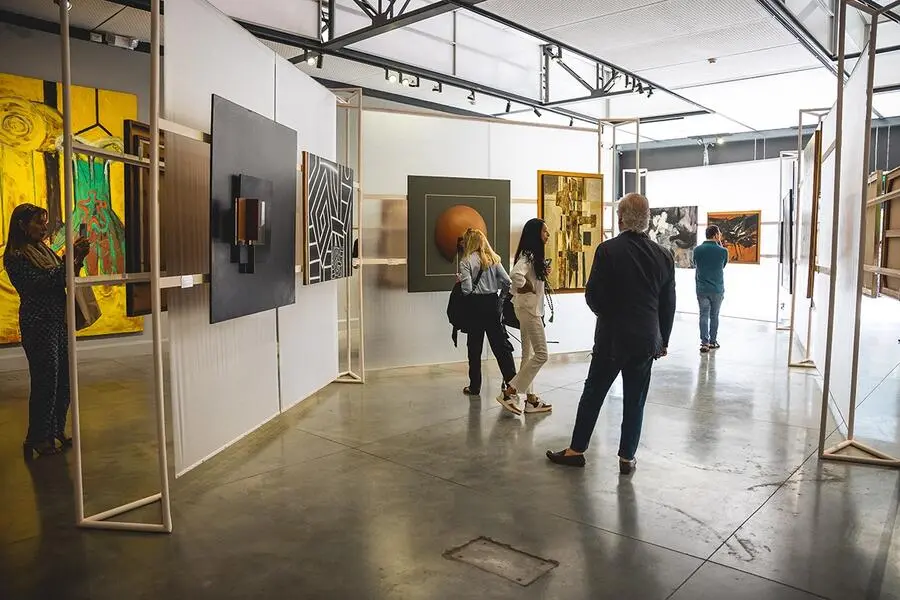

The diversity of Latin America’s artistic and cultural scene is vividly on display at Pinta Lima, undoubtedly Peru’s most important contemporary art fair today. In its 13th edition, the fair has established itself in 2026 as a space for connection between galleries, artists, curators, and collectors, framed within a narrative that showcases the country’s modernity.
For the sixth consecutive year, the iconic Casa Prado is hosting the event. This 18th-century building, located in the Miraflores neighborhood, is part of Lima’s cultural heritage. Its colonial architecture remains monumental, almost like an island from the past suspended in the 21st century.
Pinta Lima and the EFG Latin America Art Award
Pinta Lima is part of Pinta, the international network dedicated to promoting Latin American art worldwide through initiatives such as Pinta Panama Art Week, Pinta Medellin Art Week, and Pinta Santo Domingo Art Week.
In this edition, in collaboration with Art Nexus, the EFG Latin America Art Award, an annual award established in 2010 that seeks to highlight and promote the work of emerging artists in the region. Based on a selection made at fairs such as SP-Arte, arteBA, Ch.ACO, ArtBo, and Pinta Lima itself, the award recognizes a work that becomes part of a collection through acquisition. This helps strengthen the circulation of Latin American contemporary art.
The main section of Pinta Lima 2026
The event features three exhibition areas. The main one showcases works such as those from Aninat Gallery in Santiago, Chile. This space kicks off the list as a starting point in the southern part of the continent. Next is Beatriz Gil Gallery in Caracas, where the Venezuelan art scene shows its strength. From Lima, with a presence in London, comes Carlos Caamaño and his Espacio Fotográfico, which is nestled between the two cities. Meanwhile, Collectio brings us back to Santiago, weaving a circuit that connects cities and ideas.
The tour continues to Bogotá with El Museo. It then returns to Lima with ENLACE, underscoring Peru’s significance in the event. Madrid is represented by Espacio Valverde and Fernando Pradilla, establishing that essential link to Europe that is a must for amodernart eventin Latin America. Once again from Chile, Galería de Arte La Sala and then Galería del Paseo strengthen the map’s reach toward the Southern Cone.
Buenos Aires is a key hub for Pinta Lima 2026
Lima returns to the fair’s lineup through Galería Forum, Galería Martín Yépez, HÉCTOR LA ROSA, LA GALERÍA, La Mancha Galería, Livia Benavides, and Marissi Campos. Their presence underscores the vitality of the local contemporary art scene. Caracas adds another presence with GBG ARTS, while Herlitzka & Co. connects Buenos Aires with New York, expanding the dialogue toward the West.
Buenos Aires is a key hub. With Linse Galería, Pabellón 4 Arte Contemporáneo, ROSEUM, The White Lodge, and Tramo, joined by Lyv Gallery in Córdoba. Chile returns to the spotlight with NAC and Prima Galería. Likewise, Madrid makes its presence felt with Ponce+Robles.
The network expands even further with Sammer Gallery in Miami and TM Galería in Guayaquil, completing a diverse network of venues spanning Latin America, the United States, and Europe. This creates a contemporary landscape of artistic exchange that rivals that of other international art fairs.
The Next section
In this second section of the event, the selection shines a spotlight on artists from Argentina, Chile, and Peru, whose emerging careers engage with a network of galleries based primarily in Argentina, Peru, and the United States. Spaces such as BLOC Art in Lima, CASAGALERIA in Salta, and Mahara+Co in Miami bring this initiative to life, serving as platforms to highlight new voices on the scene.
These are joined by initiatives such as Matia Borgonovo in San Salvador and Salón Comunal in Bogotá, expanding the program’s geographic reach and reinforcing its regional character. Taken together, this supplementary section paints a rich picture of collaborations spanning Latin America and reaching out to the international scene. Not a bad outlook for what lies ahead.
RADAR at Pinta Lima
The RADAR section brings together a selection of artists primarily from Argentina, Peru, and the United States, whose emerging practices are represented by a group of galleries operating in Buenos Aires, Lima, and Salta. With a strong Argentine presence, both in terms of artists and venues, this section stands out for its experimental nature
Galleries such as COTT in Buenos Aires and Remota in Salta engage with projects in Lima such as CRISIS and It brings together galleries, fostering a broader artistic dialogue. Overall, RADAR serves as a space for exploration and discovery, where new voices and ideas converge, reflecting the diversity and vitality of contemporary art in the region. As Peruvian gallerist Livia Benavides, also present at the fair, told us: “I believe that languages ultimately end up being universal, because there is also a factor of influence that is art history.”
In this context, the event taking place at Casa Prado—located at 878 Av. 28 de Julio in Miraflores, Lima—from April 23 to 26, 2026, serves not only as a gathering place for galleries and artists. It also serves as a sign of the current state of contemporary art in Peru. The concentration of local and international initiatives in a single space confirms a growing scene that is increasingly connected to global circuits. In 2023, it was reported that 1.5 million people attended visual arts exhibitions in Peru, and 1.1 million purchased works of art.
Pinta Lima: An Artistic Ecosystem That Continues to Expand
The table is still set, and the ají de gallina and ceviche are ready for guests from South America and across the ocean to enjoy.
Pinta Lima invites—in a subtle way—reflection on certain challenges that still persist. Such as the breadth of representation or the actual reach of these Latin American spaces. In that sense, rather than a one-off event, the exhibition emerges as a reflection of the progressive development of an artistic ecosystem that continues to expand and refine its own forms of visibility, from the lands of Vargas Llosa.
To keep exploring this thread, visit our contemporary art coverage.