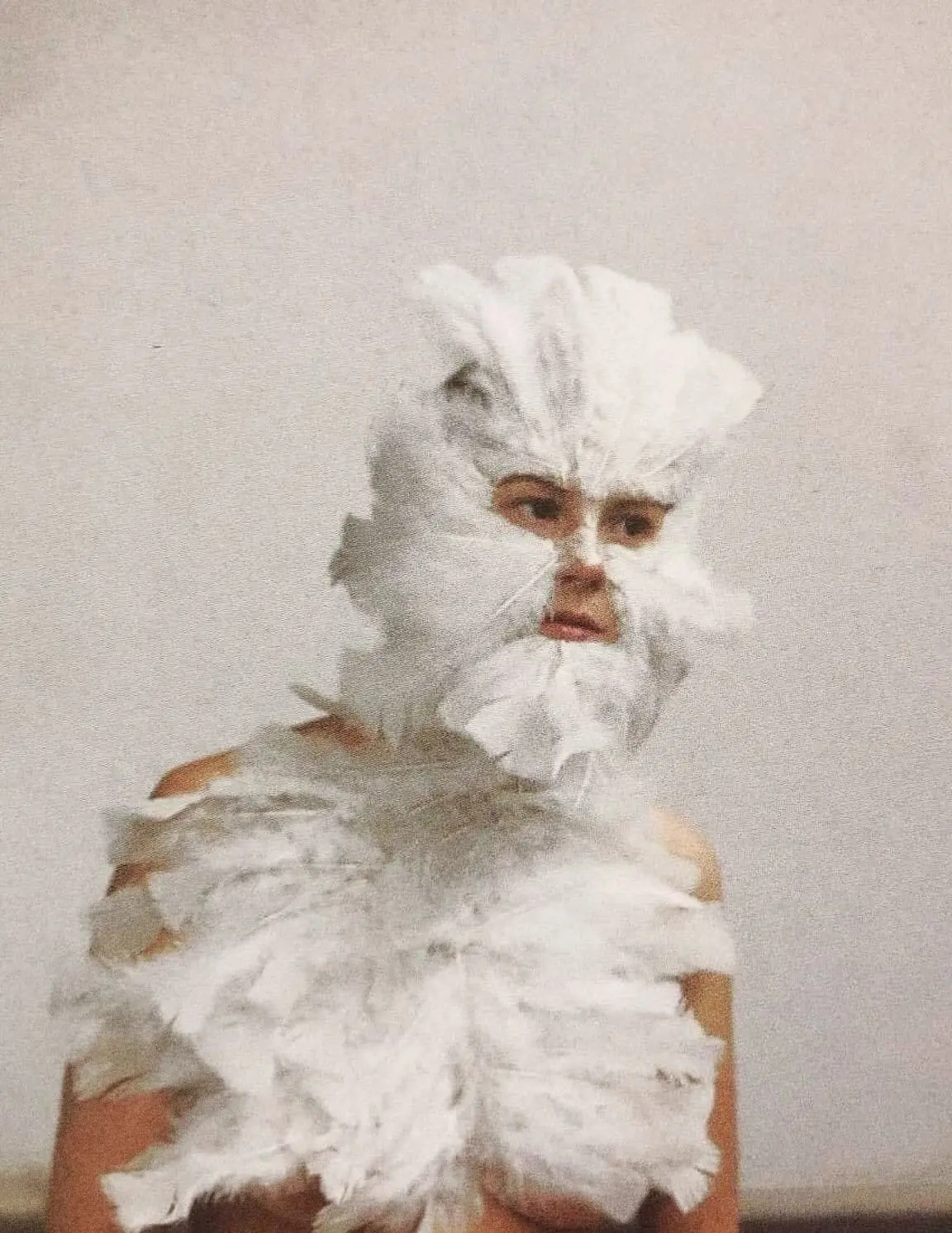
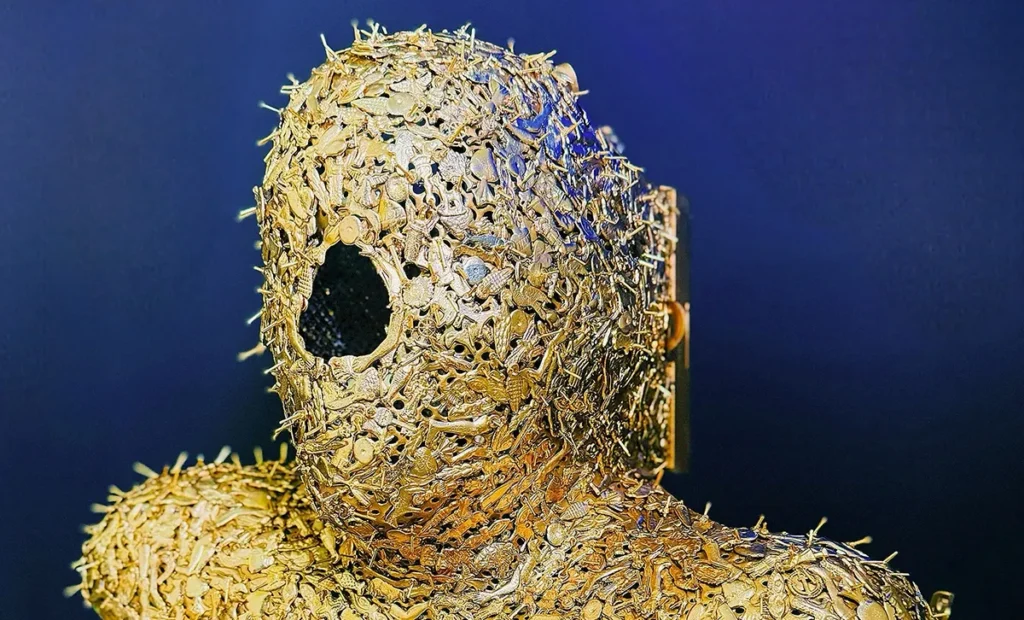
The work of Mexican artist Nardiz Cooke emerged from an unexpected diagnosis of stage IV cancer: eight brain tumors and one in her breast. When she received the news in 2022, instead of giving up, Nardiz decided to transform the masks that doctors used during her initial radiation treatment into a series of pieces called The Radiant Sentinels.

Paul Klee, a leading figure of the Bauhaus, argued that art makes the invisible visible. Nardiz’s masks are a good example of this. “Sometimes I feel drained,” she confesses, “but I usually play the victim. I’ve never actually done that.”
“I take things as they come and face them head-on because I don’t give up on life “– Nardiz Cooke
Nardiz was born in Guaymas, Sonora, but grew up between Hermosillo and Guadalajara. She also lived in Scotland, where her father was pursuing a doctorate. “My grandmothers: one from Nicaragua and the other from Texas,” she says. In recent years, he lived in New York, but now he’s based in Miami. For several years, he was the vocalist for Sweet Electra, a Guadalajara-based electronic music duo initially linked to the Nopal Beat collective.
“It is sacred to know who you are and where you come from: who your mother is, who your father is, and so on,” reads one of the labels on her masks, and her deep roots attest to the fact that she takes this sacrament very seriously.
“Don’t think I’m crying—I’m just allergic to the sea breeze,” she explains. Actually, I didn’t think that. She doesn’t seem like a sad woman—quite the opposite. She’s calling from a turquoise-colored beach in Florida, where she’s just opened her first exhibition, curated by Oscar Glottman.
The pieces from *The Radiant Sentinels*.
He often spends hours and hours gazing at the sea while working on his pending tasks. His life’s journey has provided him with many experiences and lessons and has revealed more about his cultural heritage. In his series of altered masks, for example, one can see the syncretism of northern Mexican traditions with Western symbolism. “Yes, two of the pieces, Ode to the Desert and The Force, were created in honor of the deer dance, the Sonoran desert, and the Yaqui tribe.” Those pieces, in particular, are adorned with butterfly chrysalises.
“At the Silvester Comprehensive Cancer Center, they made two custom masks for me that were like a map of my face. I felt like they were my trophy, and that’s when I asked if I could take them home to make art,” he tells me. These thermoplastic materials have holes strategically placed according to the patient’s face, through which the gamma rays enter.
Nardiz says that as soon as the hospital agreed to let her reuse the masks—which meant so much to the patients who wore them—she took them home and began decorating them with quartz crystals.

She named the first piece she created—which she later donated to the clinic— The Mother Sentinel and it was the one that gave rise to the project. This mother of all masks was created with a message: “To be reborn.”
The symbols of a silent story
The Silvester Comprehensive Cancer Center felt that this was indeed an inspiring artistic initiative worth supporting. So, they authorized the donation of some masks with the goal of setting up an exhibition in the clinic’s lobby: “They collected the masks from patients anonymously. The 13 that make up The Radiant Sentinels,” she recalls.
“There’s a lot of respect involved here; wearing these masks is a responsibility. They arrive without a sender’s name, but each one is a symbol of a silent story. They all have their own name and description,” she says.
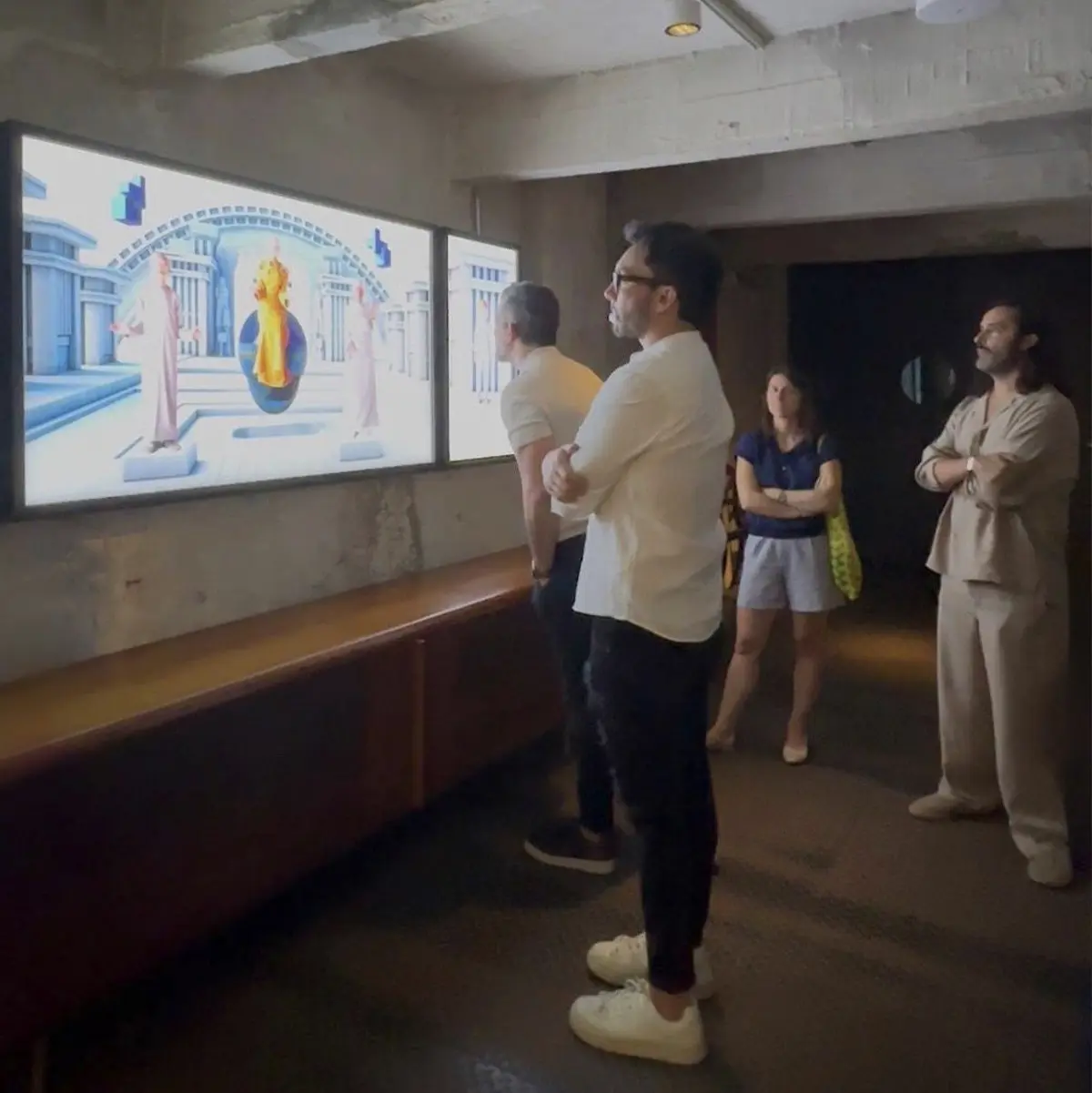
In addition to the exhibition at the hospital entrance, the artist professionally showcased her work at the recent Art Week Miami. “It was very moving, raw, beautiful, and real,” she recalls.

The public has reacted in different ways to his work: “Many people are thrown off because a lot of the masks have mirrors inside them, so when you look through a tiny hole, you see your own eye, your own pupil; they’re pretty trippy, and there’s a heavy vibe,” he says.
“But the response has been very positive, especially because people know where this comes from: ‘Many people connect with the story of cancer because they’ve had a family member or friend who’s gone through it. So the experience is intense, profound, and genuine—beyond just how cathartic it might be for me,’ she acknowledges.”
Nardis Cooke: art that tells the truth exactly as it comes
For Nardiz, attempting to objectively explain the meaning of his pieces requires a great deal of energy, especially when it comes to a body of work that relies on the short stories that accompany each piece. In Espejismo, pyrite—that fool’s gold that shines as if it were gold—appears as a symbol of the illusions we create for ourselves: mirages that seduce, that promise, but that sooner or later dissolve.
“The lesson here isn’t about avoiding deception, but about learning to accept the truth as it comes, even when it reveals the disappointment of what once seemed solid,” she says, speaking in a mix of Spanish and English.
In the piece Ocean Hope, however, a deep, clear blue dominates—the blue of kyanite—evoking an intimate sea. The piece feels enveloped in waves that lull, that sustain, that repeat a soft and constant song, like endless lullabies. There is a sense of being rocked by something greater, a continuous movement that does not break, but rather contains: an ocean of hope.
It’s a different story with El Buzo, where the narrative becomes more introspective. The piece suggests a descent into the depths of emotion, in silence, without witnesses. “It is covered in tiny, almost imperceptible zebra shells, interspersed with rougher elements: pufferfish spines, sea urchin fragments. Everything evokes that seabed where the beautiful and the sharp coexist, where diving in means accepting the risk of feeling it all,” she says.

And then there’s Radiant Phoenix, which captures the idea of rebirth without over-romanticizing it. Here, the transition from ashes to a luminous figure occurs not by fate or obligation, but by choice. “It’s not about what must be done to survive, but about what we choose to do with what remains: to rise, to rebuild, to burn anew from a different place.”
Behind each of their pieces lay months of research, persistence, and delving ever deeper into the themes, materials, and concepts. “It took months and months of searching, of diving in. Each mask was very demanding,” says Nardiz.
The process wasn’t just intuitive; it involved both fieldwork and study. “For example, with a piece called The Balance of Being, which consists of two masks filled with milagritos from Querétaro—handcrafted amulets in the shape of hearts or other figures, made mainly of tin, wood, or ceramic, which symbolize gratitude—,” he says of one of his most baroque yet most significant pieces.
The Van Gogh of La Lagunilla
That drive to incorporate traditional magical elements into her work even led her to seek out the creators of these objects themselves. Nardiz traveled to Mexico several times and delved into their stories. That’s how she came across the artist Alfredo Vilchis, a regular at the capital’s tianguis, whose work is filled with these very same little miracles. “Is it true they call him the Van Gogh of La Lagunilla?” were the words with which she first approached the painter, whose works have even been exhibited at the Louvre.

As we say goodbye, Nardiz reveals that the main tumor in her chest—once enormous—is now barely noticeable. “Thanks to the work of soul science, it’s tiny,” she says. “I can barely feel it. I don’t like to count my chickens before they hatch, but I’m doing really well.” She acknowledges, however, the aftereffects: “The right side of my body is different from the left. Sometimes I feel as if I’m burned in half.” She pauses briefly and adds, “But ultimately… I feel very strong!”
To keep exploring this thread, visit our contemporary art coverage.