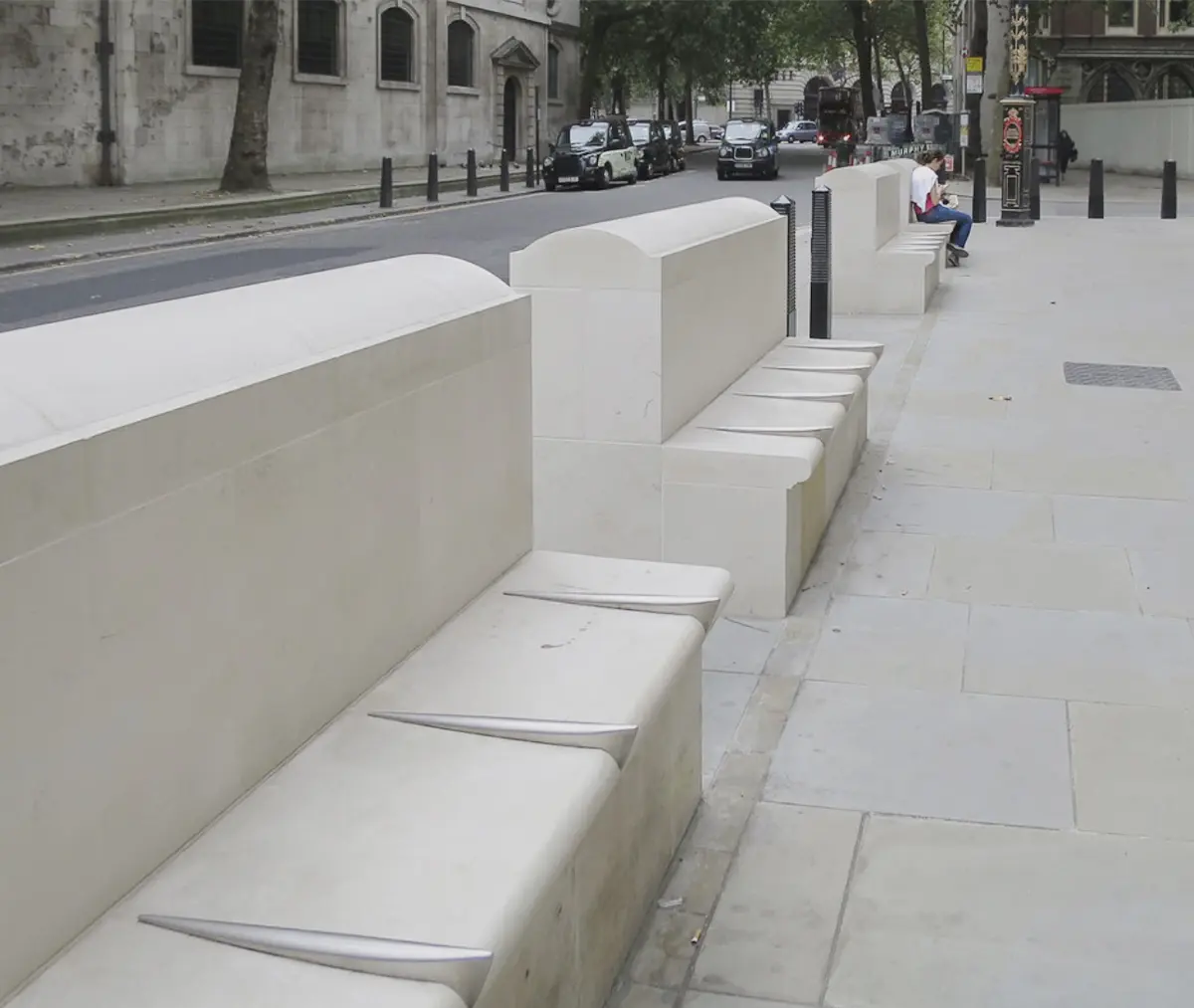

No, it’s not the title of a science fiction movie in which buildings and urban elements come to life and attack us—there’s a forgettable German movie called Brick (2025) that more or less uses that idea. “Hostile architecture” is the name given to an urban design strategy that uses physical elements to limit, control, or prevent the use of public space by certain groups, especially people experiencing homelessness.
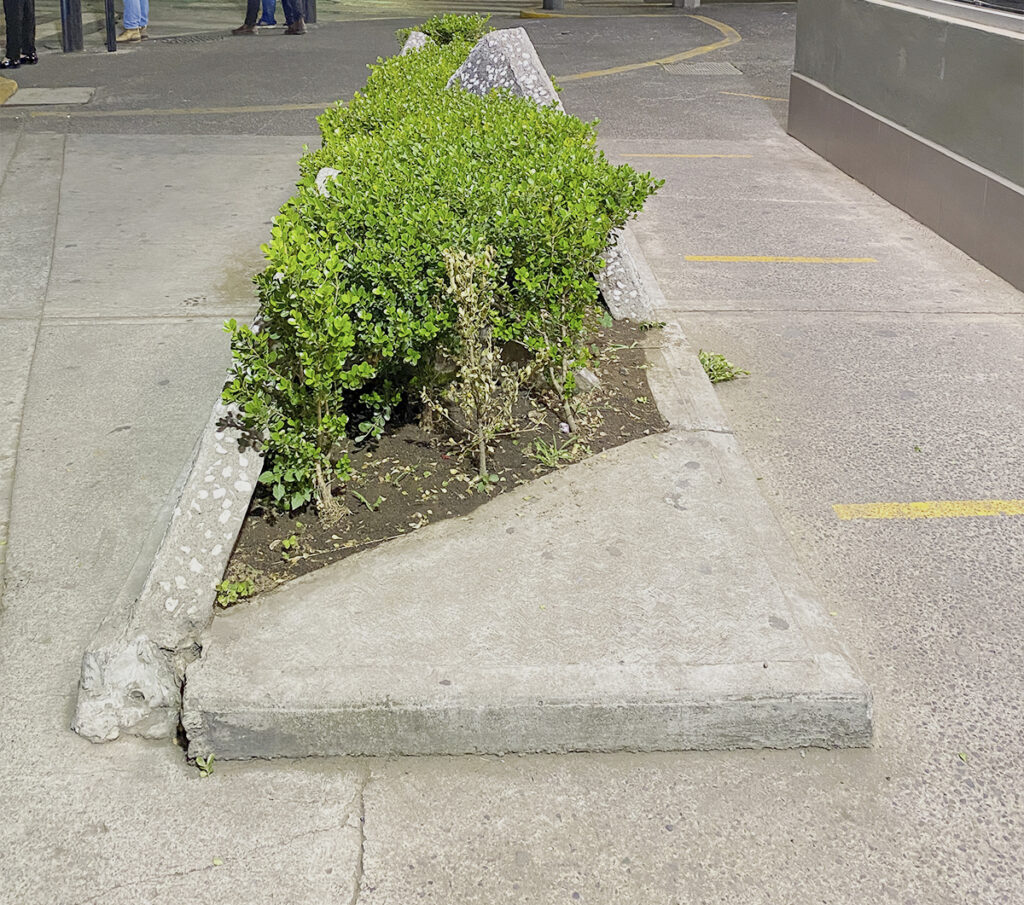
What is hostile architecture?
The term, also known as defensive or exclusionary design, is clearly a form of structural violence, discrimination, and social exclusion; although it is not formally defined in international law, critics consider it to be an exclusionary measure.
You’ve surely come across it: hostile architecture is everywhere—benches with dividers, sloped surfaces, sharp corners, or structures that prevent people from resting. Although urban planners such as the American architect Oscar Newman had been proposing ideas like “defensible space” since the 1970s, the term was coined in 1996 with the express intention of controlling behavior in public spaces and preventing what was considered “misuse” by citizens.
Activism Against Hostile Architecture
In practice, this trend seeks to ensure that certain groups cannot find places to stay and are excluded from the urban landscape. Its proponents argue that it helps improve safety, reduce crime, and maintain order; however, critics—activists, human rights advocates, and people with a modicum of common sense—point out that these measures are based on a logic of exclusion, not integration.

Thus, the use of aggressive design and construction is justified as a mechanism for “organizing” the city without addressing the root causes of the problem. Barriers in public spaces not only physically isolate people, but also create an architecture that marginalizes them, punishing poverty rather than finding solutions.
An exclusionary urban intervention may seem harmless, but its impact has long-term consequences: it dehumanizes the environment, reinforces stigmas, and weakens the social fabric as we know it. The result is a city that is not designed for everyone, but for a select few; an urban architecture that prioritizes “efficiency” and image over human dignity and what truly matters: life in society.
Hostile architecture: a necessary evil?
“It just shifts the problem elsewhere; homeless people exist, but hostile architecture makes their lives worse,” commented a user in a Reddit thread I didn’t want to get involved in—I just lurked to see who agreed with something I think is indefensible.
What I did find, at least, was a performance installation called Archisuits (2005). In her piece, the artist Sarah Ross presented her solutions to the hostile architecture of Los Angeles, California.
A widely publicized case illustrating just how extreme this practice can be occurred in Toronto, Canada, in 2020, where Twitter user Chad Loder—whose account, by the way, has now had his account permanently suspended—shared an image that went viral of a structure made of metal rods placed over a ventilation shaft to prevent homeless people from lying down there in the middle of winter in search of warmth.
The Debate on Hostile Architecture
The publication sparked a global conversation about what some experts call “unpleasant design”: urban interventions that, through subtle details, reduce the usability of spaces without explicitly prohibiting them. Researchers such as Selena Savic have pointed out that these elements function as “silent agents,” as they control behaviors and restrict interactions in public spaces without the need for direct confrontation, effectively eliminating any possibility of questioning or debating their presence. In other words, there is no one to hold accountable or make demands of.
I remember the storefronts of some bakeries or shops with elaborate display cases that had steel spikes along the edges to keep us from sitting down. Maybe there was some logic to that. But the thing is, when it’s a matter of life and death, and that space is the only one you have if you have to stay on the street, your perspective changes.
Latin America and “ugly design”
What is happening in Mexico? There are no formal or organized protests, but the debate over hostile architecture highlights tensions between different levels of government. At the federal level, in April 2026, the Chamber of Deputies’ Commission on Urban Development and Land Use Planning regrettably rejected a bill to ban it, arguing that it lacks legal clarity, contains technical flaws, encroaches on municipal authority, and is not viable in operational or budgetary terms, concluding that “it is not a legally necessary measure.”
At the same time, the issue has gained public attention: experts such as Gerardo Tavares point out that contemporary urban design has been geared toward restricting access for homeless people, young people, and even people with disabilities, sparking a debate—at least on social media.
The argument put forward by advocates of hostile architecture
In contrast, at the local level in Chihuahua City, municipal authorities halted the implementation of this type of urban design: the director of Urban Maintenance noted that measures such as uncomfortable benches or deterrent structures, while intended to discourage certain behaviors—the main argument of proponents of this type of architecture—ultimately affect the general public by limiting the normal use of public spaces. Instead, the city chose to keep these spaces accessible and address issues through security and surveillance strategies.
The documentary Hostile Architecture in Mexico City (2025) shows how these practices are already part of the urban landscape: benches divided by bars, spikes under bridges, walls designed to prevent people from resting, and steel spikes in the outdoor gardens of banks. Under the supposed logic of maintaining “order” in public spaces, these interventions ultimately aim to displace homeless people and restrict the use of the city for certain groups—even skateboarders have complained : that type of design prevents them from skating.

Fronts Against Hostile Architecture
This phenomenon has been well documented in other countries, regulated, and even challenged on various fronts. In Barcelona, for example, the Arquitectura Sin Fronteras collective and the “Barcelona is Not a Bank” platform have identified and documented more than 1,500 instances of hostile architecture in public spaces, highlighting its impact and promoting more inclusive urban policies.
In Montevideo, Uruguay, the issue gained prominence in 2025 following the death of a man who fell onto spikes installed on the facade of his building, leading to a decree banning these dangerous devices, although regulations governing them have yet to be finalized.
The debate even reached the national level in countries such as Brazil. During the 2022 elections, President Luiz Inácio Lula da Silva denounced the placement of rocks under bridges to prevent homeless people from sleeping there, in the context of the passage of a law against hostile architecture.

Although it was initially vetoed by Jair Bolsonaro, Congress managed to pass it under the name of the Father Julio Lancellotti Act, in honor of the priest who has spent decades advocating for Brazil’s homeless population. His activism—which includes physically removing these barriers—has exposed the contradictions of one of the region’s wealthiest cities, where thousands of people live on the streets and where urban design contributes to social exclusion.
To keep exploring this thread, visit architecture in transit.