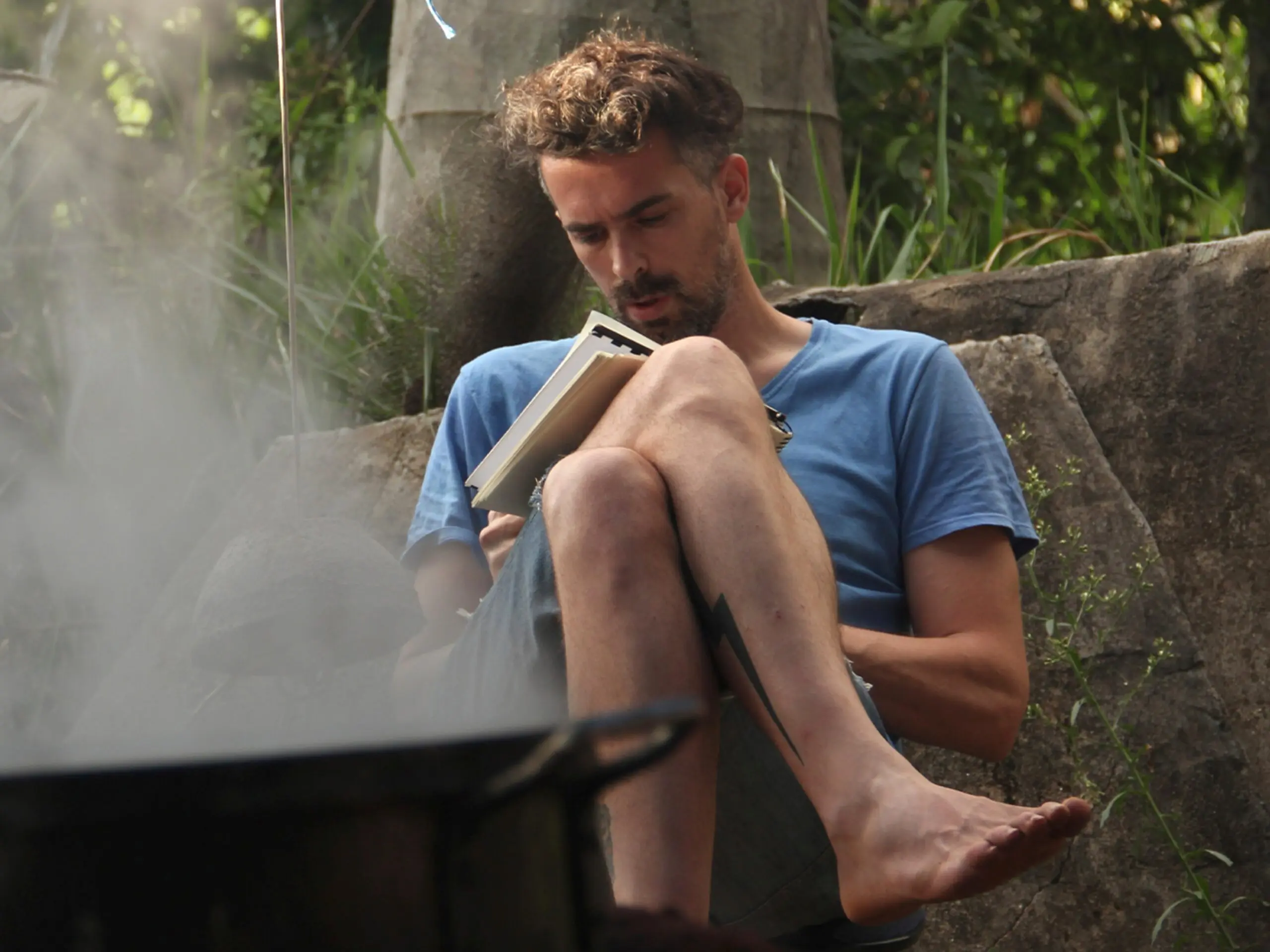

Ezequiel Black is an Argentine artist, a veteran—so to speak—of “psychic wars,” as in the Blue Öyster Cult song. He has just released a new art book titled Las Visiones (Fan Ediciones, 2026): “a sensitive travel journal chronicling more than a decade of ceremonies with sacred plants in different regions of Latin America,” he explains.

Throughout his career, he held solo exhibitions in Argentina and Mexico, including *Floresta Psicotropical* at Salón Acme in Mexico City and *La luz entre nosotros* at Galería Wunsch. He also participated in major group exhibitions and contemporary art festivals. In addition to his work as a visual artist, he created graphic universes for bands such as Miranda!, Los Fabulosos Cadillacs, and Celeste Carballo. He served as art director for El Teje, the first Latin American transvestite newspaper, and worked on cultural and editorial projects as well as exhibitions for various venues and institutions. We spoke with him.
Is this your most solo project?
Yeah, look, it’s a very personal project. I started it in 2012. I’ve been participating in plant ceremonies for years. One day I started carrying a Moleskine notebook without really knowing why
When did you realize that your drawings could become a book?
Very soon. Within a few months, I realized this was a book; I was already working on it, but without realizing it. It was always a very personal project—no one had actually seen it before. Because when people asked me, “What are you drawing? Let me see,” I’d show them just one or two drawings.

Did your perception of plants change along the way?
“It’s a world you never fully understand. It’s like being in a dark cave with a flashlight: you shine it on one side and it seems clear, but when you turn it back on, everything has changed.”
Is drawing while under the influence of those plants different?
Sure. Drawing in that state is a technique you can only learn… by doing it. Being able to maintain your focus on a drawing or a painting with that level of intensity is something that only comes with experience.
What plants have you typically used?
Ayahuasca is the one I’m most familiar with, but I’ve also had experiences with huachuma and yurema.
So is this book more about discovery or more about contemplation?
At first, it was a book created by an artist who painted his visions. But over time, and with the many trips I took with the notebook to Peru, Brazil, Mexico, and Argentina, I began to notice that some of the information from those places found its way into the notebook: a loom, a statue, a T-shirt, a vase. There was something about the communities around those places that seeped in there. So the notebook also became a sort of travel journal.
And what about the community?
Sure. Since I’m an artist, when I go to these places I’m interested in meeting other artists, visiting studios, museums… I’m always moving within that world. And at some point, I began to feel a certain responsibility to place this book within a series of lineages and traditions. So I embarked on a somewhat anthropological investigation: to understand which cultures, where, and in what way. That’s when the book took on a new meaning. The visions blend with elements from the communities, with notes on the aesthetics surrounding those spaces.
Does your drawing technique differ from what you usually do?
When I found the ballpoint pen, it struck me as the perfect choice for this project. It was super portable: I could just slip three or four pens in there and I was set. And, poetically speaking, I thought it was really nice that a ballpoint pen has something of a tattoo about it. You can’t erase it.

Your work includes a wide variety of pieces. “La mazorca,” for example, is very evocative.
Yes. I think there’s something that runs through all my work and has a lot to do with Latin America as a source of reflection and inspiration. I’ve been working with mirror fragments for years. I started by breaking down materials from disco balls: foam PVC and tiny mirrors, evoking the effervescence of the night, the excitement, the excess. But then I started thinking about the famous phrase “the little colored mirrors.” I find it incredibly interesting because outside of Latin America, no one really knows what it means. So I started working with corn covered in colored mirrors to see what happened between those two worlds: pop, reflection, fantasy, and this icon so important to pre- and post-conquest Latin America. That’s how the series began: three large and nine small ears of corn. In fact, two are in Mexico.

At a gallery?
One of them was bought by a guy who was opening a restaurant in Mexico City and wanted to put it right in the middle of the place. He took it, though I don’t know if he ever ended up installing it. He’s a chef who has been named one of the best in the world: Luis Palmeros.
I understand that there is an iconic work by Marta Minujín in Argentina that also features corn cobs
Yes, the piece in which Marta Minujín “pays off” her debt to Andy Warhol with corn. She presents him with some corn surrounded by a sort of photo-performance. And later, Marta referred to the corn as “American gold.”
Although his work engages with ritual and Latin American traditions, it also features a strong influence from pop culture
Many years ago, I was asked to contribute to a poker magazine, and they gave me a page. I was thinking about what to do, and it occurred to me to play around with the banknote icon.

You experienced the transition from traditional to digital art, even before AI came along.
For me, it was the opposite. As I began to gravitate more toward the art world, I gradually moved away from the computer and toward hands-on work. In fact, I don’t want this book to have a digital version at all. It has to be physical—or it’s nothing. The experience with that object has to be tangible. To bring it into the digital realm would be to distort the very essence of the project.
I also notice that some of your work touches on LGBT themes. Although you once said in an interview that “there is no such thing as LGBT art”
As a theme, of course it exists. There’s also a certain queer aesthetic . But I think artistic practice is something greater than that. It can touch on those themes, yes, but it doesn’t stop there.
Do you consider yourself part of an artistic collective?
Look, two years ago our beloved President Milei—and I say that ironically—was in Davos, and, in a very strange way, he started spouting a string of nonsense attacking the LGBT community. And it was really strange because it wasn’t even an issue that was really on the agenda here in Argentina. When that speech came out, I thought, “I don’t want to read this news,” because I felt like I was going to be overwhelmed by all that current events logic, that agenda.
But in the end, you feel like you have to take a stand and face things head-on, don’t you?

Yes, over time I also came to understand that there are moments when you can’t just pretend not to notice. Because even though I don’t believe in rigid categories like “LGBT art,” I do believe that there are bodies, communities, and sensibilities that have historically been excluded from certain spaces. And that inevitably permeates artistic production.
And do you feel that this comes across in your work in a conscious way?
Sometimes yes, sometimes no. Some things come naturally because they stem from my own life experience. But I’ve never been interested in working from a propagandistic standpoint. I’m more interested in works that have layers, contradictions, and ambiguity—that aren’t a one-dimensional message.
Are you currently facing that problem?
I don’t feel like I face discrimination these days; I’m fully integrated, and it’s no longer an issue for me. But I do remember that when I was a kid, things were different. Those are experiences that leave a lasting impression. Even though I’m doing fine now, there was a time when I had a really hard time.
There is also a very strong sense of Latin American identity in your work.
Yes, absolutely. Because Latin America is also a region deeply shaped by cultural blending. Indigenous, colonial, pop, religious, nightlife, and marginal elements—they all coexist at the same time. And I think my work also stems a bit from that: from trying to understand those layers without over-organizing them.
Find more interviews with Latin American artists in AW Magazine.
To keep exploring this thread, visit contemporary artists and galleries.