At a contemporary art party, an artist uses a man’s back as a canvas and draws phrases taken from Donald Trump’s tweets by biting into his skin. In another story, an aspiring writer tries to sell his soul to the devil in exchange for fame. There’s also a father who fights a beast in his backyard while his family watches, and of course, there are a few miraculous apparitions seen through the eyes of an agnostic experiencing a crisis of faith.
Joselo Rangel blends science fiction, art, and pop culture in *Final Feliz*
Most of the images that fill Final Feliz, the latest book by Joselo Rangel—guitarist for Café Tacvba and also a writer—are filled with captivating cinematic imagery. In the slang of the massage world, it’s said that a “happy ending” of that nature is when the masseuse or masseur brings the client to orgasm. I won’t even ask. There’s no sex in the book, other than a few allusions, but other kinds of references abound.
“Actually, I once wanted to be a screenwriter,” Joselo confesses. When someone told him it was the worst job in the film industry, he decided instead to focus on writing short stories and novels, as well as recording albums with his famous band and as a solo artist.
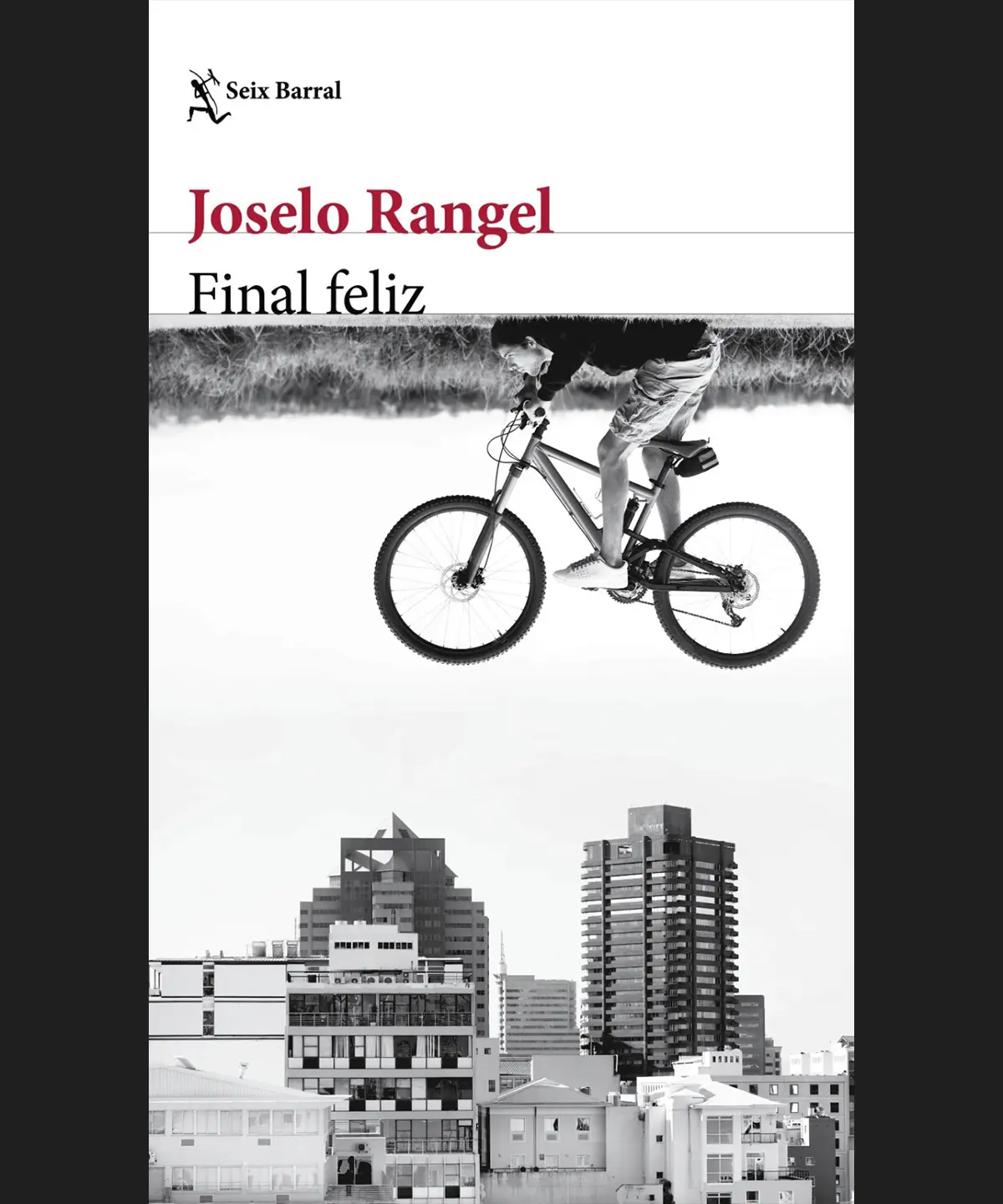
This new collection of short stories, published by Planeta, marks his seventh book. It brings together works of fiction that explore themes such as fatherhood, childhood, and religion, as well as “all those story ideas that come to mind and that I jot down.”
Literature, Fame, and Pacts with the Devil
The story that opens the book reminded me of a documentary about the band Pulp. In it, the guitarist from the English band says he’s afraid of flying because he feels that an airplane is like “a coffin in the air.”
In the short story “They Fly,” a man wonders if the aviation industry is just a myth and if everything operates on faith. “I’m afraid of flying too, even though people say to me, ‘But how? You get on a plane all the time.’ ‘Well, that’s exactly why,’ Joselo confesses. ‘The story came to me on a flight. Suddenly I found myself wondering how something so heavy can fly.’”
There are also stories of true domestic horror, such as “A Model Father,” which could have been written by Richard Matheson or even by Quiroga, given the terror it evokes within the context of everyday family life.
Of course, there are plenty of musical references: figures like David Sylvian of Japan, Robert Smith of The Cure, Depeche Mode, and even a dog named Jethro—a nod to the long-running progressive rock band—make an appearance. There’s even a story in which Charly García plays the leading role.
“But you’re from Café Tacvba—how could you not have thought of that?”
“A friend of mine from Argentina, Mariano, from the band Mi Amigo Invencible, came to visit recently. We went out to eat, and he told me he wanted a copy. Then he asked if I was going to send a copy to Charly García.”
“I was left wondering why it hadn’t even occurred to me. I saw Charly as a mythical, distant figure. Mariano was even surprised: ‘But you’re from Café Tacvba—how could you not think to send him the book and that he’d actually receive it?’”
“It really hadn’t crossed my mind. But it was good that he practically forced me to do it. We don’t really know how Charly is doing either. Sometimes you see him in videos and he looks really run-down. The truth is, we don’t hear much from him anymore.”

Science fiction, faith, and people as the central themes of the book
While writing *Final Feliz*, many themes emerged, though almost all of them ended up being interconnected: “There are questions and reflections. My parents have passed away, and now we are the ones at the top; the new generations are coming up behind us. That’s why I dedicated the book to my siblings.”
However, that isn’t the only common thread. Themes such as religion, darkness, the literary world, and contemporary art also come up. “At least that’s how it is for me: you don’t fully realize what you’re creating, and then you discover that it all fits together nicely.”
There are also plenty of stories related to the literary world, such as “Encrucijada,” in which—much like blues musicians—an aspiring author decides to sell his soul to the devil so that his novel will be a success. “I accept that I come from another world, the world of music. But when I started publishing and attending book fairs, I began to meet authors. That’s where ideas like that came from,” he admits.
The influence of José Agustín on his writing
There is also a short story with the same title as the book, set in Tepoztlán, the “Magical Town” located in Morelos. It echoes the style of José Agustín, the recently deceased Mexican author.
“I lived in Tepoztlán for many years with my family—my two daughters and my wife, the actress Luimi Cavazos. And yes, I’m a fan of José Agustín. Along with Juan Villoro, he’s one of my biggest influences,” he admits. “When I discovered them, I realized that I, too, could write about everyday things, just like the authors of La Onda did.”
Buñuel, Disillusionment, and the Harsh Reality
Although he titled his book Happy Ending, we already suspected it might have been meant ironically, and there are a couple of stories—or several of them—that don’t live up to that promise. What’s more, some are so wild that there’s no way they could end like those movies where everyone lived happily ever after.
“I’m reminded a lot of Buñuel’s *Los olvidados*. It’s one of my favorite movies,” he says.
“When I found out there were two endings—one in which the boy returns to the children’s home with the money and cigarettes, a sort of ‘happy ending,’ and another that’s much more terrible—it really shocked me.”
“I remember liking the harsh ending better because I felt it was more realistic—that’s just how life is. Now when I watch the other ending, I think it also has something valuable: a certain hope, because sometimes I feel that humanity isn’t so lost after all. But Buñuel chose the crueler ending, the one closer to reality. I suppose that’s why they booed him so much in Mexico, because many said that wasn’t what Mexico was like.”
From Unrealized Films to Fantasy Literature
When I tell him that many of the stories in the book seem easily adaptable for the screen and mention the Argentine film *Historias salvajes* (2014), Joselo is surprised.
“What a coincidence. A very close friend just told me about it two days ago. He described the first short film to me, and I thought: of course, it’s a story I could have written myself. Yes, exactly—I love that kind of idea,” he concludes.
To keep exploring this thread, visit our cultural perspectives section; you can also continue through first-person cultural voices.