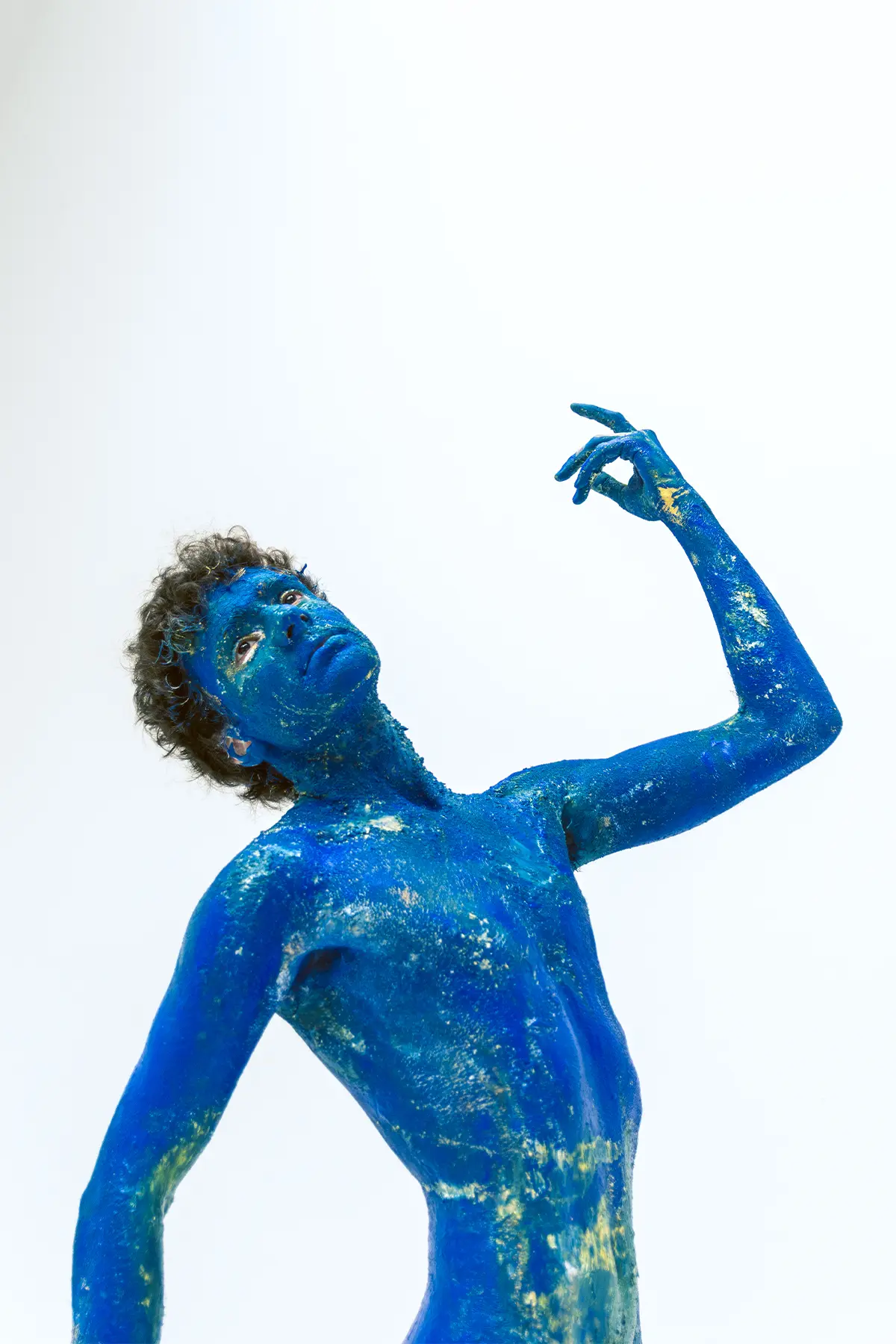

With just a few years under his belt, Trucha —the stage name of Ramiro Carrera—has become one of the most interesting voices on the new Argentine music scene. Originally from San Martín de los Andes, the musician caught people’s attention after performing at Lollapalooza Argentina 2024, where, at just 19 years old, he presented a sound that doesn’t worry too much about labels. Now he presents *Ilusiones de Amor*, an album that, paradoxically, was born out of a desire to distance himself from vulnerability. ”
“When I looked at the blank canvas, I saw a mirror, and I still don’t know who the decision-maker is,” the artist sums up. In an interview with Art Weekends, Trucha reflects on the importance of visual identity in contemporary music, the enduring relevance of pop as a language, his influences—from Andy Warhol to Luis Miguel—and the pursuit of creative freedom that runs throughout his new album.

The image as a starting point
How important is the visual aspect of your project?
Very important. First of all, we’re very connected to sight. I think this era is deeply connected to seeing. Maybe we don’t listen much, maybe we don’t touch things, and we eat in a bit of a rush. I think sight is everything today because it drives us so much. On the street, there are billboards with changing colors and images.
Yes, although—to be fair—the previous decades, starting in the ’80s when music videos first emerged, were also a very visual era…
I’ve been heavily influenced by that era. Ever since people started paying attention to album covers and the concept behind them. In fact, long before that, when The Beatles released the song “Lucy in the Sky with Diamonds.” I think the album on which it appeared had one of the covers that best exemplified the concept behind an album. It’s something that’s been in the works for a long time, but I feel that today the visual presence has to be very well thought out so that it’s recognizable in any format—not just on the album cover, but in a way that can be applied to everything: to TikTok, to social media, to merchandise, to whatever.
What does it mean to be a pop star in 2026?
Journalist David Quantick once wrote that “pop would end up devouring itself.” Today, it seems like anything can be pop. How do you understand that concept?
Well, that’s one of the challenges because, to me, these days you think pop has a very, very distinct pop sound, and then you realize it’s actually very broad. Pop comes from “popular,” right? So I think pop is kind of created by the people. It’s not so much a genre to be categorized, but more like: do people like it or don’t they?
So, does success ultimately define what pop is?
And what I wanted to do was sort of define my own pop—a pop that’s full of genres and artists, including Cerati and Virus, who are artists that today you’d say: “They’re not pop, they’re rock”; that’s pure, hard-core Argentine rock. And I kind of like that, too. I feel like this album still has that influence, but filtered through a more pop-oriented lens. In fact, it’s kind of like playing with that. There are a lot of artists you’d say today aren’t pop; I don’t know, there are references to Prince, Snoop Dogg, and Luis Miguel—before Prince.

Taboo Pop
For much of the alternative scene, mentioning Luis Miguel is still taboo
Maybe, maybe it’s a bit of a cliché too, but the truth is, I really enjoy it. Nothing’s going to take that away from me. I don’t really believe in the whole “guilty pleasures” thing; I feel like it doesn’t make much sense these days. I think it made more sense back in the emo-vlogger days.
Do you think the indie music scene is still more prejudiced than the general public?
I don’t think there are no hidden tastes. The other day I was talking to a friend, and she told me, “The only guilty pleasure there is today is those TikTok ‘frutinovelas.'” I kind of think that’s the only thing that can be considered a guilty pleasure.
Andy Warhol, Marilyn Monroe, and Trucha’s Visual Universe
How would you describe the visual style of your project?
I try not to label it too much; people have called it art-pop. There’s also an element of visual pop, like the stereotype—or what I consider pop. And yes, I’m heavily influenced by Andy Warhol and a whole bunch of artists who strike me as very pop and, at the same time, flashy. I wanted to bring that into the visual realm, with my own style and imagination, but still aiming for that impact, that color, and that intensity as well. Very Marilyn Monroe, too—lots of pink and red.
Your songs tend to be emotionally charged, even though they’re musically uplifting. How do you work with that contrast?
The other day, the guy who mixed the album told me that he loves doing pop-style mixes with a dark edge. I saw it that way too, but then I understood—I understood the darkness it carries and how it’s connected, in a way, to sincerity. It’s pop—I mean, it’s music I made in a very sincere way, without any pretensions. It’s like just letting myself be in pop. But, obviously, I’m an artist—there’s a part of my emotions that I like to delve into, and, well, there are feelings in life that aren’t always so pretty.
Dancing While It Hurts
The lyrics have a tragic side to them, too, don’t they?
On this album, too, it’s mostly about love and heartbreak. So, in a way, the most tragic thing—if you will—is more of a love-related issue, and I feel like that has its own performance aspect as well. I think what I wanted to do was use the performance as a springboard to express those feelings even more powerfully. It’s as if a sad song becomes even sadder.

I’m surprised you’ve released seven albums in just a few years.
And they’re full-length albums. I did it that way because I had the time, the motivation, and the tools. For those albums—up through the sixth one—I mixed and mastered the songs, and I produced them as well. Back then, the production wasn’t all that elaborate, either. Today, I’m still deeply committed and eager to make good music: polished, clean. That’s always been my goal. I don’t like doing things halfway. But it was also a different time. I released my first album during the pandemic. So I had a lot of time at home. I made that album when I was 16 to 17. I made that one when I was 17 to 18. I made that one when I was 20 to 21.
Trucha’s Double Life
Today you’re making a few changes to your processes…
Yeah, but I’m handling it really well; I’m taking it in stride. But I’m not writing as much as I was a couple of years ago.
In one of your songs, you mention a double life. What do you mean by that?
It’s like living a double life. It’s about seeing things from that perspective. It’s not so much about him being in a relationship and the other person he’s dating also being in a relationship, but rather about being that third wheel who’s kind of meddling in the relationship between two people.

Why Trout?
Actually, the word comes from the animal—the trout, the fish—which is quite native to Patagonia, where I’m from, just like the typical regional cuisine. And when I was choosing my stage name, I said: I want something that reminds me of Patagonia. I started looking into animals and wildlife, and that’s how I came up with “Trucha.”
I liked it. I feel like it’s a word with a lot of power, but at the same time, it’s light. Yes, I think it’s easy to say and easy to remember, too, so I’m really happy. It’s good because that name takes you back to your roots, and that’s important.
Discover more interviews on avant-garde music in AW Magazine.