
What would have become of the avant-garde and contemporary art without her? Yayoi Kusama was not only one of the most influential artists of our time. Her name resonates because she was also a pioneer in breaking down the barriers between disciplines. It’s impossible to categorize her. Failing to appreciate her legacy is equally impossible. It’s no coincidence that when you translate her name, you discover it means “Flourishing Life.”

In 1929, in the midst of the global Great Depression—known in Japan as the great economic crisis of the Shōwa Depression—the future artist was born in Nagano, in the Japanese Alps region. After a colorful childhood—not without physical abuse from her mother and some psychological issues that caused her to have visions—she decided to study art.
Visual Language and Hallucinations
Her childhood left a deep mark on her life and her work. She herself recounted this on one occasion in a 2011 interview republished by Time Out: “My dad had several mistresses, and my mother forced me to keep an eye on him. Because she was so angry, she made the idea of sex very traumatic for me. My work—including my nude performances—is an attempt to overcome that bad experience. My entire visual language comes from the hallucinations I’ve had since childhood,” she says.

In the 1950s, after studying Japanese painting since she was a teenager—and becoming disillusioned with its traditional rigidity—she decided to travel and explore the European and American avant-garde that was flourishing (as its name suggests) during those years. And what better way than to move to the United States? In 1957, she boarded a plane bound for the United States.
A year later, she settled in a bustling New York City. But before she began exhibiting alongside Andy Warhol, Claes Oldenburg, and George Segal in the 1960s, she had to struggle to survive and even eat scraps of food she found in the trash, as she herself has recounted.
Kusama later insisted that Warhol drew inspiration from—or plagiarized—her concept of repeating the same image to cover entire walls. This came after she saw, in 1964, his installation of rowing boats covered in phallic shapes and walls covered with repeated images. Warhol unveiled his popular “Cow Wallpaper” in 1966.
Pop Art and the Barriers of the Established Order
Thus, her work began to attract attention with a series of paintings influenced by Abstract Expressionism, and she later turned to Pop Art and psychedelia, immersed in the city’s artistic avant-garde. Around that same time, she began to stand out for breaking the mold of the established order (did we mention that she was also a pioneer of feminist art?).
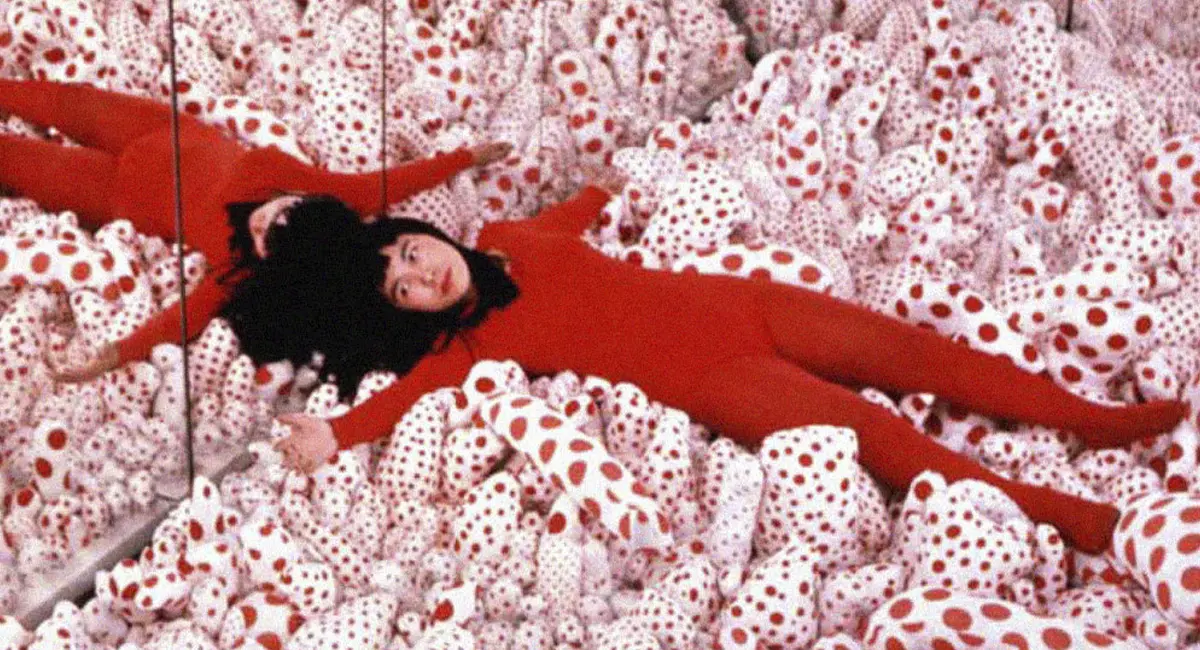
Soon, she began to alternate between different artistic disciplines—something we now refer to as being a cross-disciplinary artist. Her happenings, in which she painted nude figures with colorful polka dots, were highly acclaimed.

Her rise to cultural icon status ultimately took her polka dots far beyond museums and chic galleries. Her career was recognized with some of Japan’s most prestigious cultural awards, including the Order of Culture. In 2006, she also became the first woman to receive the Praemium Imperiale from the Japan Art Association, one of the most prestigious international awards.
“I’m an obsessive artist. People say I’m crazy, but I’m not. My vision is clear even in my madness,“Yayoi Kusama
While her fame grew to massive proportions, Kusama remained increasingly removed from the public spotlight. But not from artistic production. She was never able to escape the hype, although after her success in the 1960s, she fell into relative obscurity upon returning to Japan. However, her career experienced a strong resurgence in the 1990s. Shortly thereafter, between 2009 and 2021, she created *My Eternal Soul*, the most extensive series of paintings in her career, comprising around 900 works.
Yayoi Kusama and Louis Vuitton: When Art Became Luxury
The relationship between Yayoi Kusama and Louis Vuitton began in 2006. Marc Jacobs, an admirer of her work, visited the artist at her studio in Tokyo. During that meeting, Kusama hand-decorated a Louis Vuitton trunk with her signature polka dots, transforming one of the brand’s iconic symbols into a canvas for her unique universe. This gesture foreshadowed a collaboration that would come to fruition in 2012 with “Infinitely Kusama.” It was a collection in which her polka dots adorned iconic bags such as the Speedy and the Neverfull, as well as clothing, shoes, and accessories, blending with the French house’s monogram in an iconic collaboration.

Her polka dots, sculptures, and installations transformed Louis Vuitton stores and storefronts around the world into venues for contemporary art. In New York, a hyperrealistic robot created by the artist appeared to be painting her “Infinity Dots” on the glass of the Fifth Avenue store.
In Paris, a monumental sculpture by Kusama seemed to take over the façade of the Louis Vuitton store on the Champs-Élysées. It was undoubtedly a large-scale installation that made the collaboration between Kusama and Louis Vuitton one of the most recognizable examples of the dialogue between contemporary art, fashion, and contemporary popular culture.
Yayoi Kusama in Mexico and Around the World
His influence also reached Latin America. Between late 2015 and early 2016, his exhibition Infinite Obsession caused a sensation in Mexico City. Her exhibition drew around 2,000 visitors a day at the Tamayo Museum and turned Kusama’s arrival in Mexico into a phenomenon that transcended the usual art circles.
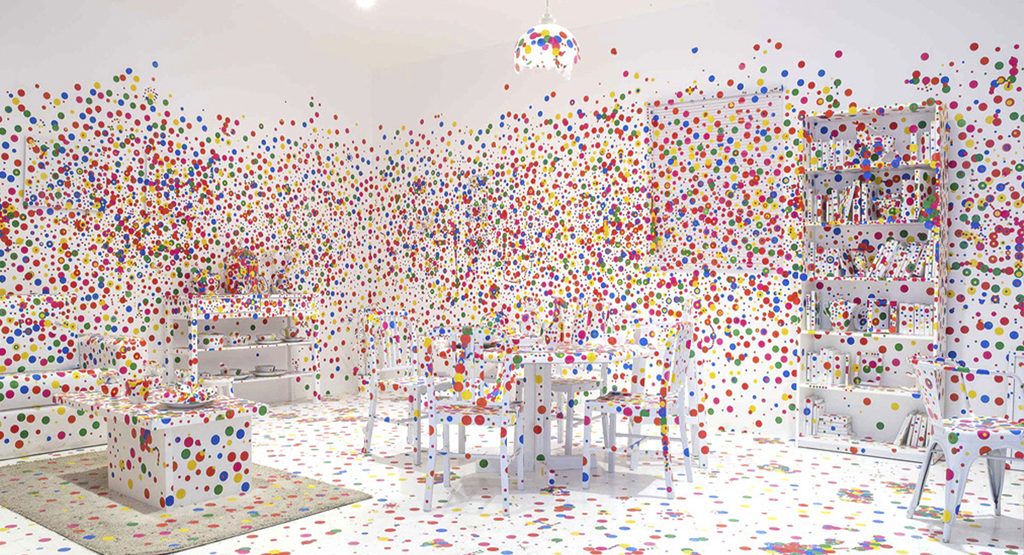
The global reach of her work continued to grow in the years that followed: between June 27 and October 8, 2023, the Guggenheim Museum Bilbao presented the retrospective “Yayoi Kusama: From 1945 to Today,” a journey through nearly eight decades of her work in the art world.
For the love of art
Kusama died on August 14, 2026, at the age of 97, in a Tokyo hospital. The news was announced on August 27. The cause of death was not disclosed. According to the statement published on her official website, the artist continued to paint until her final days, maintaining the spirit of constant exploration that characterized much of her work. Literally, for the love of art.
Discover more connections between art, pop culture, and fashion in AW Magazine.