
Since 2018, Galería Ethra has witnessed the transformation of Mexico City’s art scene: there are more galleries, new audiences, and a “beta” generation that is beginning to take an interest in collecting art. As part of the recent GAMA Week 2026, we spoke with Andrea Walther, the founder—along with Rodrigo Borrás—of this art space. Walther also shared her thoughts on the gallery’s evolution and current status, as well as on “Trópico de Jersey” —the exhibition by artist Emi Winter—currently on view at the gallery.

How has the art world changed in the years since you opened the gallery in 2018?
I think we’ve noticed a big change in the audience. In fact, there used to be far fewer galleries in Mexico City, and although there has always been interest and a certain number of people with different profiles—as well as various groups—who enjoy visiting galleries, we’ve found ourselves right in the midst of a period where the market has grown tremendously.
A New Generation of Collectors
And does that market growth include young people?
Young people have really gotten into collecting—or at least taken an interest in it—and much of that is thanks to all the things happening in Mexico City today that didn’t happen before.

When the gallery first opened, wasn’t the situation the same as it is today?
No, when we started out, things were different. I feel like everything was just beginning—there weren’t certain platforms that today provide a lot of support for the arts, or activities like art tours or art weeks. That opened up a new way of visiting galleries, such as art fairs themselves, which are events separate from visits to individual galleries. Now, galleries also go to places where people go to see art brought together.
Ethra and GAMA Week 2026
So are trade shows a model that, from their inception to the present day, have remained just as important?
I think this is one of the basic models, because people come to the gallery precisely to get to know the space, to meet those of us who work there—the gallery owners—and it’s always important to have the opportunity to come together in one place.
As for the GAMA tour, what was the experience like this time?
It’s interesting because there are galleries like ours—whether at GAMA or at art fairs—that, in a way, are different, with different approaches, all coexisting in the same space. And it’s really positive that people come by, understand where each gallery is located, and gradually lose their fear. It’s a different kind of weekend, but sometimes the public doesn’t know that we’re also open on Saturdays and Sundays. The difference is that at this event the artists are here, and it creates a great gathering—thanks to the sponsorships we have, which are made possible precisely because of GAMA Week.

Overcoming the Fear of Entering a Gallery
What fear have you found to be common among people who visit galleries?
Sometimes people think that to visit a gallery, you have to have an invitation or make an appointment, but that’s not always the case. We, for example, are always open to the public during specific hours, and anyone can come see the exhibitions. As I mentioned earlier, we’re also seeing a lot more young people visiting.
Are young people the new collectors?
Yes, once they take their first steps, they start to show an interest in collecting—even if it’s just small items—and that becomes really interesting, too.
As gallery owners, do you make a point of working with and seeking out young artists?
In fact, there are artists we started working with and continue to work with; we’ve witnessed how they’ve either evolved in their work or explored other paths.
Emi Winter and Jersey Tropic
What about the artist who presented her exhibition at GAMA Week 2026 and whose work will be featured in the gallery’s lineup over the next few months?
The first time we had Emi Winter was at a group exhibition more than ten years ago—an exhibition called *Yo También*—which featured artists who had won the Tamayo Biennial at that time or who had received an honorable mention. That’s where we met Emi.
And in Emi’s case, has she stuck to one style, or have you seen her evolve?
She’s one of the artists who has changed the most— previously very abstract, very expressionistic, very physical, with a lot of intensity—she created very large works that she would spread out on the floor. We truly felt that she left her soul imprinted on the canvas, but it also took a tremendous toll on her, and she eventually reached a point where she grew tired of it. So, after living in Oaxaca, she moved to New Jersey and began to explore figurative art more, and today this exhibition has many surrealist and dreamlike elements. And that’s when you really realize the unique blend she brings—being the daughter of Americans and having been trained in Oaxaca.

Clashes and Concepts
So, conceptually speaking, what is the focus of your exhibition?
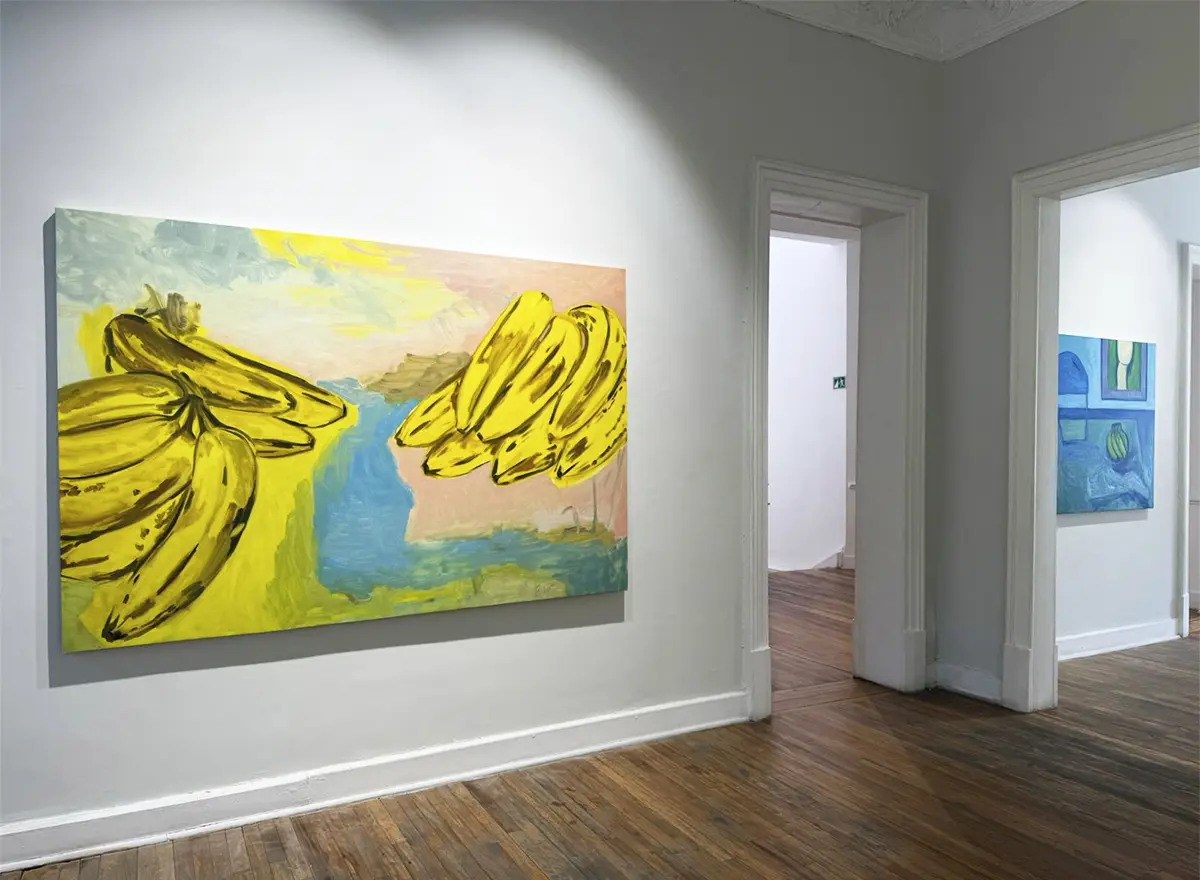
It has a lot to do with digital media, with this barrage of images we’re bombarded with on our phones today; Emi takes as her starting point the reflection at the heart of this exhibition—what we see in excess as we scroll through our phones but not in real life.
Why do you use bananas as motifs in your pieces?
Look, these bananas really shocked her when she went to a mini-market in the United States and saw those fruits that really don’t belong there. Frankly, nobody is surprised anymore to see bananas in an American store, so it also invites reflection on the fact that nothing surprises us anymore, but it also speaks to globalization—how everything is now mixed together, available, and within everyone’s reach. And well, there’s also that ephemeral aspect—the fact that when she begins the piece with the bananas in the foreground, they’re green, but by the time she finishes the painting, they’ve ripened. And that reveals that what she’s drawing is alive and changing, and she’s very interested in that transformation.
Collecting is also about learning to see
Getting back to the topic of young collectors, I also see that you offer a service that involves advising collectors. In general terms, what does that entail?
It has to do with the fact that many of our clients don’t just want to buy a painting they liked; they also turn to us to find a piece if they’re building a house, rearranging their space, moving offices, or renovating, and that’s where we really step in as consultants, because we can work specifically with each client to identify pieces they might like, that might interest them, and that complement their collection.
By the way, did you take the gallery’s name from Greek literature and mythology?
The truth is something very simple that seems more complicated, but it’s just the word “art” spelled backward with an “h” in the middle: Ethra—though it surely has a poetic meaning as well.
Discover more galleries in Mexico City and Latin America in AW Magazine.