For this visual artist, collage is a practice that shares fundamental characteristics with poetry.
Alfredo Quintana Garay, also known as Tintorera, is one of the most important figures in Mexican collage art. His work explores themes of eroticism, the body, and dreams.
In 2016, Tintorera was featured in two key books on collage in Spain and around the world. The first is 101 Book Collage Edition, which brings together collage artists from around the globe. The second is a publication by Eje Central, an independent publishing project that focuses on this discipline as a primary creative form.
For him, collage is a sister discipline to poetry.
The Art of Mexican Collage: Who Is Alfredo Quintana Garay, “Tintorera”?
For him, collage is indistinguishable from poetry. Both art forms are the product of association and chance. Quintana Garay was born in Mexico City in 1974. He is a collagist, poet, and editor. He studied Communication Sciences at ITESM. In the late 1990s, he worked as an editor at Quo magazine and later served as editor-in-chief of Conozca Más. In 2001, he published the poetry collection *Primavera de carroñas*, which also features his visual works.
““I’m currently working on a collage that references the Olivetti Lettera 22 I had when I was in high school and college. I’m talking about 1991—that’s when I started writing poetry, and almost at the same time, I started making collages.”
“It wasduring *Primavera de Carroñas* that I first combined poetry with analog collage. It was a particularly… how should I put it? Dark period in my life, if you will, in existential terms. That’s why the poems just flowed. To write them, I used the Dada method. I cut out phrases from crossword puzzles in Vanidades magazine, for example, and other random phrases from magazines. I used them to create combinations in the style of a collage.”
Analog collage is created using printed sources of images and text, as well as a physical medium. Scissors are the primary tool. In contrast, the digital version uses software tools. Alfredo Quintana Garay began experimenting with Photoshop in 2013. It was then that he created the Tintorera brand. Regardless of the tool used to create, his guiding principle has always been the same.
“Chance is the invisible gunpowder of collage. When I Google an image of an antelope, for example, I might get a result that has nothing to do with an antelope. When I look through old magazines or books, I don’t know what I’m going to find. That element of chance is wonderful.”
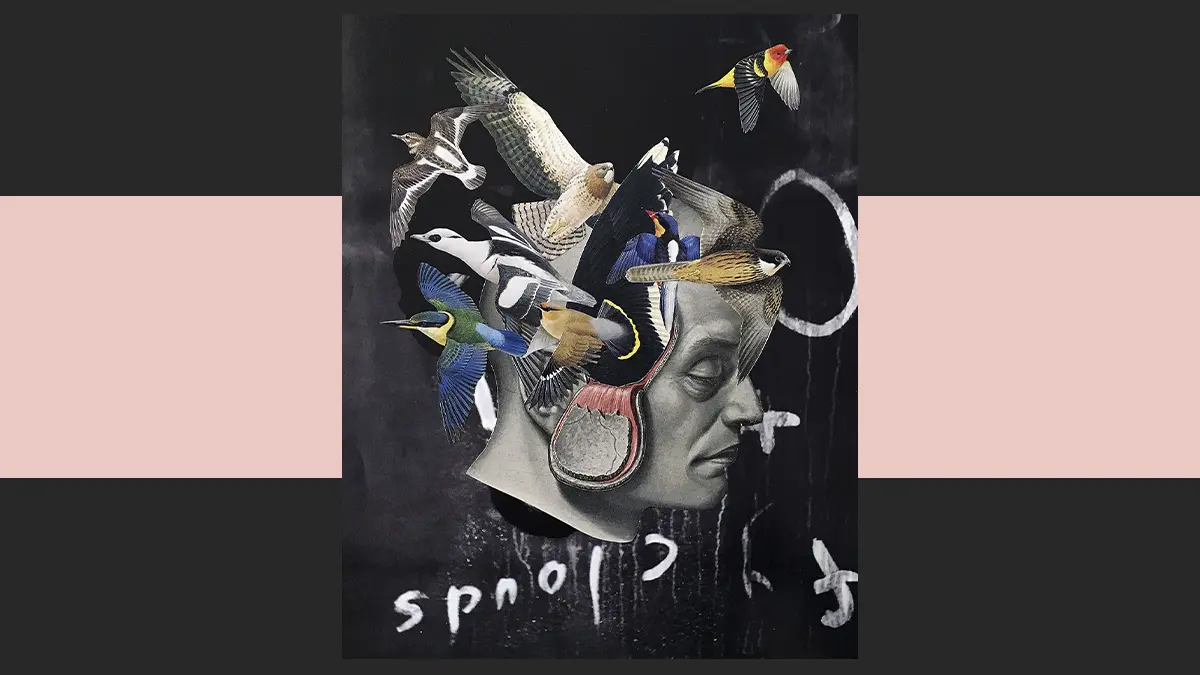
Quintana Garay has had his collages published in magazines such as Tapas Magazine, Esquire Mexico, and Fortune en Español. He has received awards such as the Bronze Prize at the 2016 ÑH Awards in the Illustration/Portfolio category. He has also participated in exhibitions such as Aglomeraciones, organized by Art Latinou at the Semanario de Cultura Mexicana, and BADA (Buenos Aires Directo de Artista). In 2023, he presented a solo exhibition featuring the series Jesus in Wonderlandand Humano que fue pájaro. In his personal manifesto, we read the line “his scissors never sleep.”
Tintorera, Mexican Collage, Dreams, and Eroticism
Contact Alfredo Quintana Garay is more like dealing with a poet or a psychoanalyst from the early 20th century. His primary topics of conversation are dreams, poetry, and human eroticism.
“I remember a collage that I still have. It’s an anatomical figure of a couple—a man and a woman with their skin removed, just as they appear in anatomy books. There are clouds in the background. What I did was type the poem, or rather, individual phrases, on the typewriter. Then I cut them out and pasted them around the images, as if it were a kind of anatomical diagram.”
Alfredo talks about his most significant influences. He mentions Jorge Luis Borges. “The House of Asterion”, which appears in The Aleph (1949), is the precursor to his 2024 piece “Medusa Minotaur Medusa.” In it, both mythological figures merge into one against an explosion of color. For Tintorera, the definitive expression of collage lies in another literary work: Canto VI of *Les Chants de Maldoror* by the Comte de Lautréamont.
“As beautiful as the chance encounter between a sewing machine and an umbrella on a dissection table. I see collage as a poetic activity, don’t you? Often, collage functions in and of itself as a poem.”

It’s interesting that he mentions dissection, a practice that also involves the use of scissors.
“Even when scissors are asleep, they still cut. Last night I dreamed I was making a collage at some kind of artists’ gathering—there were painters, photographers, and collage artists. I had a pair of scissors there; maybe they were dreaming, if you want to look at it that way.”
Dreams lie at the heart of Tintorera’s work. The dreamlike world finds expression in the way she weaves together images and words. When we dream, we see a friend who is, at the same time, someone else. These condensed moments come to life in her scenes.
“Sometimes, what starts out as an eye ends up being something that doesn’t involve an eye.” Dreams have been important to me for as long as I can remember. “Erotic dreams, too. I still have them. With some of them, I tell myself, ‘I’m going to take these to the grave, honestly.'”
Tintorera works with what Sigmund Freud, the father of psychoanalysis, called the principle of free association—that is, the patient says whatever comes to mind without censoring anything. Quintana Garay has learned to explore the nooks and crannies of his imagination and memory without anxiety.
“It’s a trigger. Sometimes you come across an image or a scent, and that triggers a memory of a date, a movie, a song, or a personal experience. It happens to me often when I’m editing the collage, and that allows me to keep working on the image.”
As in dreams, eroticism is central to Quintana Garay’s work. In Son tus cardúmenes, mujer, a “school” of fish hovers over a beautiful female face. In Hablar en lenguas, the man in an old photograph has replaced his face with a vulva. The body becomes the territory of cutting, association, and montage.
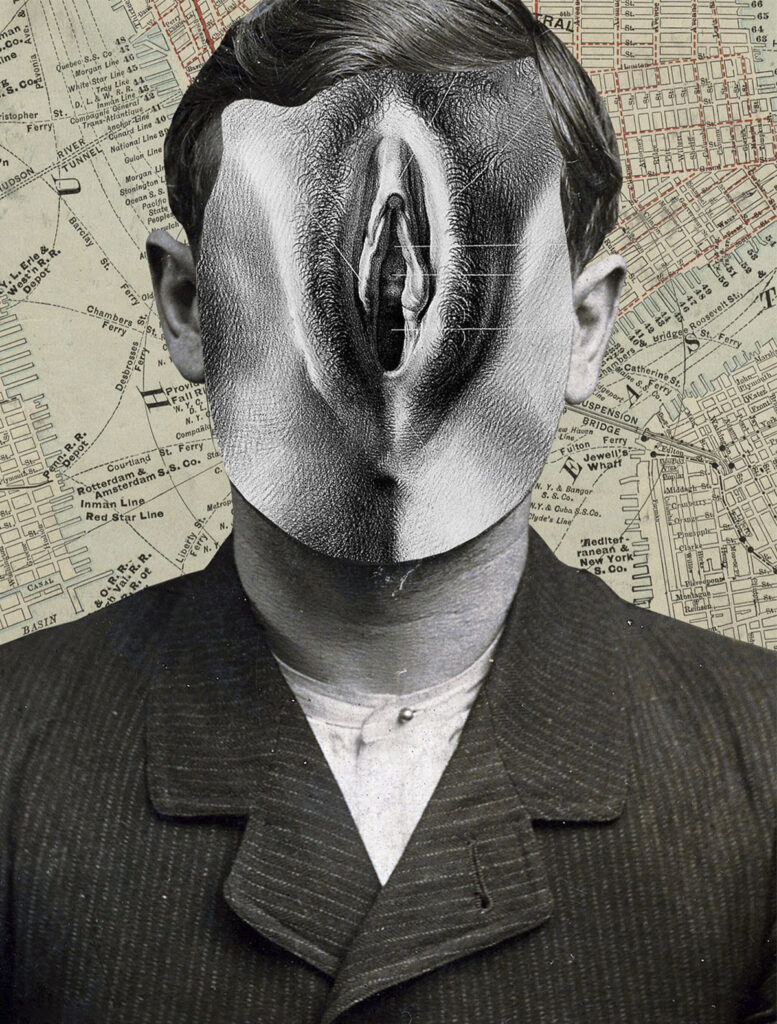
“Many of these combinations of body parts are associated with an artist like Hans Bellmer. His drawings and his theories on the image explored these associations. Why not imagine, I don’t know, a vagina where the armpit is, or an eye right where the anusis.”
2026: Upcoming Publications
Alfredo Quintana Garay’s work will be featured in two publications dedicated to collage. The first is *101 Book Collage Edition*, a collection of works by 101 collage artists. Each artist has a full page to showcase their work.
“The piece to be published is digital and encompasses some of the things that obsess me: eyes, human anatomy, the female form. The work is a nude; the woman’s head is an eye, and she is surrounded by two snakes representing infinity.”
His work will also appear in a publication coordinated by Eje Central, a project dedicated entirely to collage.

“This is a book of Mexican collage art that aims to showcase some of the work being done here, in different states across the country. The artists are men and women in their 20s, 30s, 40s, and 50s. The goal is to capture a glimpse of that vast universe. It is an ambitious and necessary project.”
Learn more about multidisciplinary artists in Mexico in AW Magazine.
To keep exploring this thread, visit contemporary art from Latin America; you can also continue through contemporary Latin American artists.