
LABOR is one of Mexico City’s essential galleries for understanding research-based contemporary art. Founded by Pamela Echeverría in 2009, it has supported artists who are now featured in major institutions and biennials —Teresa Margolles, Pedro Reyes, Jill Magid, Héctor Zamora, Santiago Sierra—alongside a generation of artists working in the fields of archives, architecture, science, language, technology, violence, public participation, and institutional critique.
Gallery Profile
Pamela Echeverría (Chile, 1973) is the founder, director, and public face of LABOR. She arrived in Mexico at the age of three, as part of a family history marked by exile, and received her education in industrial design, art history, museums, and galleries. She studied at the Universidad Iberoamericana; before opening LABOR, she worked at the Carrillo Gil Art Museum and Galería OMR. This career path brings together production, mediation, risk-taking, and direct engagement with artists, and helps explain a gallery built on processes rather than a stylistic image.
LABOR was born out of a decision to be independent. Echeverría came from the Mexico City gallery scene and opened a space where he could choose artists, commit to long-term processes, and support challenging works without relying on immediate commercial success. The gallery’s identity was shaped from that point on: political, scientific, sociological, and formal investigations that require time, study, and production. This stance made LABOR a pivotal space for artistic practices that did not easily fit into the city’s fast-paced market.
Viewed from a distance, LABOR helps us understand how some artists who are difficult for the market to accommodate ended up occupying a central place in international institutions. Teresa Margolles (Culiacán, 1963), who had been associated with the gallery in earlier periods, became one of the most recognized Mexican artists for her work on violence, grief, bodies, and public space. Santiago Sierra (Madrid, 1966) brought the discussion of labor, exploitation, and power to museums and biennials. Pedro Reyes (Mexico City, 1972) has presented projects at venues such as the Hammer Museum, the Whitechapel Gallery, the Walker Art Center, and the Guggenheim.
Jill Magid (Bridgeport, 1973), Héctor Zamora (Mexico City, 1974), and Pablo Vargas Lugo (Mexico City, 1968) open up another area of this significance. Magid transformed Luis Barragán’s archive into an investigation of cultural property, institutional desire, and architectural memory. Zamora has brought his interventions on public space, architecture, and collective action to biennials and museums. Vargas Lugo has worked with astronomy, landscape, time, and visual fiction. LABOR supported these practices without reducing them to formats for immediate consumption.
The location at Francisco Ramírez 5 reinforces this theme. The gallery is just a few steps from the Luis Barragán House-Studio, and that proximity took on special significance in Jill Magid’s projects on the architect’s archive. *The Barragán Archives* examined Barragán’s legacy, the private ownership of his professional archive, and the boundaries between public access, copyright, institutional desire, and modern memory. At LABOR, the city does not appear as an external context: it enters the work through archives, buildings, permits, institutions, and disputes.
The current program maintains that tension between research and form. American Artist explores technology, race, and surveillance; Erick Beltrán investigates publishing, information, and knowledge; Irene Kopelman combines drawing and scientific observation; Nicholas Mangan addresses economics, ecology, and extractivism; Yuri Pattison examines digital infrastructures and data circulation. LABOR provides them with time, production resources, context, and an ongoing relationship with audiences and collectors. This continuity explains why the gallery remains a point of reference for artists working with complex systems.
The 2024 anniversary exhibition *Bread & Roses* marked a period of internal reflection. Echeverría spoke at the time of the need for beauty and life after years of very demanding work, without abandoning research as the cornerstone of the project. The exhibition brought together themes of destruction, utopia, feminism, and transformation, featuring artists such as Raphael Montañez Ortiz and Jorge Satorre. That moment showcased a gallery capable of reflecting on its history without renouncing its critical stance or reducing research to an academic formula.
“Artists with a research-based approach put their finger on sore spots that aren’t yet visible.” — Pamela Echeverría, Excélsior, 2024
This quote defines a work ethic. LABOR is defined not only by its artists, but also by the conditions Echeverría has championed for challenging projects: works that delve too deeply into research to be immediately accessible, requiring careful consideration, time, production, and risk. In a city where the art market has become increasingly visible, LABOR maintains a unique position: it supports research without turning it into an academic posturing.
Why Go
It’s worth visiting because LABOR showcases a facet of Mexican contemporary art that can’t be fully grasped at a glance. Its exhibitions stem from questions about power, violence, archives, language, science, technology, and public life. The work may take the form of sculpture, video, documents, painting, installation, or performance, but it almost always involves extensive research. A visit requires careful consideration, time, and a willingness to engage with the process.
LABOR has supported artists who now occupy a central place in museums, biennials, and international collections. Teresa Margolles transformed grief, material remains, and social violence into a body of work with global resonance. Jill Magid turned Luis Barragán’s archive into an investigation of cultural property and public access. Pedro Reyes blended sculpture, pedagogy, and activism in projects that have received wide institutional circulation. Héctor Zamora brought architecture, public space, and collective action to biennials and museums.
The Francisco Ramírez 5 location places visitors in the immediate vicinity of the Luis Barragán House and Studio. This proximity has concrete implications: several of LABOR’s areas of interest—archives, architecture, cultural heritage, and institutional power—find a real-world context there. In just a few meters, the route takes visitors from a research gallery to one of the key sites of Mexican architectural modernism.
What to Expect
A visit to LABOR invites you to engage with processes. The gallery can host sculpture, video, archival material, documented performance, painting, installation, or works born of long-term research. A single program can encompass political violence, surveillance systems, botany, urban planning, science, language, architecture, or forms of collective organization. The gallery does not require a spectacular viewing experience; rather, it calls for attention to the context of each work, the materials on display, and the information accompanying projects that are developed over time.
The space is located at Francisco Ramírez 5, across from the immediate surroundings of the Luis Barragán House-Studio. The street is short and quiet, with an almost domestic scale. This setting helps visitors concentrate: there’s no need to navigate a crowded area to get there, and the gallery doesn’t compete with any grand facades. Upon entering, you find yourself in a space where each exhibition typically calls for context, interpretation, and time—more akin to a critical laboratory than a venue for quick consumption.
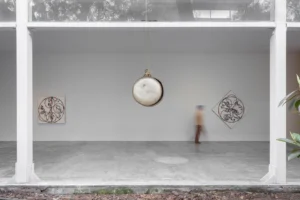
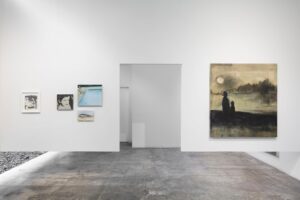
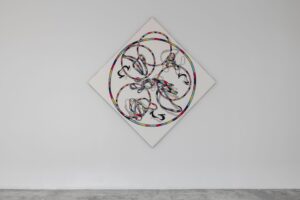
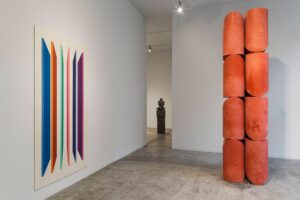
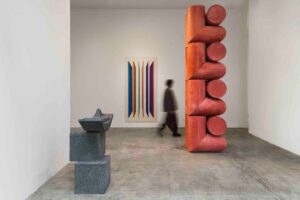
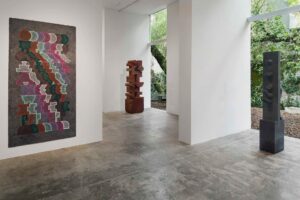
In 2026, the current exhibition is dedicated to Pedro Reyes. The artist presents sculptures carved directly from stone—recinto, tezontle, xiluca, and green Oaxaca quarry stone—along with oil paintings on amate paper. Following projects known for their social dimension, such as *Palas por Pistolas*, *Disarm*, and *Sanatorium*, this exhibition focuses on a more formal aspect of his work: carving, material, Nahuatl nomenclature, volume, and Mesoamerican memory.
LABOR can be harsh, precise, ironic, political, or materially beautiful. Its exhibitions have ranged from acts of destruction to critiques of bureaucracy, impossible archives, public sculptures, understated paintings, and works that transform research into art. The experience reveals a gallery where the art market, intellectual discourse, risk-taking, and artistic production are inextricably intertwined. It’s best to leave early enough to walk toward Barragán, Chapultepec, or the San Miguel Chapultepec area, so the visit doesn’t become a one-off stop.
Represented Artists
What to Do Nearby
After leaving LABOR, I’d start with the Luis Barragán House and Studio, located at 12 General Francisco Ramírez, built in 1947 and recognized as one of the most important residential works of the 20th century. Reservations are required for the tour, but the connection with LABOR makes sense: archives, architecture, cultural heritage, and modern memory intersect directly on this street. For a quick break nearby, Cafecito Alex, located at Jardín 17 / General Francisco Ramírez 17, keeps you in the same micro-neighborhood as Barragán.
If the route leads to Chapultepec, the Tamayo Museum offers an institutional continuation. In June 2026, it will present *Tamayo Horizontes* and *Ante el eclipse. Arqueologías del arte en México*, an exhibition focused on works and debates from the Mexican art scene between 1981 and 1991. This transition from LABOR to the Tamayo takes the visitor from a research gallery to a museum that charts recent genealogies of contemporary art in Mexico.
For dining, El Mirador de Chapultepec, located at 606 Chapultepec Avenue, retains the feel of a historic cantina without using the same tables found on other routes in San Miguel Chapultepec. Open since 1904, it features both a restaurant and a cantina, offering a timeless menu that includes soups, fish, meat dishes, and after-dinner treats. For lodging, I’d choose a base that connects Daniel Garza, San Miguel Chapultepec, and Chapultepec: Las Alcobas or Casa Polanco let you explore the Bosque’s museums, architecture, and cuisine without being limited to a single neighborhood.


