
AGO Projects plays a prominent role in Mexico City’s art scene. It is an international platform for collectible design that showcases works by both emerging and established visual artists. Founded in 2019 by Rudy F. Weissenberg and Rodman Primack, the gallery works with furniture, ceramics, lighting, textiles, and functional objects, fostering a dialogue about contemporary material culture.
Gallery Profile
AGO Projects was founded in 2019 as the result of a serendipitous insight. Mexico City had a vibrant design scene, with workshops, architects, artists, artisans, and studios producing objects of exceptional quality, but it lacked a platform capable of positioning them within the international design circuit. Rodman Primack and Rudy F. Weissenberg arrived in Mexico with experience in art, trade shows, interior design, media, and collecting, and from there, the gallery has succeeded in building a bridge between local production, international creators, global collectors, and specific commissions.
Of course, the founders’ prior experience helped bring the project to life. Primack has worked at Christie’s, the Gagosian and Phillips de Pury galleries, and Design Miami, where he served as Executive Director and Chief Creative Officer. Weissenberg, a graduate of the Harvard Graduate School of Design and Columbia Business School, brings a solid background in design, development, and management. AGO Projects thus stems from an understanding of the market and trade shows, a passion for interiors, and an intuition for how a piece can circulate without losing its connection to the workshop.
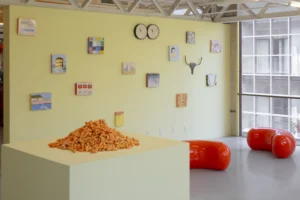
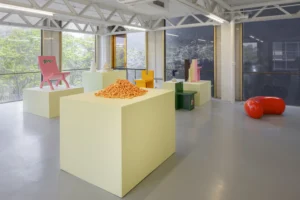
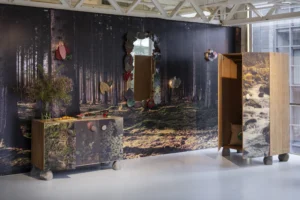
AGO’s initial impetus stemmed from looking around a city of boundless dimensions. In Mexico City, its founders identified a vibrant design scene that needed platforms capable of connecting it with both local collectors and international circuits. The inaugural exhibition, Otro reino, presented in 2019, already established this scope of work. Lanza Atelier, MT Objects, and Pedro y Juana—three distinct practices united around furniture, objects, material imagination, and ways of living—planted the seeds for what was to come.
The gallery works with objects that can find a place in a home but are not limited to their functional purpose. Its exhibitions feature chairs, tables, lamps, ceramics, textiles, screens, and other household items— yet these pieces compel us to question the processes behind them. Where does the material come from? Whose hands transform it? What technical expertise underpins it? What relationship does it have with a community or with a formal history? That boundary between functionality and meaning is AGO Projects’ natural territory.
And from Mexico, the world was its next chapter. The gallery has participated in FOG Design+Art and Design Miami, and has also attended TEFAF in the Latin American design and crafts category, with the mission of bringing designers from Mexico, Latin America, and other regions into conversations that have long been dominated by Europe and the United States.
The recent exhibition clearly reflects their interests. “Azul y verde” by Lanza Atelier focused on capturing a blend of color, language, perception, and furniture. “Parenchyma” by Kauani—the studio of designers Inés Llasera and Inés Quezada—brought botanical elements into textile lamps. “Ready-Maybe” by Ramiro González Luna transposed everyday objects and references from art history into ceramics. “Earthling; life through earth, by Taller Los Tepalcates—the family pottery workshop of the Enríquez Chávez family from Santa María Atzompa, in Oaxaca—brought the techniques of Atzompa’s green-glazed ceramics to a fantastical scale in lamps, tables, vessels, and mythological creatures. These are distinct projects, but they share the same question: what can an object tell us when its material is taken seriously?
"We love handmade items; to us, they're a true luxury." —Rudy F. Weissenberg, Architectural Digest, 2019
AGO Projects has helped give public form to a scene that already existed but needed better conditions for presentation, circulation, and quiet contemplation. Its strength lies not only in marketing beautiful pieces, but also in building context so that these pieces can be understood as contemporary design, applied art, material research, and cultural work. In a city where art often takes center stage, AGO reminds us that a lamp, a chair, or a piece of ceramics can also tell a complex story about place, craftsmanship, and, above all, the desire to live with meaningful objects.
Find more stories like this by exploring contemporary Latin American art; you can also browse contemporary art galleries in Latin America.
Why Go
It’s worth visiting because AGO Projects offers insight into a key aspect of Mexico City’s recent shift toward collectible design. Its program doesn’t rigidly separate art, furniture, ceramics, textiles, or lighting; it operates in that space where an object can be functional while also possessing sculptural depth, material exploration, and a clear cultural stance. In a city with a highly visible art scene, AGO has helped design carve out its own place within the circuit of galleries, fairs, and collecting.
The starting point is Mexico, but not as a limitation. AGO Projects represents creators with ties to Mexico and Latin America, while also incorporating international voices to foster a broader conversation about craftsmanship, interiors, domestic life, and global circulation. This mix is reflected in names such as Fabien Cappello, Agnes Studio, MT Objects, Kueng Caputo, and Leanne Shapton.
But above all, the gallery’s success also depends on the people behind it. Their goal is for it to be seen not just as a showroom, but as a platform that connects artists, collectors, commissions, art fairs, and international contexts.
What to Expect
A visit to AGO Projects doesn’t begin like one to a street-level gallery. The address at Paseo de la Reforma 382 leads to an office building in the Juárez neighborhood, accessible by elevator and directly connected to the vertical cityscape of Reforma. That setting sets a different tone. You don’t enter through a commercial facade, but rather through a more discreet urban architectural setting, where the space feels like a discovery within an area dotted with hotels, law firms, embassies, restaurants, and buildings from different decades.
The exhibition is often best viewed as a diverse showcase of design rather than a conventional exhibition. It may feature furniture, lamps, ceramics, textiles, artist-made pieces, and household objects that call for a different perspective than that required by a painting on a wall. And of course, the scale of the object matters: how a chair occupies a room, how a lamp alters the light, how a ceramic piece reveals the artisan’s touch, and how a local material transitions into an international context without losing its depth.
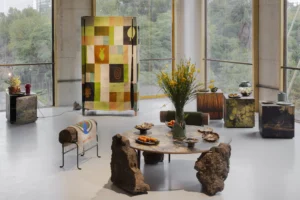
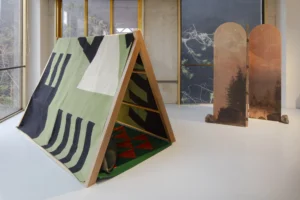
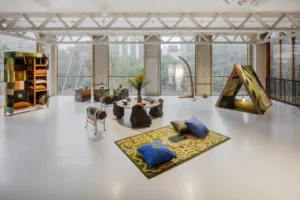
AGO Projects works with a design philosophy that goes beyond mere finishes or styles. Its exhibitions feature practices related to workshops, artisanal processes, experimentation with materials, and collaborations with communities or specialized studios.
It’s best to arrive early and, if possible, with a prior appointment or confirmation. The experience is more like joining a conversation about how contemporary design is produced, collected, and lived in than simply walking through a neutral gallery space. The real appeal lies in the close-up view of the objects: examining assemblies, textures, technical solutions, workshop techniques, and decisions regarding scale. AGO Projects is a great option for anyone who wants to understand the city through design, not just through its museums or art galleries.
Represented Artists
What to Do Nearby
After leaving AGO Projects, the Juárez neighborhood offers a wide range of artistic, culinary, and urban experiences. Reforma is just a few steps away, with its mix of corporate towers, monuments, hotels, and remnants of the old 19th-century promenade. Further in, the streets of Juárez take on a different scale, featuring Porfirian houses, bars, restaurants, galleries, and creative studios. The tour can continue to the MUCHO Chocolate Museum on Milán Street, which explores the history of cacao through its collection, exhibitions, and activities in a neighborhood house.
To look at design from a different angle, it’s worth stopping by Niddo Café—not just for breakfast or coffee, but because the space was designed by Frida Escobedo in collaboration with Mauricio Mesta. The space complements AGO well: both places demonstrate how, in Mexico City, design isn’t limited to exceptional objects but permeates everyday life—in a table, a bench, a bar, or a way of using light.
When it comes to dining, Masala y Maíz serves as a natural extension of the route if you want to explore the concepts of matter, fusion, and origin through cuisine. Norma Listman and Saqib Keval explore the migration of ingredients, techniques, and memories between South Asia, East Africa, and Mexico; their restaurant on Marsella Street maintains that political and emotional interpretation of food. It’s best to make a reservation and not treat it as a spur-of-the-moment stop: it’s the perfect place to wrap up your visit with conversation.
If the afternoon calls for a longer walk, Juárez Street takes you down to Havre, Londres, Hamburgo, or Versalles—streets where old houses, office buildings, cafés, independent projects, and restaurants still coexist, turning the neighborhood into a gathering place for designers, artists, architects, and publishers. AGO Projects is best understood when viewed within the context of this city, which combines a showroom, office, workshop, hotel, contemporary eatery, and the Paseo de Reforma all within a few blocks.


