
House of Gaga is one of Mexico City’s most unique galleries. Founded in 2008 by Fernando Mesta and José Rojas, it operates out of Roma Sur with an international program where painting, performance, literature, archives, fashion, pop culture, humor, and institutional critique coexist without a single overarching aesthetic. Its history connects Fernando Palma Rodríguez, Juan José Gurrola, Adriana Lara, Daniela Rossell, and Ana Pellicer with Cosima von Bonin, Bernadette Corporation, Marc Camille Chaimowicz, Peter Fischli, Laura Owens, Nicolas Ceccaldi, Calvin Marcus, Karl Holmqvist, and Claire Fontaine.
Gallery Profile
House of Gaga was founded in 2008 by Fernando Mesta and José Rojas. Mesta came from Perros Negros, a project platform based on artist residencies and local production; Rojas, an architect by training, brought a spatial sensibility that was crucial to the staging and production. That combination—an international network, hospitality, architecture, and close ties with the artists—explains why Gaga developed such a distinctive identity within Mexico City.
Perros Negros was already operating on an unconventional model: inviting artists to Mexico, producing work on-site, collaborating with limited resources, and maintaining a network that connected Mexico City with scenes in New York, Los Angeles, and Europe. Gaga didn’t abandon that way of working; she made it more stable. The gallery was founded when that energy needed continuity, an archive, representation, and a place where relationships could be sustained beyond a temporary exhibition.
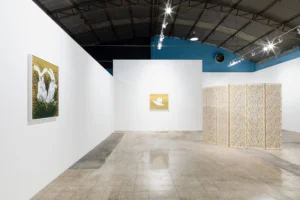
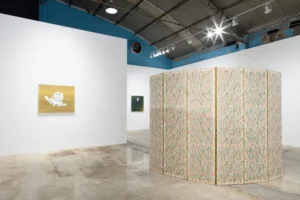
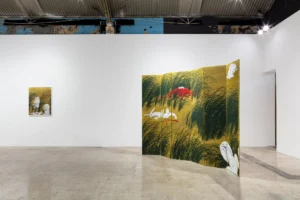
José Rojas gave the project a physical dimension. In the early years, his training as an architect became evident in the installation, the execution of the projects, and the use of space. Perhaps this helps explain why Gaga does not function as a gallery with a purely curatorial program: the exhibition is also shaped by spatial decisions, fabrication, collaboration, and available resources.
The early history of Mesta and Rojas blends life, work, and the art scene. The artists would travel to Mexico for weeks at a time, produce work, and often stay with them. That way of working fostered an international community even before Gaga had a more visible structure. The gallery grew out of sustained relationships with artists, not from a branding strategy.
Gaga’s Mexican program brings together figures who don’t fit into a single lineage. Fernando Palma Rodríguez works from Milpa Alta with robotics, software, engineering, indigenous worldviews, and land advocacy. Juan José Gurrola brings Mexican experimental theater, translation, opera, film, performance art, and an unconventional approach to understanding the arts scene. Daniela Rossell offers a provocative exploration of class, domestic interiors, and the representation of women. Adriana Lara shifts images and objects across the realms of art, music, design, and cultural circulation. Ana Pellicer connects jewelry, sculpture, and community work with a keen awareness of the body and craftsmanship.
The international dimension is not merely decorative. Bernadette Corporation introduces a corrosive relationship between fashion, branding, writing, and nightlife. Cosima von Bonin works with textiles, plush animals, humor, and a deliberate resistance to heroic gestures. Karl Holmqvist shifts poetry toward voice, repetition, typography, and performance. Marc Camille Chaimowicz has turned domestic interiors, design, and everyday life into a highly influential queer vocabulary. Gaga presents these practices without turning them into imported curiosities, because it places them alongside Mexican artists who also work through deviation, the archive, the scene, and gesture.
The current location at Tehuantepec 148 in Mexico City marks a new position within the city. Gaga no longer relies on the myth of its first space next to Contramar or on the Condesa neighborhood as its place of origin. Roma Sur gives it a different feel—less polished and closer to art studios, restaurants, movie theaters, residential buildings, and everyday shops. This location suits a gallery that doesn’t strive to appear flawless: its exhibitions can be dry, theatrical, literary, uncomfortable, or deliberately odd.
“It all started naturally. People would come to Mexico for a month or two, produce work, and put on an exhibition.” — Fernando Mesta, Flash Art, 2016
This quote, translated from English, sums up a work ethic that still defines Gaga today. The gallery is defined by the way Mesta and Rojas have brought together unlikely communities across Mexico City, Los Angeles, New York, and Europe. In an increasingly professionalized art scene, Gaga retains a valuable rarity: it creates context without erasing the dissonance that makes its artists so interesting.
Why Go
It’s worth visiting because Gaga maintains a somewhat untamed approach to exhibitions within Mexico City. The gallery doesn’t aim for each exhibition to be immediately understood, nor does it seek to have the viewing experience confirm a recognizable visual identity. In its galleries, a painting, a drawing, a small sculpture, or an archive can hover between humor, discomfort, and precision. That ambiguity isn’t just an effect—it’s a central part of how the gallery works with artists.
Many works appear unremarkable at first glance (a drawing, a phrase, an absurd figure, an unremarkable object) but begin to take on new meaning when viewed within their context. An exhibition can spark a conversation about Mexican theater, the economy of the image, desire, fashion, class, or pop culture without explicitly stating so. Gaga doesn’t explain too much; she lets the strangeness do its work in the gallery.
Gaga is also significant for the way she has brought together scenes that rarely coexist without a hierarchy. Juan José Gurrola and Fernando Palma Rodríguez explore Mexican themes linked to experimental theater, robotics, language, and territory; Cosima von Bonin, Bernadette Corporation, Karl Holmqvist, and Marc Camille Chaimowicz steer the conversation toward fashion, writing, pop culture, design, and queer practice. The gallery does not smooth over these differences. It allows them to coexist as elements of a single conversation—sometimes dry, sometimes absurd, almost always more complex than it seemed upon entering.
What to Expect
A visit to Gaga is not an exhibition that can be fully grasped at a glance. The gallery may feature recent paintings, works on paper, archival materials, sculptures, photographs, texts, drawings, or installations by artists from very different scenes. The official website reflects this mix: painters, writers, collectives, performers, photographers, designers, historical figures, and young artists all coexist within the same archive.
In 2026, the confirmed main exhibition is *Rabbit Hole* by Calvin Marcus. The project brings together recent paintings and a fable by Luis Felipe Fabre, *Fable of the Rabbit*. Rabbits and carrots appear as recurring, almost childlike figures, but the repetition sets a tone that is at once logical, absurd, and somewhat sinister. Marcus works in series, frequently shifts his artistic language, and often takes simple images and transforms them into states of psychological unease or dry humor.
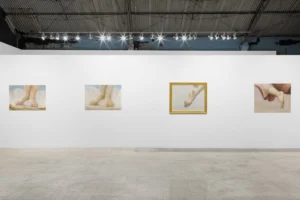
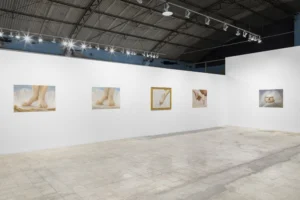
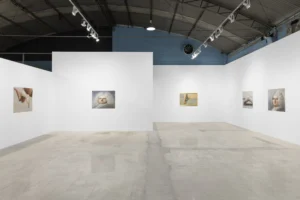
The concurrent program features works on paper by Juan José Gurrola and sculptures by Danny McDonald. This juxtaposition aptly captures Gaga’s versatility. Gurrola brings a Mexican background in theater, stage direction, translation, film, and performance; McDonald works with objects, popular culture, narrative humor, and small scenes where the everyday becomes strange. The gallery does not present these worlds as curiosities: it places them in relation to one another to spark a conversation between archive, object, drawing, and scene.
Gaga is best experienced without looking for a single key. One exhibition may seem lighthearted and be laced with literary references; another may seem like a joke and end up addressing the market, desire, class, or the circulation of images. Some works require context, while others operate through direct strangeness. The gallery preserves this instability as part of its approach: it does not tone down the oddities of its artists to make them more accessible.
Represented Artists
What to Do Nearby
After leaving Gaga, I would stay on the route through South Rome before heading up toward the busiest part of North Rome. A few blocks away is Cine Tonalá, at Tonalá 261—a movie theater, bar, and restaurant that lets you extend your visit with film screenings, conversations, and a nighttime stop in the neighborhood. The proximity makes sense given Gaga’s focus: many of its exhibitions blend moving images, performance, pop culture, and the local scene.
For a weekend meal, El Hidalguense, located at Campeche 155, is a must-visit spot in Roma Sur. It’s open Friday through Sunday and offers a menu centered on Hidalgo-style barbecue, consommé, tortillas, salsas, and long, leisurely meals. It’s not just any old spot—it’s a neighborhood institution, complete with lively atmosphere, families, large tables, and hours that require you to plan your visit carefully.
If the route continues toward Roma Norte, the Casa del Poeta Ramón López Velarde, located at Álvaro Obregón 73, offers a shift in focus toward literature, archives, and urban memory. The scale of the venue is a welcome change of pace after Gaga: a cultural center linked to the neighborhood’s literary history, in an area where the real estate market, nightlife, and cultural activities continue to transform the neighborhood.
For a bookstore stop, Cafebrería El Péndulo Roma, at Álvaro Obregón 86, lets you stay on course in a space for reading, conversation, and a long break. It doesn’t have the quirkiness of Gaga—nor does it try to—but it helps ensure your day doesn’t end solely at restaurants and galleries. From there, you can head back toward Roma Sur or walk toward Condesa, depending on the pace of your afternoon.
For accommodations, I’d choose a place in Roma or Condesa that allows me to walk without having to take a car for every trip. Nima Local House, in Colima, offers an intimate setting in a restored mansion; Ignacia Guest House, in Jalapa, provides a quieter stay in Roma; Hotel San Fernando, in Condesa, is a good choice if your itinerary includes galleries, restaurants, and Chapultepec. From any of these bases, Gaga is within a day’s reach, allowing you to mix gallery visits, movies, neighborhood dining, books, and walking.


