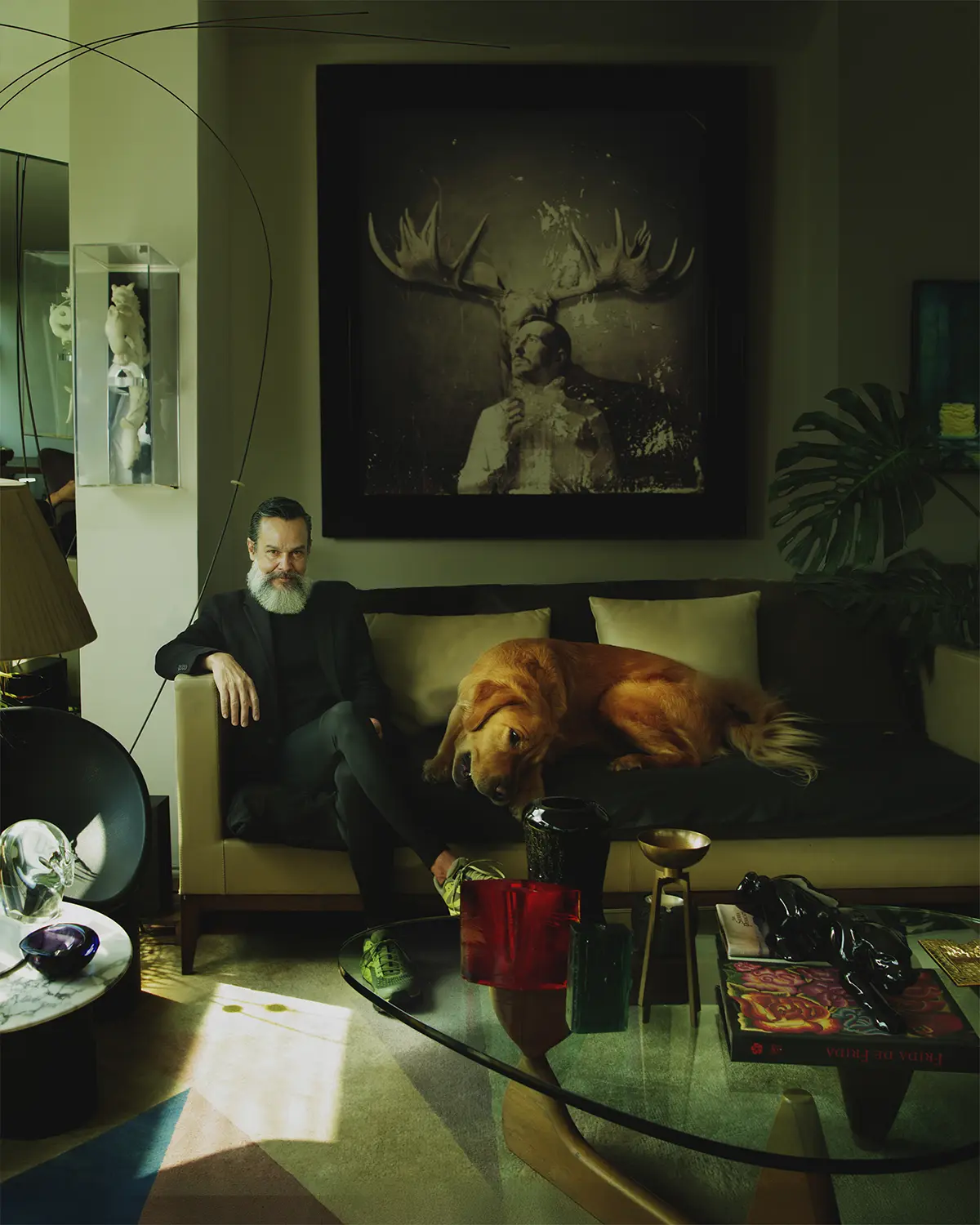
Daniel Rodríguez has designed some of the trains that millions of people around the world ride every day. Even after more than twenty years living in Japan as design manager at Kinkisharyo, he says, “There isn’t a single aspect of my life or work that doesn’t reflect my country.”
However, embracing that Mexican identity—at least in everyday life—isn’t entirely possible: bullet trains (shinkansen) run in Osaka, and plans are already underway for magnetic levitation (maglev) trains, but there’s no technology capable of guaranteeing tamales on a Saturday morning.
Between Japan and Mexico
Rodríguez starts his day with a traditional Japanese breakfast that he shares with his wife, who is from Hokkaidō—an island in northern Japan—: salmon or mackerel, miso soup with seaweed, green tea, and salad.
In the evening, they often visit the Shin-Fukushima station area, a culinary hub steeped in history; there is also a restaurant in the city called Avocados Mexican Cafe.
Shin-OsakaStation is a twenty-minute walk from his home; from there, he sometimes takes the train to his office at the corporate headquarters founded in 1920 where he works. His arrival was the result of a journey that began with a scholarship from Kyoto University of the Arts and the Japanese Ministry of Culture at the time, the Monbushō. Today he works under a seishain contract, one of the most coveted in Japan due to its lifetime nature.

Internationally recognized design
His employers’ trust in him is no accident. Rodríguez’s work—who clarifies that he is not an industrial engineer, but an industrial designer—has been recognized with international awards such as the Red Dot Design Award and the iF Design Award, among others. He has participated in major projects such as the Doha and Dubai metros, the Express Super Hitachi, and the Green Mover in Hiroshima.
In the case of the Qatar train, he explains, his cultural background was key to understanding that the design had to be built around a strong symbolic foundation: “I thought of the Arabian horse, a very iconic figure there, and I realized that horses also have a strong presence in Mexico. That’s where the inspiration came from.”

A quick glance at the design of this Arabian Peninsula nation’s high-speed trains is enough to appreciate their sophisticated design.
He ensured that everything was in keeping with the local culture by drawing inspiration from geometric patterns to make the windows unique. “It completely transformed the look; combine it with a special design, and suddenly you have a train unlike any other in the world.”
For the Doha and Dubai trains, Rodríguez immersed himself in the study of pre-Hispanic sculpture in the Americas. “That treatment of surfaces and those soft forms draw heavily from that tradition.”
Tracing that origin also means following the course of a life that moves between cultures, where tradition and modernity come together.
Trains in the colors of their native cultures
“Every society travels differently; in Mexico and Latin America, for example, mobility patterns differ from those in the Middle East,” says the designer, a graduate of the Universidad Iberoamericana.
The Mexican firmly believes that trains are more than just a means of transportation; they are public spaces, true works of architecture in motion capable of reflecting a city’s personality.
Based on the premise that there is no such thing as a universal aesthetic, Rodríguez identifies a distinctive feature in his work: the color and character of his native culture. This approach is evident in his stylistic contributions to the Metro systems where he has left his mark.

“When I look at the work of David Alfaro Siqueiros or José Clemente Orozco, I understand where that influence of perspective and faded tones comes from.”
“When I look at the work of David Alfaro Siqueiros or José Clemente Orozco, I understand where that influence of perspective and faded tones comes from” —Daniel Rodríguez.
“Color is essential, and one thing I do—which many Japanese designers don’t—is use bold color palettes. The most recent train I designed, in Matsuyama, is a vibrant orange; the one in Dubai is a deeply saturated blue.”
Hiroshima and the Challenge of Sensitive Design
Among his most significant works—more than twenty designs created in various parts of the world—are the lines for the Cairo Metro and the light rail systems in Seattle and Los Angeles, as well as one particularly notable project: the Hiroshima train. “The design for that city was comprehensive. I drew inspiration from the circular eyes found in many pre-Columbian sculptures, especially those of the Aztecs.”
Train design is a highly competitive field. There are, at most, twenty professionals in all of Japan; nineteen are local, and he is the only foreigner. That’s why working on a historic site like Hiroshima was challenging. “How am I supposed to talk about that place if I’m Mexican? It’s a very sensitive issue, ” he told his boss when the company director assigned him the project, despite his status as a gaijin—the term used for foreigners in Japan.
Would looking at the situation from the outside work in their favor, or would the mission fail? Hiroshima is a green city, as are Okayama, Kyoto, and Sendai. What could set apart a place that inevitably reminds us of what happened in 1945?
“For me, the most important thing was realizing that this is a city dedicated to world peace. It represents what people can achieve when they come together and the resilience of the human spirit. That is the character of Hiroshima,” he explains. “How does that translate into design? In soft shapes, in white with green accents: the colors of peace, the dove with the olive branch.”

Trains in Mexico and Latin America
“If I’d been the one to design the Maya Train, I wouldn’t have had to put a sign next to it: its origins would be 100 percent obvious,” he says. The long-standing Mexico City Metro, for its part, holds a special place in his memories: “It was one of the first first-world services that all Mexicans had access to.”
“Brazil has made tremendous technical progress: they even manufacture airplanes. However, it’s not really a Brazilian industry. And the Buenos Aires Metro, for example, used cars from the Tokyo system,” he notes.
The Future of Railway Design
“The world relies too heavily on airplanes and cars; that model is outdated. Here in Japan, most people travel by train, and it’s wonderful. You get on, for example, at Shin-Osaka East Station and arrive right in the heart of Tokyo,” he says, emphasizing that it is a sustainable option.
“They say that at certain times of the day, Metro employees in uniform and white gloves come along and, apologizing, push passengers aside so they can get into the car. I’ve only seen it once,” he explains.
Several decades after being inspired by the cover of a book by Raymond Loewy—the father of modern industrial design—and deciding that this was the career he wanted to pursue, this Mexican industrial designer’s current success speaks for itself.
In addition to focusing on the details of his work in Egypt—on the railway line connecting the Pyramids of Giza with Cairo—and on other confidential projects currently out for bid, Rodríguez recently founded an organization of transportation designers with his fellow countrymen. “The goal is to raise awareness that Mexicans design transportation systems around the world, and also to open up opportunities for designers working in Mexico who are unable to break into the international market because projects are often awarded to foreigners.”

And yes, the challenges are constant: “If we’re talking about what I face today as a designer—and what any contemporary designer faces—it’s humanizing objects. That’s why culture is so important, and that’s why it’s essential to create vehicles and objects that are made by humans for humans.”
As night falls in Mexico, trains begin to move in Osaka. Through sketches, curved surfaces, and bold lines, Daniel Rodríguez continues to bring design to cities in motion through his unique perspective on the world—one in which his culture is always present. For him, design is just that: bringing his own identity to life.
To keep exploring this thread, visit architecture in transit; you can also continue through where architecture meets art.