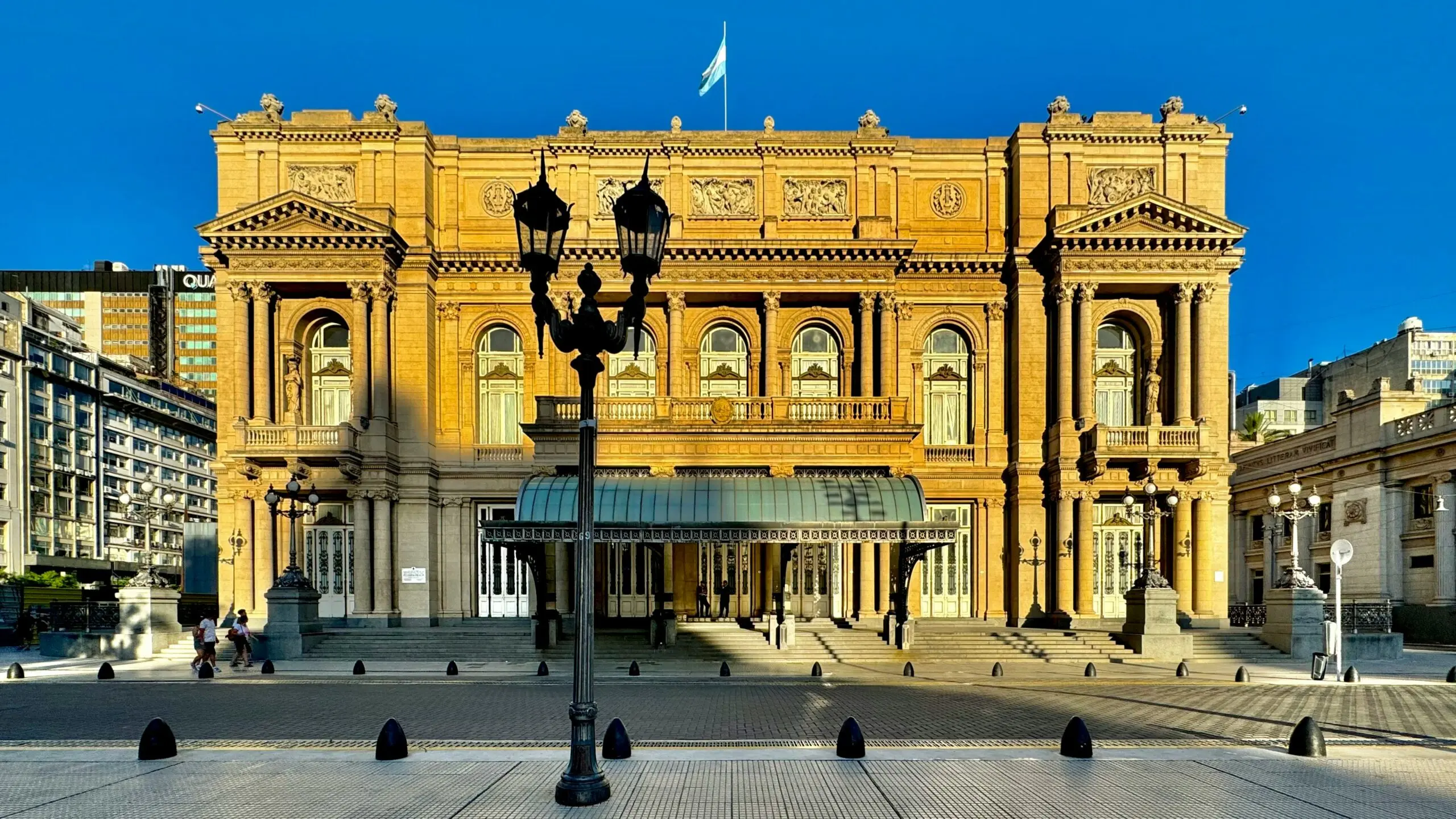

The legendary Teatro Colón stands on the streets of Buenos Aires, an iconic symbol of Argentina’s modern history. It is one of the most important cultural and artistic venues in Latin America and the world.
The Teatro Colón has hosted the works and performances of artists such as Martha Argerich, Maria Callas, and Luciano Pavarotti. It has also borne witness to the history of a country that has suffered the military brutality of torture and forced disappearances.
For those interested in cultural travel in Latin America, the Teatro Colón is a must-see.

The Teatro Colón: The Modernization of Argentina
In fact, the history of the Teatro Colón is the story of two buildings. The first was inaugurated in 1857, in Plaza de Mayo. It was the same year that Argentina opened the tracks of its first railway line. The theater was part of the same wave of modernization sweeping the South American country. The venue operated for more than 30 years before closing in 1888 to make way for the construction of the new building. The city’s growth made it clear that a venue comparable to the best and most beautiful in the world was needed.
The Teatro Colón as we know it today was inaugurated on May 25, 1908. Funding for its construction came from private investors and, to a lesser extent, from the Buenos Aires City Council. The first production to be performed at the Colón was Giuseppe Verdi’s Aida, an opera about love and jealousy. The theater quickly established itself as one of the world’s leading opera houses.

In its early years, the theater hired foreign companies to perform during its seasons. In 1925, it established its permanent chorus, ballet, and orchestra companies, as well as its own production workshops. In the 1930s, the theater was able to organize independent seasons funded by the Buenos Aires government.
Over the course of more than 100 years, the venue has hosted performances by the greatest figures in opera, ballet, and symphonic music. It has been visited by composers such as Richard Strauss, Pietro Mascagni, and Camille Saint-Saëns. The voices of Enrico Caruso and other great tenors have echoed within its walls. Conductors such as Herbert von Karajan and Arturo Toscanini have led performances on its stage.
On the other hand, the Teatro Colón has witnessed the darkest moments in Argentina’s political history. Five military dictatorships took place in that country, right in front of its facade and within its walls.

The Teatro Colón: The Architecture of the Past Future
The Teatro Colón is one of the most beautiful and colossal cultural venues in Latin America. The main auditorium is horseshoe-shaped and conforms to the standards of late 19th-century French and Italian classical theater. The floor plan features boxes that extend up to the third level. The horseshoe has a major diameter of 32.65 meters, a minor diameter of 29.25 meters, and a height of 28 meters.
The venue has a seating capacity of 2,478, and an additional 500 people can watch the shows standing. The dome is one of the building’s most iconic features. It measures 318 square meters.

It originally featured paintings by Marcel Jambon, the same French painter and decorator who created the artwork for the Paris Opera. However, due to deterioration, the original painting was replaced in the 1960s with another work by Raúl Soldi, an Argentine painter and set designer. Soldi’s work is also on display in the Vatican Museums.
The stage is one of the largest and most complex in the world. It has a slight slope that ensures good visibility from all areas of the stage. The orchestra pit can accommodate up to 120 musicians.
For the traveler, stepping into the Teatro Colón means entering a place where time has stood still. Suddenly, we find ourselves in 19th-century Argentina. What ghosts dwell within those walls and seats?

The Teatro Colón: The Architecture of the Past Future
The Teatro Colón has managed to maintain its status as a comprehensive theater company, boasting resident companies, its own workshops, and a program that stands out among its peers in Latin America and around the world.
Any traveler visiting Buenos Aires should definitely stop by this place. Afterward, you can stroll through Plaza Lavalle and continue immersing yourself in a setting that invites you to enjoy a unique experience blending history, architecture, and memory.
Discover other historic theaters in AW Magazine.
To keep exploring this thread, visit contemporary and heritage architecture; you can also continue through buildings with history in Latin America.