
Films about Latin American art: Beyond the galleries and the artist’s journey between recognition and obscurity, cinema has managed to portray the art world in various ways.Today, we recommend five must-see Spanish-language films on the subject. And if any artist sees themselves reflected in them, it’s no mere coincidence.
The artist
Directed by Gastón Duprat and Mariano Cohn, The Artist is a 2018 Argentine-Italian-Uruguayan film that critiques the world of contemporary art. The story follows Jorge, a nurse who steals works from a geriatric patient and sells them as his own, thereby building a reputation and achieving fame.
This drama with comedic undertones (just like real life) takes a satirical look at how, in contemporary art, the value of a work often depends more on its context and the prestige surrounding it than on the work itself, exposing the deceptions and dynamics of the art world.
My masterpiece
In Argentina, comedy has a particularly biting tradition—think of the great actor Jorge Porcel—even when it takes aim at the art world. My Masterpiece (2018), directed by Gastón Duprat and Mariano Cohn—the same directors behind The Artist—is a very clear example of that tone.
The film portrays the relationship between a gallery owner and a retired painter, a misanthrope who lives completely on the fringes of society. Through this dynamic, it constructs a scathing satire of the contemporary art market, questioning how the value of artworks is determined and the role of those who uphold it.
With an ironic and rather sharp script, it also resonates with certain artists who feel isolated or out of place, as it portrays them without glossing over their contradictions. In 2024, the directing duo released the series “Bellas Artes,” continuing in the same vein.
Museum
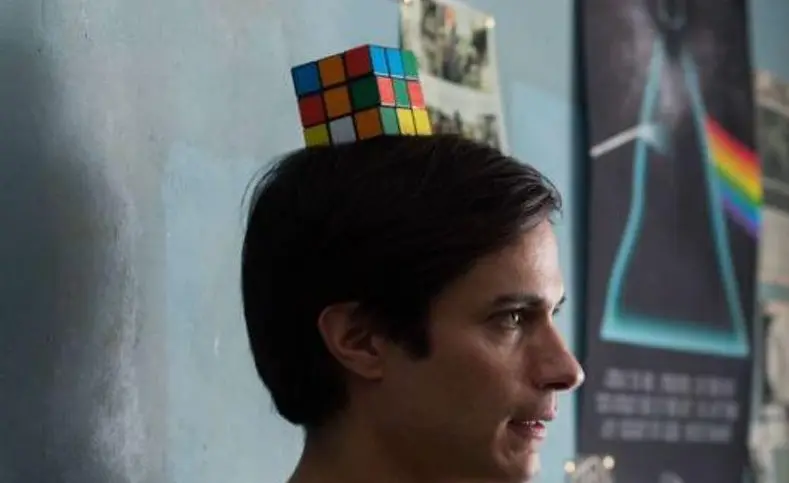
Museum, by Alonso Ruizpalacios, is based on a true story—the robbery of the National Museum of Anthropology on Christmas Day 1985— but it doesn’t turn it into a conventional thriller; rather, it becomes a very Mexican-style crime drama. Set in the year leading up to the 1986 World Cup and the earthquake that shook Mexico City, the film follows two disoriented thieves, more prone to whimsy than to sophisticated crime (in fact, they are two veterinarians who are amateur art thieves). Gael García Bernal builds a character full of contradictions, who carries much of the film’s tone.
The art direction is key: it recreates the 1980s and the museum spaces in great detail, creating a well-crafted atmosphere. From there, the script offers a reflection on absurdity, guilt, and the very concept of value in artifacts such as the famous Mask of the Bat God, of Zapotec origin, stolen in what was dubbed “the heist of the century” (and no, it wasn’t carried out by any political party) in Mexico.
The mural
The mural, by Héctor Olivera, takes as its starting point David Alfaro Siqueiros’s arrival in Argentina in the 1930s to paint his monumental 200-square-meter mural *Ejercicio plástico*. But the film doesn’t stop at this historical anecdote. Rather, it delves into something more murky: art, politics, sex, and egos.
The film navigates that familiar line between artistic creation and personal chaos. Siqueiros is not portrayed as a solemn figure, but rather as an intense, contradictory character entangled in ideological conflicts as well as—let’s say—quite mundane ones.
The atmosphere around him is tense: politics, anarchy, and artistic rivalry…and we’re talking about the 1930s. Mexican actor Bruno Bichir plays Siqueiros, and he does a fine job.
The Picasso Band
The film *Picasso*, directed by Spaniard Fernando Colomo, revisits that curious episode—the theft of *La Gioconda* in 1911—and turns it into a comedy with historical references.
The film is based on the real suspicion that Pablo Picasso may have been accused of being part of an international art theft ring. From there, it weaves a narrative that blends Da Vinci’s classical art with the modern art that Picasso himself was beginning to revolutionize. Colomo, one of the pioneers of Spanish comedy, opts for a lighthearted tone that is enjoyed more for its anecdotes than for its depth. Even so, it works well as the kind of story worthy of being adapted into a fictional format.
Spoiler: Picasso was cleared of the charges, but the film plays with that possibility and weaves a fascinating tale about one of the most famous art thefts of the last century.
Ultimately, these five films demonstrate that Ibero-American fiction centered on art has been in good hands. Beyond the documentary genre, the decision to focus on stories where art—whether classical or contemporary—is explored in playful, ironic, or even unsettling ways has yielded results that are well worth watching.
And yes, you can love them or hate them, but they’re unlikely to leave you indifferent if you enjoy the art world. Plus, most of them are already available to stream, so there’s really no excuse.
To keep exploring this thread, visit our contemporary art coverage.