
Mexican wrestling has been part of popular culture ever since someone decided to put on a mask, step into the ring, and become the closest thing we have to a national superhero. Unlike this spectacle in other countries, wrestling is an element of identity that, beyond the kitsch, is taken just as seriously as a child buying his first Blue Demon mask in Chapultepec. Or with the ambition to build an empire, as El Santo did.

Spanish director Álex de la Iglesia has been working on a film about El Santo, the Silver-Masked Man, for years. If the project comes to fruition, it will once again bring one of the great icons of Mexican popular culture into the spotlight.
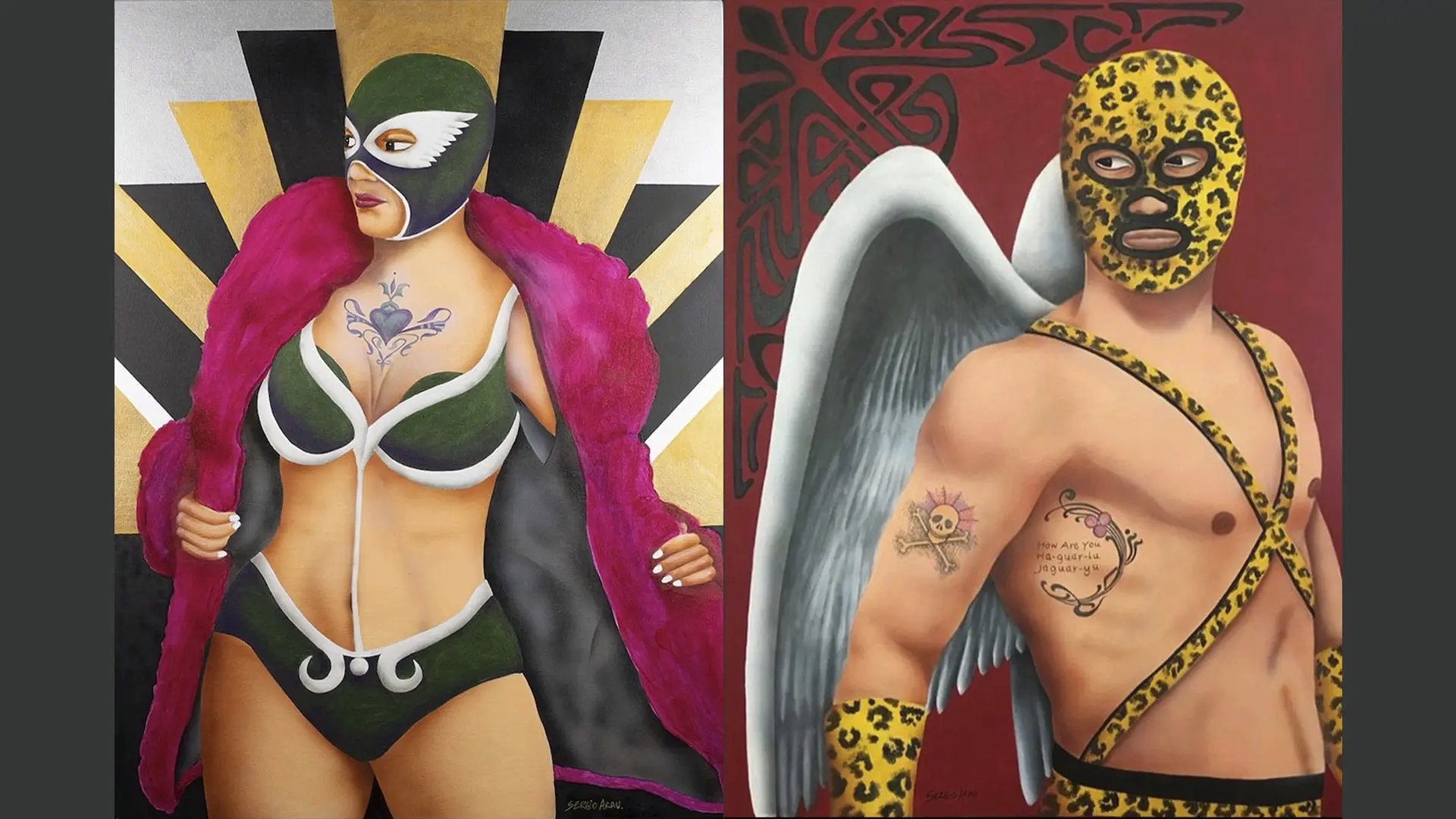
But long before luchador masks began appearing in film scripts, galleries, museums, and advertising campaigns, Sergio Arau had already turned them into art. When he started out, they called him a “naco.” Decades later, wrestling—a recurring theme in his work—has become one of Mexico’s most recognizable cultural exports, and his pieces have been featured in international exhibitions.
We had a casual chat with the Mexican musician, filmmaker, painter, and writer—founder of Botellita de Jerez and director of the prophetic *Un día sin mexicanos* (2004)—about his work, his fascination with lucha libre, and his advocacy for Mexican popular culture. The artist, who once dared to dress up as Frida Kahlo to promote his film Mi Frida sufrida.
What aspects of Mexican popular culture interest you as an artist?
I’m a huge fan of Mexican popular culture, of the streets, of street altars. From back when long-haul trucks were decorated with a doll’s head on the gearshift, the old-fashioned Nivea jars—the purple ones with a little light inside that looked like neon.

How did the concept of Art Naco come about?
Alongside Botellita Jerez, the Mexican rock band I formed in the 1980s, I came up with the idea that my visual style for my painting should be “Art Naco”—which is neither Art Nouveau nor Art Deco, but rather Naco.
What was the general perception of wrestling when you first began incorporating it into your work?
The truth is, there’s a huge difference between how wrestling was perceived back then, in the 1980s, and how it’s perceived today. In the beginning, when I was creating my works with wrestlers, there was a lot of resistance.
What did they tell you at the galleries?
He was a total redneck. Wrestling was really looked down upon. It’s like if a painter today only painted drug lords. It was that bad—that’s how it looked. The first one I did was El Santo, but sanctified, with little angels around him. It looks like the Virgin of Guadalupe, to be honest.

What have you learned about wrestling through your artistic work?
That the fight in the ring is like the battle between good and evil, right? The rudos against the técnicos. Kind of like what the Pastorela is today—the devil and God fighting over something. The mask gives you a special power. Because it’s you, and at the same time, it’s not you. There are many myths. Among the Greeks, for example, Zeus had a lover, but he demanded that he wear a mask, because otherwise, he wouldn’t be able to bear seeing his god, Zeus.
But Blue Demon is also a babyface—that is, one of the heroes.
Yeah, but El Santo was a rough-and-tumble wrestler. And then he became a technical wrestler. The thing is, I wasn’t really following the wrestling matches themselves, but rather the iconography of the matches. In fact, the only wrestler I’ve painted—and the painting is called Santo Santificado—is El Santo, around the time he died, in the ’80s.
Sometimes influence reaches places you wouldn’t expect, doesn’t it?
Yeah. Right now, for example, I live in Los Angeles. I’ve been here for many years, and at first, everything was about guys with mustaches—because that was the Mexican look—or a sarape, a charro hat, you know? And now, I swear, everything Mexican is associated with luchador masks.What happened is that after Nacho Libre, Mexican wrestling, the masks, and all that became super popular. Because American wrestlers are really big. They just push each other around. They don’t have the acrobatic skills that Mexicans have, who are smaller and lighter.”
Wrestling fans come from all walks of life, don’t they? Even murderers, like La Mataviejitas, who was a wrestler.
Exactly, yes. But many of them also work as bodyguards for politicians or businesspeople in their day-to-day lives. I know a lot of them. Not personally, though. I have several friends. Cero Miedo and Rey Fénix live in Los Angeles, too. Yesterday I was in a bookstore and suddenly I saw a book on wrestling by a social researcher from Duke University. The cover features a painting of El Santo, actually; wrestling has become an international thing, and for me wrestling used to be a street thing, a working-class thing, a gang thing. And suddenly now it’s “nice.” Now you go here to the Arena México and the tickets are super expensive and it’s full of gringos and Europeans. It’s become a luxury thing.
How was your work received when you first started?
Before I got into “naco” art—with my cartoons and illustrations—I did a lot of engraving, lithography, and screen printing. When I started doing this more “naco” stuff on purpose, using really bright colors, even glitter and materials like that, the galleries kicked me out. Once a friend set me up with an appointment at a gallery so they could see my work. When I got there, they were taking it down, so I put it outside, at the entrance. The owner came out and said, “Get this crap out of here.” We almost came to blows.

Your work features nudity, eroticism, and lots of tattoos.
Yes. In fact, it was because of the tattoos in several of my paintings that Jodorowsky—with whom I had worked before—invited me to work on the film *Santa Sangre*. I didn’t actually do any tattooing, but I drew Thelma Tixou every day. She was massive. She was taller than me. Impressive. Very professional, too. Very pretty. Great friends. But I had to draw her every day.
I can’t remember if there are any wrestling scenes in *Santa Sangre*.
No, not wrestling. More like boxing, I think. They’re in a circus, actually. I gave tattoos to almost all the main characters. Plus, in the end I ended up tattooing a mare. Thelma Tixou is supposed to have been reincarnated as a mare, so I drew tattoos on the mare.

Do you have any upcoming exhibitions?
Here, at Tonalá 145 in Mexico City, there’s a group show featuring many painters. I have a piece there. One interesting thing is that they just held an exhibition of Leonora Carrington’s work in Paris, at the André Breton Museum. Since Leonora Carrington was English but lived in Mexico, they selected three of my pieces for the exhibition. They’ve considered me a Mexican surrealist. In fact, *El Jaguar* is there. It’s one of the pieces. I’ll also be in an exhibition in Spain this year.
Has Mexican popular culture been co-opted by those who once looked down on it? What new icons do you think will emerge?
Absolutely. Before, our issue was “cool naco,” because naco wasn’t cool, but now it really is cool. Now there are lots of artists painting wrestlers. But I feel there’s a big difference, because they paint wrestlers exactly as they are in real life. I take characters from the Sistine Chapel, from Caravaggio, from Da Vinci, from Raphael, and turn them into angels or devils, tattooed and obviously masked. My idea is that they’re part of this universal struggle for the balance between good and evil.
Discover more Latin American pop culture in AW Magazine.
To keep exploring this thread, visit our contemporary art coverage; you can also continue through profiles of Latin American artists.