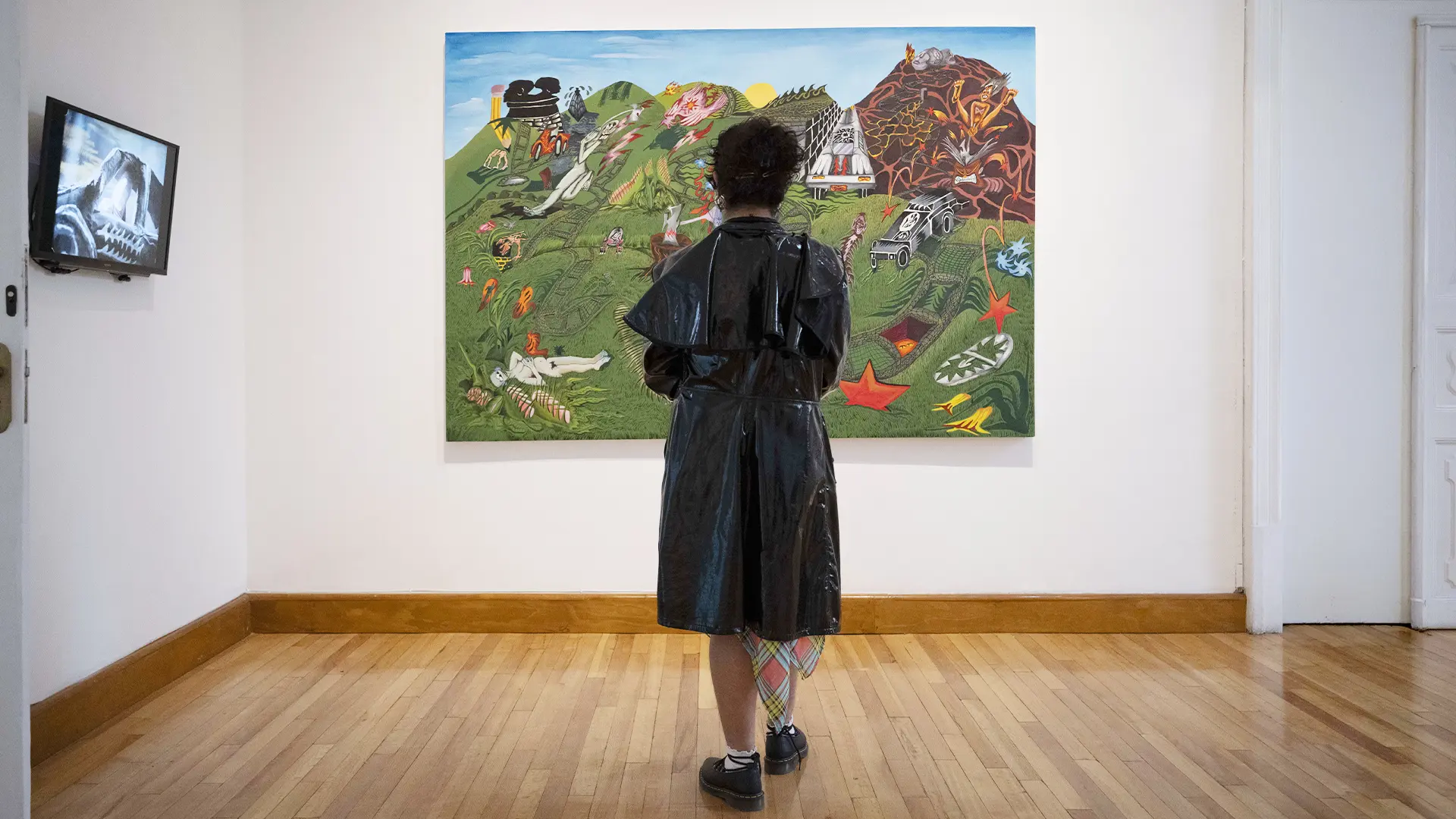

Laura Cortés Hesselbach has spent more than a decade working in cultural management, including public programs, artist residencies, and partnerships to strengthen arts education.
She is the current director of SOMA, an organization dedicated to cultural exchange and arts education in Mexico City and a breeding ground for emerging artists who are making a name for themselves today. We spoke with her about *Pisarnos los talones*. This exhibition brings together the work of the 12 artists who are completing their two-year program.

The entire exhibition is on display at the UAM’s Casa del Tiempo Cultural Center through December 11. The exhibition features works by Carolina Berrocal, Miguel Bravo, María José Casazza, Guadalupe Dorantes, Roberto Elías, Fidel Ernesto, Elianne Islas, Salomé Jüey, Julia Levstein, Raisa Pimentel, Jos SML, and Salvador Xharicata.
Why Are We Hot on Each Other’s Heels?
Where did that eloquent title come from, Hot on Our Heels?
The title refers to that somewhat clumsy dance that it sometimes turns out to be. But it also refers to the fact that they were interested in staying very close together, right on each other’s heels, seeing what the other might come up with. It came out of conversations among the artists participating in the exhibition.
How is it decided what this exhibition will look like?
At SOMA, one of the main challenges we set for the artists as part of the conclusion of the two-year program is to work together to make all the decisions. When they began reflecting on what it meant to share a physical space—with 12 pieces in shared galleries—this image emerged of the 12 artists dancing together in a ballroom.
How do you find common ground among artists with such different practices?
Our end-of-year exhibitions at educational institutions are always complex; our cohorts are made up of artists who come from very different backgrounds, with practices and bodies of work that, at first glance, seem unrelated. But over the course of the two-year program, they participate in shared discussions where they begin to see where their paths cross, where their ideas and interests align, and where they differ.
Collectivism versus individualism?
In the newsletter, they discuss how the current situation is driving people toward isolation and how to keep alive the possibility of working together. In the art world, collectives are often used to build community, but couldn’t pushing for that kind of coordination cause the artist to lose some of the individuality that isolation sometimes brings?
Yes, I agree. But that’s why, from SOMA , we try to provide different opportunities for them to explore different ways of working. As you say, there’s been a tendency to think about collectivity or collective work, and people often pay lip service to it, but it rarely ends up being a truly collective effort.
It’s important to distinguish between teamwork, collaboration, and individual work in which several people are involved. These are different concepts.

So individuality isn’t compromised?
No, with this final project we’re actually trying to help them recognize their individuality. That’s also what the program is about: for each artist to strengthen their own voice, their methodologies, and their personal processes, while recognizing that they’re embedded in a context and are part of a broader community with which they’ll sometimes collaborate and sometimes not. It’s a group exhibition, but everyone has individual pieces.
Another practical dictionary, rather than a catalog
In addition to the exhibition, I understand that they’re publishing a kind of blog…
Yes, another aspect—which I find to be one of the most revealing of these processes—is the publication they produced, *Another Dictionary of Practices*. We always ask them to produce a publication on the premise that it shouldn’t be a catalog of the exhibition or of the artwork, but rather that they should think of the editorial format as another space into which they can translate their artistic practice.
They have considerable freedom to develop it and receive editorial guidance from a specialist—this year, Vania Macías. As a group, they decided that, instead of creating a publication in which each person would have a chapter, they would produce a dictionary. This little book brings together concepts that, through the courses and workshops they took at SOMA, they identified as relevant to defining their own artistic practice or that of others. The definitions were written by the artists themselves.
Very different points of view
From what I can see in the works, there are indeed very different perspectives. The motorcycle piece, for example, doesn’t resemble the devices that look like microphones but are actually lamps.
We aim to approach this by carefully selecting the students’ mentors and the faculty who support them—a group that also consists of artists with established careers and very diverse artistic practices. For example, we have Tania Candiani, who has a well-established studio practice, and on the other hand, someone like Vivian Abenshushan, who comes from a background in writing and literature and, more recently, from bodywork and dance.
“It is extremely important to recognize that there is no single way to be an artist. There are many ways to pursue an artistic practice; there is no one ‘right’ path.”

Are the internships usually multidisciplinary?
That’s right; it’s about understanding that there are different ways an artist can develop. That also influences the selection of who is admitted to the program. We’re interested in students who aren’t limited to a single medium, but who understand that they can draw on different media to develop their ideas; who have the tools to figure out how to address what they want to question or express.
The Next Step
What is the age range of the artists?
The average is roughly between 25 and 33 years old. But these are artists who already have training. The program is at the graduate level, but one of the reasons SOMA exists as an alternative to these programs is that we recognize there are many artists who already have an artistic practice but weren’t necessarily able to pursue formal studies. There are incredible artists who come from other regions of Mexico—some who started studying something else but didn’t finish, or who weren’t able to earn a bachelor’s degree. This allows us to accept and bring together people who already have an artistic practice, who identify as artists, but who want to take that next step to deepen their thinking and their work.

Precisely because of that aspect related to academia and the Ministry of Public Education, does the logo allude to the SEP’s old logo?
Exactly, it’s a nod to that. I’m glad you brought it up. SOMA was founded on the initiative of a group of artists. It opened its doors in 2009, but discussions about what it would become began long before that. At the time, there were 16 artists who started brainstorming ideas about what could be done.

The lines of work had already been defined, and the hardest part was coming up with a name. Someone suggested SOMA—I don’t remember who—and it resonated strongly because it can mean so many things. For us, it doesn’t mean anything specific, but what ties everything together is the logo, which is part of a project by the artist Mario García Torres. Once the name was decided, Mario mentioned that he had a project from the ’90s: he’d realized that the typeface used in the old SEP logo wasn’t registered, so he registered it under his own name. He owns the rights to that design and granted us the use of those letters for the SOMA logo.
Art and Indigenous Communities
Regarding Salvador Xharicata’s installation, the press release mentions the tianguis. Did the exhibition take place outside the gallery space, or did it incorporate elements from that environment?
The piece relates to the tianguis because Salvador is from Cherán, Michoacán, and his family works there: his parents and brother are tianguis vendors.
Much of his work relates to his identity as part of a community in Michoacán where the indigenous language has also been lost. Salvador does not speak his family’s indigenous language; he never learned it. In his work, he reflects on how he has acquired knowledge within the environment in which he grew up—which, in his case, is the tianguis.
Indigenous communities are often associated with their relationship with nature and the forest. His grandfather, for example, had a much more direct relationship with the forest and worked with it, but that has been gradually lost. Salvador has spent most of his life in the tianguis. In fact, he wrote a piece called *My Forest Is a Tianguis*, because he grew up in those spaces.
Violence and Catharsis
Some works combine playfulness with violence. Was the task they were given more cathartic or aesthetic? Was there an intention for them to bring out that aspect, beyond simply ensuring the works were aesthetically flawless?
We don’t approach this as a way to do something cathartic. What we do try to foster during their time on the program and at SOMA is a sense of social and political awareness; we want them to be more reflective about the spaces and contexts in which they find themselves.
Almost organically—due to the nature of many of them, their places of origin, and the state of the world today—they find in art the best tool for addressing the issues that affect us all. For some, these issues affect them more directly.
For example, Roberto Elías is from Acapulco, Guerrero, and he grew up amid that wave of violence. The photos that emerge from these panels—which appear and disappear as the day goes on—are images of fires at businesses in Acapulco that failed to pay protection money.

In addition to being a school, does SOMA also function as a gallery? Will the artworks be sold?
No. It’s important to note that we are a school and, first and foremost, a nonprofit organization. We do everything we can to raise funds so that the program is free and so that the artists have the resources to produce their work. They had a budget, but at the end of the day, the artworks belong to them.
Cover photo: Israel Esparza
Discover more news about art and emerging artists in AW Magazine