
From Diego Rivera to Miguel Covarrubias, from Rufino Tamayo to Nahui Olin, the private collection of the Mexican Micha Levy family is on display for the first time in Spain as an intimate narrative that is not merely exhibited, but experienced.

Welcome home
“Avant-Garde Rebellions of the 20th Century ” is not just an exhibition. Or not exactly. In fact, it’s something that doesn’t quite fit the definition. Perhaps because what unfolds here doesn’t entirely follow conventional curatorial logic or a linear narrative. It’s something else. A relocated house. A memory organized into successive rooms where one surprise gives way to another, even more interesting one. Or a story in chapters. Or a serial in which the good guys, the heroes and heroines, triumph despite everything. And leave a legacy. And it is also a way of peering into a house that suddenly ceases to be a morbid curiosity of the individual to become public property.
The first room is deceptive. White. Clean. Airy. Perhaps too perfect. The works are spaced at a distance that would seem natural in any museum. Here, it isn’t. Here it is almost a fiction. “At home, it doesn’t look like this, ” explains Moisés Micha, the son of businessman and patron Marcos Micha Levy and his wife Vicky Smeke, the original owners and curators of the collection, who accompanies us as we move through the exhibition rooms of the unique mansion built in the 1920s by Luis Bellido in the Arapiles neighborhood, which houses the Casa de México Foundation in Madrid. “At home, they coexist. Here… here you can understand them.” And what becomes immediately clear is that this exhibition is not just about art. It is about distance. About what happens when the intimate is separated from itself.
The moment when things get serious
There’s a scene that Moisés recounts matter-of-factly, but which encapsulates the entire story. New York. The late 1970s. Two frescoes by Diego Rivera purchased over the phone.“They weighed… one about eight hundred kilos and the other almost a ton,” he recalls. “And we went to see them. I was eleven years old. And that’s when I realized this was serious.”
That really isn’t about affordability. It has nothing to do with price. It has to do with the weight—both literal and symbolic—of what enters a home when art enters it. Rivera doesn’t appear here as just another name. He appears as the origin. As the starting point of an obsession. It’s not the monumental Rivera of the murals. Or not just that.
Here, too, is the studio painter—the one who introduces a mirror into the portrait, who crafts the composition with almost silent precision, who leaves the gulls as an intimate signature. The one who earns a living through commissions like portraits, perhaps not his finest work, of Nastia Berger from 1943, or his curiosity about other figures far removed from his political or social discourse, such as the unusual *The Hatter*, a 1944 portrait of the fashion designer Henri de Chatillon, a controversial figure known for his views on fashion in Mexico. “Rivera was his great passion, ” Moisés tells me. “For years, everything revolved around him.”

Building a house for something that doesn’t exist yet
What makes it extraordinary isn’t just what you buy. It’s what you build around it. After the initial construction work, the family made a bold decision: to build a new house. I don’t know if it was bigger. Certainly taller. “The architecture was defined by double-height spaces, large walls, and areas for projects that weren’t there yet, ” he recalls. There’s something deeply intuitive about that gesture. Building the container before filling it with content. Preparing the space as one prepares for life.
In that house, which still stands today, the collection isn’t organized. It piles up. It overlaps. It blends together. “There’s a constant visual clutter,” Moisés tells me, smiling. “But there’s also a sense of coexistence.” Here, however, on the walls of Fundación Casa México in Spain, there is a narrative. A fundamental one, provided by Taiyana Pimentel Paradoa, the director and chief curator of the MARCO museum in Monterrey, who knows the collection well.
“This exhibition highlights the essential role of private collecting in Mexico in light of the decline in public art acquisitions,” explains Tiyiana Pimentel Paradoa, curator of the exhibition.
For the curator, private collecting in Mexico offers a new perspective on the Latin American avant-garde, the career of Marcos Micha, and an inseparable family history that, beginning in the mid-20th century in Mexico City, invites reflection on art and its connection to politics, culture, and society. From the private and privileged to the didactic and the committed. Or so we choose to interpret it.
Art: More Than Just an Investment
At one point, almost in passing, an idea emerges that seems radical today. “My father never bought anything with the intention of investing.” Silence. “He bought whatever he liked. Period.” In a global market where art is measured in terms of returns and trends, that phrase acts as a crack. Because it explains everything else. It explains why the collection doesn’t follow trends. Why there’s no anxiety about completing narratives. Why it can afford to embrace contradictions. And, above all, it explains why there is truth in the journey. A wall that brings together many things. Heads. Studies. Sketches. Fragments. Rivera, Siqueiros, Orozco. They are not in competition. They are in conversation.

“This is a sketch for the amphitheater at the National Preparatory School,” Moisés notes. He mentions it in passing, but this marks one of the defining moments of Rivera’s Mexican muralism—both in terms of timing, as he began it in 1922, and in terms of his political ideology: education as the driving force of social change. “That other one is a portrait of a teenage girl, from a few years later.” The references are precise, but something interesting happens on another level. The heads are looking. Not all in the same direction. Not all with the same intention.
Muralism: A Laboratory of Forms
And suddenly you understand something that textbooks don’t explain: that muralism wasn’t just a political project. It was also a laboratory of forms. A way of thinking about how to represent the collective without losing sight of the human. And an aesthetic treatise in which the lived experiences of its creators—the avant-garde movements of the time, not just in Paris but also in New York or Berkeley in the case of the artist from Guanajuato—coexist with the influence of cultural mixing and sensibilities toward indigenous traditions… The natural, or what has almost become a public treatise: national identity. Construction.
“The reclaiming of the Mexican people’s past (their history) and the incorporation of elements of popular tradition (customs) would be the hallmark of Mexican nationalism, since, through the recognition of diverse cultural groups and their unification into a new, the Mexican one, would support the need to foster a national identity,” explains Rodolfo Ramírez Rodríguez in his article Diego Rivera and Images of the Popular in Cultural Nationalism. (2013, Tramas, Universidad Autónoma Metropolitana).
And opposite Rivera, Siqueiros. A much more radical style, avant-garde in both form and technique, and the great disruptor of volume in muralism. A piece, Untitled 1973, in which the painter from Cuernavaca displays his already highly mature power—a late work that is a cry in the face of Rivera’s serene silence.
The twist: leaving Mexico without leaving the collection
There comes a point when the collection shifts. Not all at once. But it does shift. “After Rivera, my father began to look toward Latin America, ” explains Moisés. Artists like the Chilean Roberto Matta, Wifredo Lam, and kinetic artists such as Jesús Rafael Soto and Carlos Cruz-Diez appear. They aren’t here (not in this exhibition), but their influence is evident. Because they show that this collection was never closed off. It was never nationalist in the strict sense. It was always an expansion of perspective. And yet, Madrid made a clear decision: to focus on Mexico. “These are 20th-century Mexican artists coming to Europe together for the first time, ” he explains.
A few steps further on , we find José Clemente Orozco, Germán Cueto, and the ever-enigmatic (given how little attention has been paid to her work outside Mexico) Nahui Olin. Far from a closed school, it is a multitude of references. From Orozco, three pieces from his formative period, which coincides with the Revolution, in which the painter portrays the most painful side of the conflicts, the nocturnal scenes… Less as criticism, nothing like costumbrismo. Just sketches and brushstrokes featuring women, prostitutes, misery… on the eve of his first exhibition, *La casa de las lágrimas*. As for Olin, the Michas could perhaps have chosen any work that reflected her rebelliousness, her free spirit, or her dissidence.
One that, as essayist José Luis García Álvarez explains, reminds us how she—also a poet, writer, and pioneer of feminism in Mexico—had to devise strategies so that her work would be seen as a battlefront against the prevailing machismo in Mexican muralism, and which we now study as a reinterpretation of the female experience in the visual arts.

The works on display in the gallery, however, depict more gentle scenes—perhaps some of the calmer moments in the capital city painter’s turbulent life. Pieces that would brighten up any room. “She was an absolutely unique figure,” says Moisés. “A woman ahead of her time.” Nahui Olin doesn’t fit in. And that is precisely why she matters. Her work does not seek to please. It does not seek to explain. It simply exists. And there is something radical in that gesture.
Covarrubias: Humor as Intelligence
A little further on, the room takes on a different tone. And there appears Miguel Covarrubias. Cartoons. Illustrations. Impossible characters. “He worked at *Vanity Fair* in the 1920s,” says Moisés. “And he created these series… characters who could never have met.” The famous Impossible Interviews. All with a deceptive lightness. Because beneath the humor lies structure. There is a message, a discourse, and irony. It reveals a visual intelligence that still resonates today. Covarrubias was an illustrator, anthropologist, traveler, and observer. His time in New York connected him to the Harlem Renaissance. His time in Bali gave rise to one of the most influential cultural studies of the 20th century. “He was a Renaissance man,” insists Moisés.
And the reason is clear, despite the cliché. Covarrubias stands apart within the context of this collection. As Rita Eder of the UNAM Institute of Aesthetic Research explains, he is an artist-anthropologist, or an anthropologist-artist. But above all, he is a creator who wanders unashamedly through the glossy pages of magazines without neglecting a genuine interest in understanding a world that is more than just Mexico. More than New York. Although New York spreads across the walls and tables, where we can see some original copies of Vanity Fair, “bought on eBay,” Micha tells me.

On the walls hang his political portraits of Stalin, Hitler, and Ion Antonescu. Further down the room are his maps of the arts, the economy, and transportation in the Pacific. The ocean is the center of the world. For Covarrubias, the center is wherever his gaze falls. It does not conform to a geography of metropolises and colonies.
“The Great Tamayo”
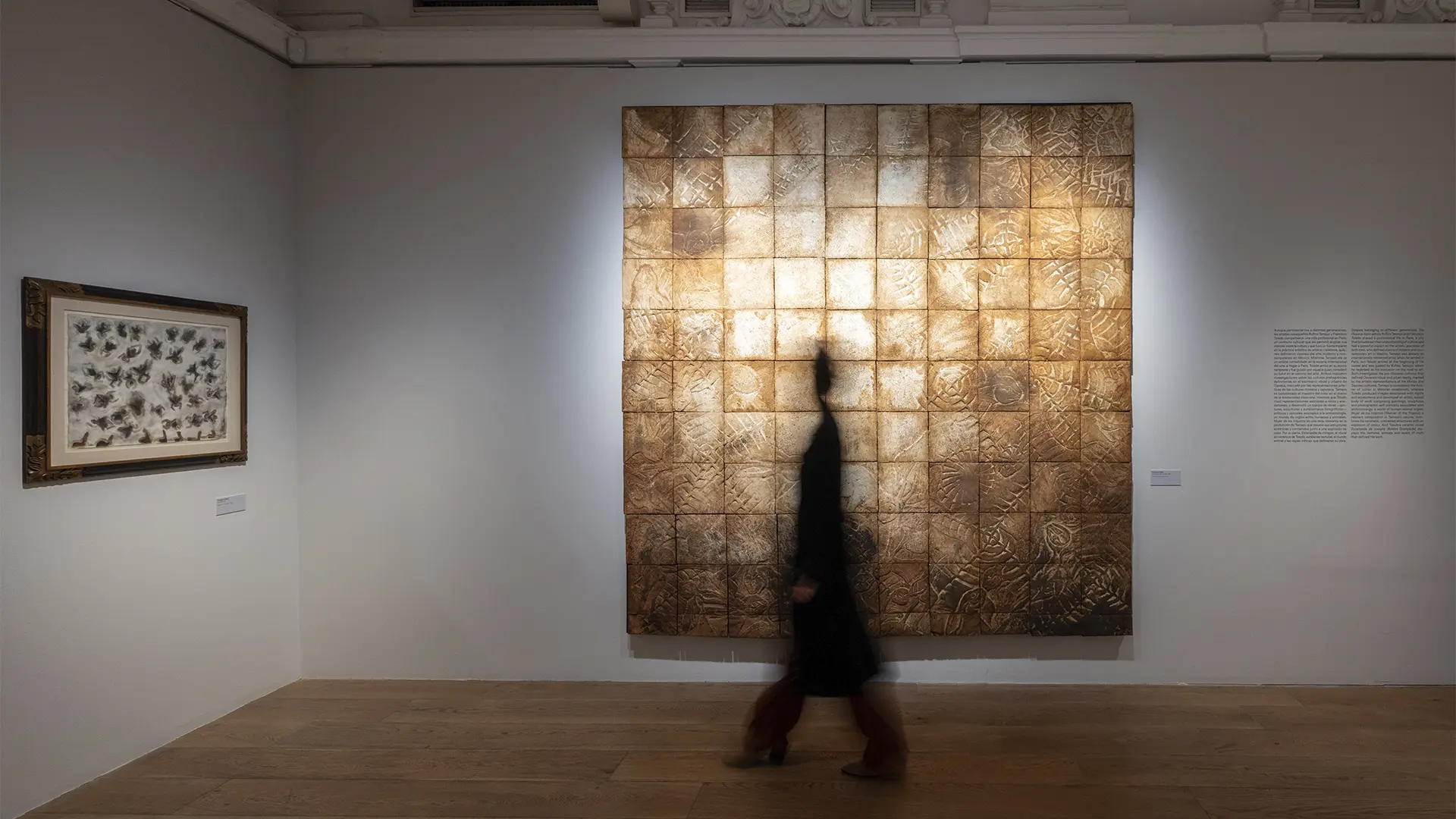
A few meters further on, the exhibition takes on a different atmosphere. Two Oaxacan artists from different generations who live together in Paris. Rufino Tamayo (the nickname “the Great Tamayo” is a delightful quip from his brother, hotel entrepreneur Rafa Micha, the day before the official opening, which makes the piece feel even more like a family affair). Tamayo, as the curator reminds us, is the master of color. Francisco Toledo introduces a different relationship with art. More physical. More material. More connected to the earth. “He was a key figure, ” explains Moisés. “He defended Oaxaca, its culture, its identity.” Toledo didn’t just produce art. He produced context. He championed artists. He confronted political decisions. He turned art into a form of action.

Foreclosure
At some point, the conversation turns political without meaning to. “In Mexico, there isn’t the same level of public investment in acquiring historical works, ” Moisés explains. “Private collections have been essential.” He doesn’t say it as a complaint. He says it as a fact. And then it all makes sense. Because this exhibition is also that: a way of making visible what normally remains in the private sphere. “My father always lent out his pieces,” he recalls. “He always wanted to share.”
Toward the end, we return to the beginning. To the distance. “It’s very rewarding for me to see the collection here,” says Moisés. “Because at home, you can’t see it like this.” There’s something almost paradoxical about that idea. Having to leave home to understand it. The works, lined up, illuminated, separated, seem different. Or perhaps they are the same, but finally visible. Before we say goodbye, one last question. How to start a collection. Moisés doesn’t hesitate. “It has to provoke something in you. And you have to want to live with it every day.” Nothing more. The Micha Levy Collection doesn’t explain 20th-century Mexican art. It cuts through it. It fragments it. It reorganizes it. It returns it to a place where art isn’t history or just an investment. And upon leaving, one has the rare sensation of having been inside something. Not an exhibition. A home.
Avant-garde Rebellions of the 20th Century. Works from the Vicky and Marcos Micha Levy Collection.
Through May 31, 2026. Casa de México Foundation in Spain. 20 Alberto Aguilera St., Chamberí, 28015 Madrid. Free admission.
To keep exploring this thread, visit Latin American culture.