Constellations and Drifts is an evocative name. And whoever came up with the idea to name this exhibition at MARCO, the Monterrey Museum of Contemporary Art, did a great job (what are they waiting for to give them their Christmas bonus?). Without a doubt, the title aligns with what visitors encounter in the exhibition.

And the fact is that Constellations and Drifts: Latin American Art from the FEMSA Collection—the exhibition’s full title—offers a retrospective journey through one of the most important collections of 20th- and 21st-century Latin American art. Nostalgia sells, yes, but here it doesn’t feel forced; rather, it serves as a starting point. And if it’s presented to us in this package, we’ll buy it without a second thought.
The History of the FEMSA Collection
The FEMSA Collection began in 1977 as a clear commitment to promoting art in Mexico. The series took its first steps with a powerful piece—El maizal (Milpa seca) by Gerardo Murillo, Dr. Atl—a work that not only inaugurated the collection but also set a trend that, to this day, maintains a focus on Mexican art and its roots. There is even something symbolic—yes, sometimes clichés are inevitable—about that beginning: a dry landscape steeped in local identity.
Over the years, the collection has been shaped by the timeless key figures of Muralism: Rivera, Orozco, and Siqueiros, alongside the then-groundbreaking works of Remedios Varo and Leonora Carrington. Fortunately, however, the museum’s vision has not been confined to history or predictability. Today, it also incorporates contemporary voices such as Francisco Toledo, Gabriel Orozco, Graciela Iturbide, and Carlos Amorales. In other words, this is not a collection frozen in time, but rather an exhibition in constant transformation.
Furthermore, behind this project lies the FEMSA Biennial, which, more than just an event, functions as a kind of laboratory where contemporary art finds spaces to question itself, expand, and, at times, provoke. Of course, there is no shortage of criticism pointing to the use of the collection—and of initiatives like the biennial—as tools to polish the company’s public image. But even amid that tension, the result remains significant for Mexican art. Perhaps it is worth, at least for a moment, separating corporatism from the aesthetic experience.
The works in “Constellations and Drifts”
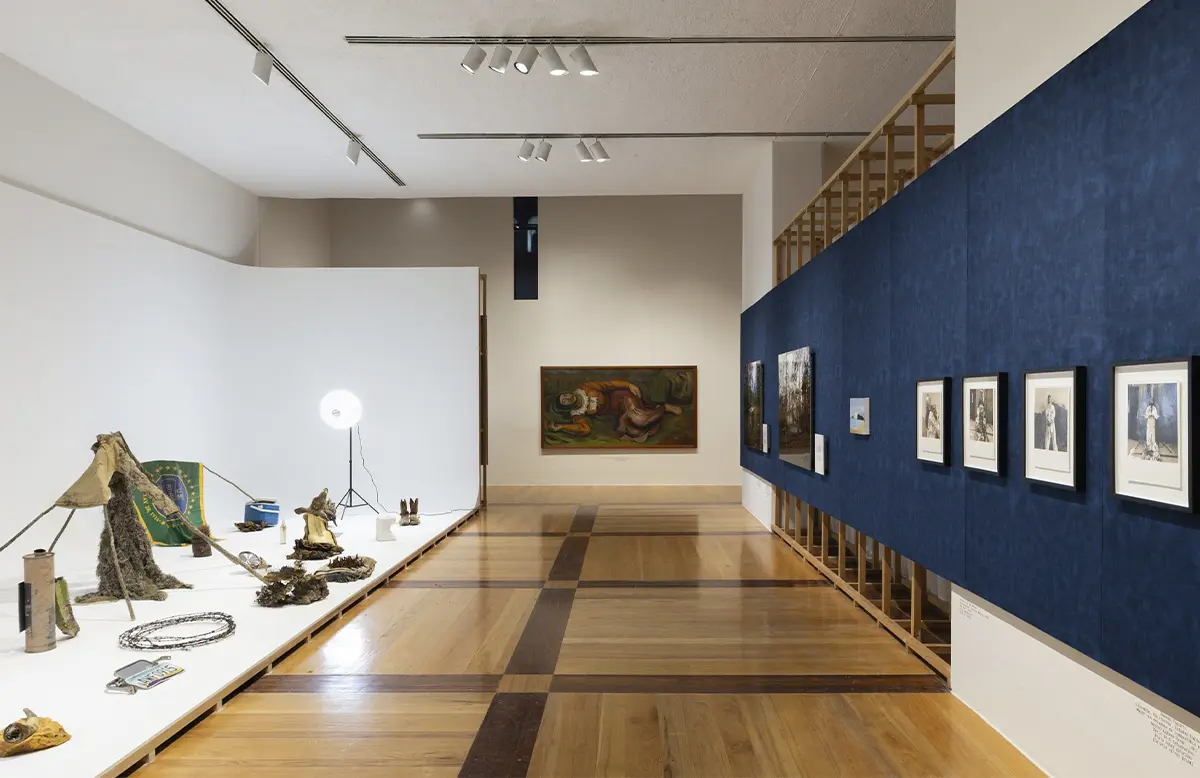
Featuring 174 works by more than 100 Latin American artists, Constellations and Drifts presents the most comprehensive review of the collection ever undertaken in Mexico. However, what is most interesting is not the quantity, but the way the exhibition was planned. Instead of being organized chronologically, the exhibition is structured around “constellations”: a curatorial framework that “connects works from different eras and contexts based on formal, conceptual, or even emotional affinities,” according to the museum’s communications department.

This approach not only breaks with the notion of linearity in art; it also invites the viewer to interact more intuitively, without being bound by time. Some may prefer a more traditional way of experiencing an exhibition, but this format is undoubtedly more in line with the experience—even though we’re not astronauts—of viewing a constellation from a distance (while drifting in space).
In *Constellations and Drifts*, there are moments when a work from the last century engages in a dialogue with a contemporary piece, creating an encounter that would be unlikely to arise in a more traditional setting. This aspect is perhaps one of the exhibition’s greatest strengths.
Curated by Eugenia Braniff, Paulina Bravo, and Beto Díaz Suárez—members of the FEMSA Collection—along with independent curator Adriana Melchor, the exhibition is organized around five themes: Territories, Colonial Structures, Debating Abstraction: Geometry and Form in Latin America, Alchemy, and Identities. Rather than rigid categories, these labels function as lines of inquiry. These taxonomies highlight the tensions, continuities, and issues that run through Latin American art, and bring Rufino Tamayo, María Izquierdo, and Diego Rivera—among others—into dialogue in the present.
Constellations and Drifts: The Themes of the Exhibition
In *Territories*, for example, the landscape ceases to be merely a representation and becomes a political and symbolic field. In Estructuras coloniales, the works challenge the legacies of power that still persist. Meanwhile, Alchemy and Identities explore more intimate processes, where the material and the symbolic merge.
Constellations and Drifts does not seek to tell a single story, but rather to open up multiple possible interpretations. To generate relationships that were not previously evident, dialogues between works that did not necessarily share space. Questions that remain relevant in the art world’s collective imagination. Because if the exhibition makes one thing clear, it is that Latin American art cannot be reduced to a linear narrative, but rather is constructed—as the title suggests—from connections in constant transformation.

As part of the celebration marking the 50th anniversary of this iconic collection, the exhibition is on view from March 20 through August 9, 2026, at MARCO ( Juan Zuazua and Padre Raymundo Jardón, Downtown, Monterrey, Nuevo León). It’s worth spending some time getting lost in those constellations.
Find out more about the exhibition schedule in AW Magazine.
To keep exploring this thread, visit contemporary art from Latin America.