
The merger of Galería Marta Cervera and Fahrenheit Madrid has given rise to Aresti Cervera, directed by Marta Cervera and Valeria Aresti. Located at Justiniano 8, the project brings together the histories and artists of both galleries. Painting, abstraction, and the visual image are part of a program that combines visual memory, surface, and historical narrative.
Gallery Profile
The longest-running history of Aresti Cervera begins with Marta Cervera. Her gallery opened in Madrid in 1996 on Plaza de las Salesas. In 2013, it moved to Valencia 28, next to Doctor Fourquet, where it remained until the start of its collaboration with Fahrenheit Madrid. During those years, Cervera built long-standing relationships with Spanish and international artists. Among them is her relationship with David Diao, born in Chengdu in 1943 and based in New York. In 2011, she organized two simultaneous exhibitions of his work in Madrid: Da Hen Li House, I lived there until I was 6... and Design Matters. The first featured the series Diao had begun in 2007 about his childhood home in China.
The second story begins with Valeria Aresti. Before opening her own gallery, she interned at Christie’s, Frieze, and The Armory Show in New York; she worked at the James Cohan Gallery in that city and later at Gagosian in London. In 2018, she decided to return to Spain and launch Fahrenheit Madrid, which opened in late 2019 in the Justicia neighborhood. Its program began with a strong focus on artists living and working outside of Spain, particularly in New York.
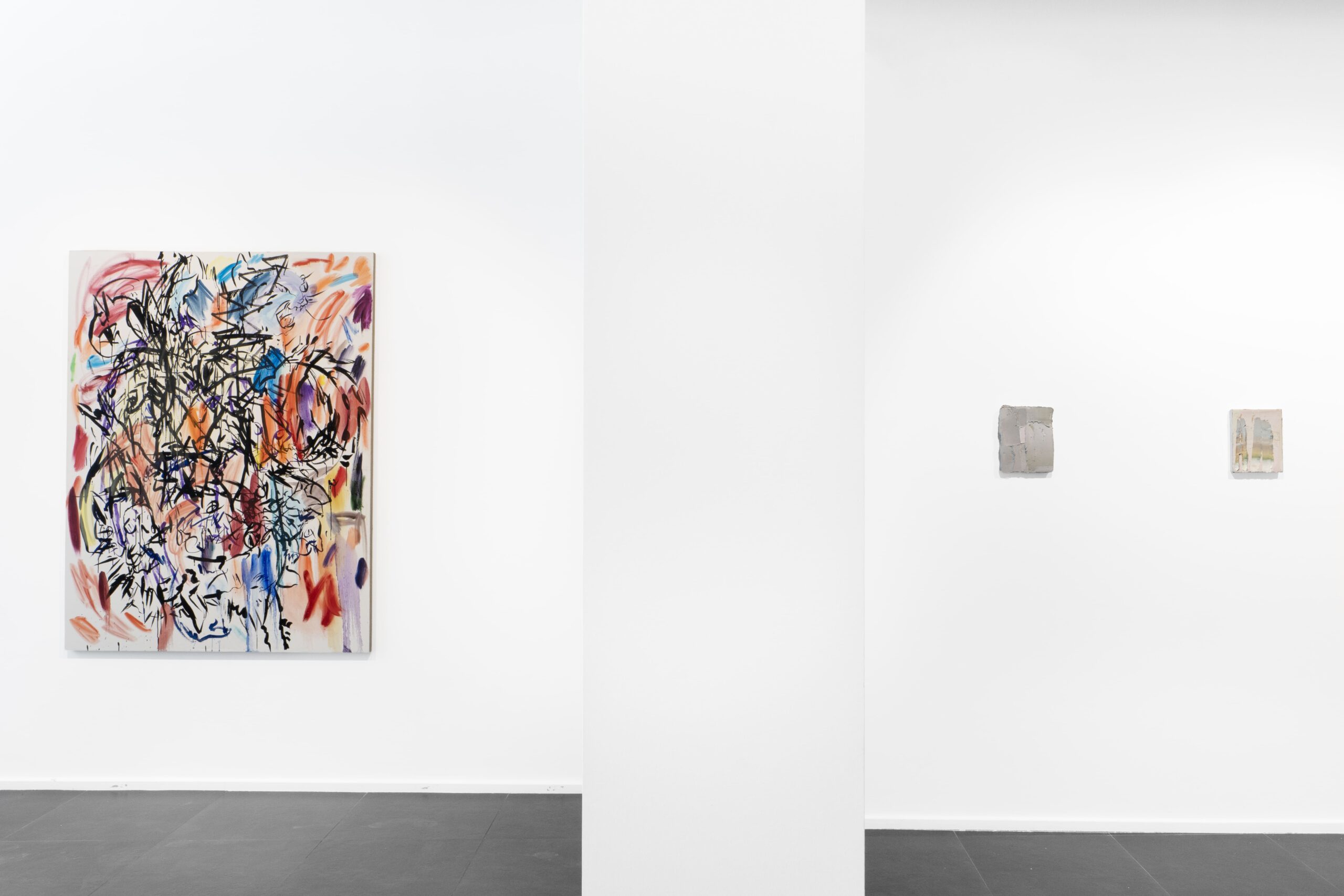
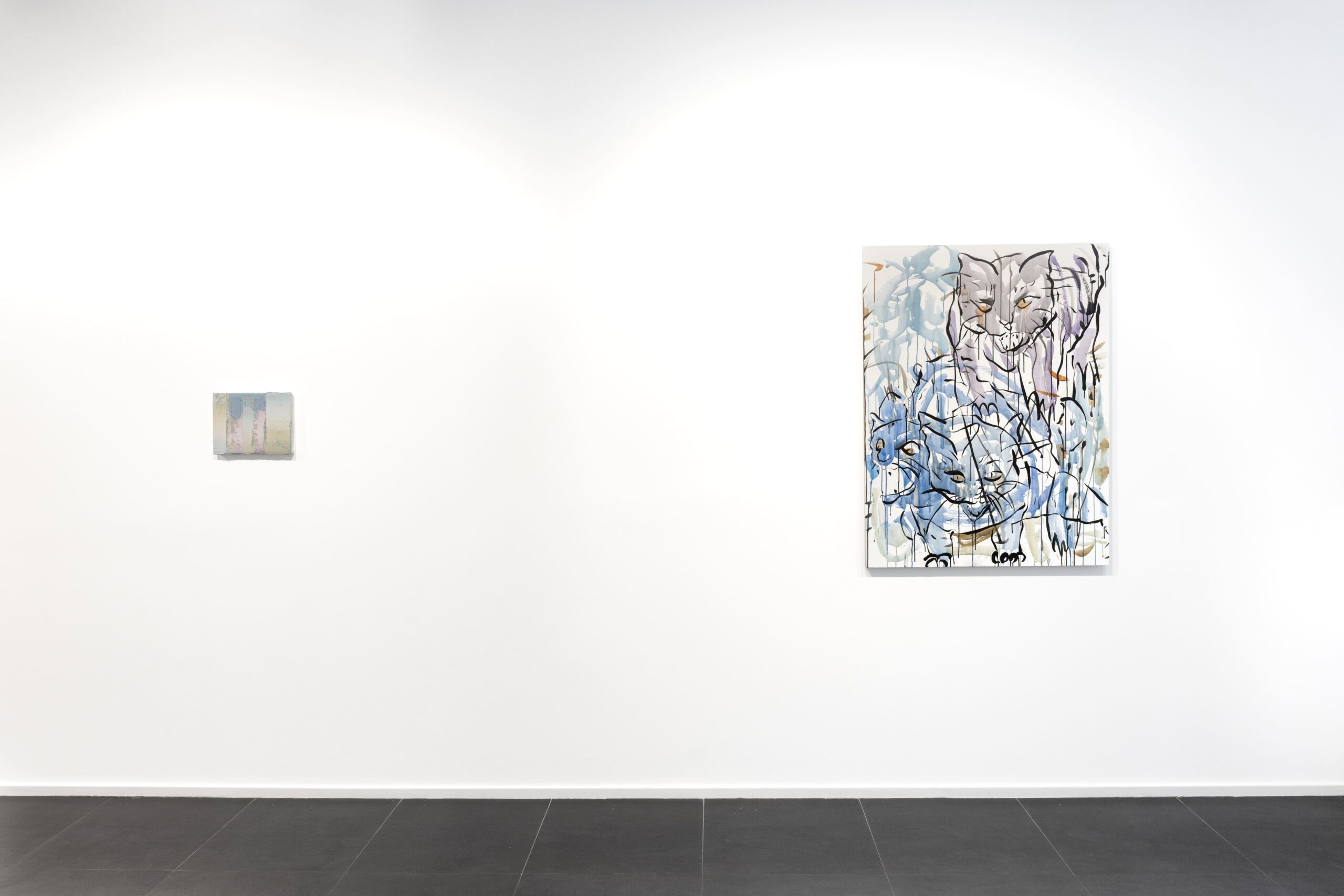
The two projects began to converge before the merger. In February 2026, Marta Cervera and Fahrenheit jointly presented an exhibition by Ruth Root. This was followed in May by an exhibition featuring Brett Goodroad and Juan Uslé. On June 25, they opened another joint exhibition at Justiniano 8, this time featuring Mercedes Mangrané and Laura Larraz.
On September 10, 2026, coinciding with Apertura Madrid Gallery Weekend, Marta Cervera and Valeria Aresti announced the merger. Since then, the two gallery owners’ names have combined to form Aresti Cervera. The project draws on the experience and collections of the two former galleries and is headquartered at Justiniano 8. The first exhibition under the new name also revives a relationship that predates Fahrenheit: David Diao is exhibiting with Marta Cervera once again, fifteen years after those two Madrid shows in 2011.
Program
Why Go
The months leading up to the merger offer a glimpse into how Marta Cervera and Fahrenheit went from being two independent galleries to working together. Ruth Root (Chicago, 1967), an American painter based in New York, was the focus of the first collaboration in 2026. The exhibition opened on February 24 and ran through the end of April. Root has been working for years with paintings composed of elements that combine rigid surfaces with printed fabrics, and her exhibition was presented jointly by both galleries.
In May, Brett Goodroad & Juan Uslé. Goodroad (Kearney, Nebraska, 1979) is an American painter living in San Francisco; Juan Uslé (Santander, 1954) divides his time between New York and Saro, Cantabria. The exhibition was on view from May through June at Justiniano 8 and reappeared, now identified as a collaboration between Marta Cervera and Fahrenheit.
The third collaboration took place immediately afterward. Mercedes Mangrané / Laura Larraz opened on June 25, also at Justiniano 8. Mangrané (Barcelona, 1988) had met Marta Cervera and Valeria Aresti through gallery owner Inés Lombardi during ARCO. The artist herself later explained that that encounter led to her exhibition in Madrid.
These collaborations took place while Marta Cervera was still curating her own program. In 2025, she presented *Habitando el color*, by Menchu Lamas, and the first solo exhibition in Madrid by the painter Paul Pagk, born in England in 1962 and a resident of New York since 1988. Pagk had participated the previous year in the group exhibition La poética del espacio and returned in September 2025 with paintings on canvas and works on paper.
Aresti Cervera is thus launching, following a period of joint operations that can be tracked exhibition by exhibition throughout 2026. The merger announced in September transforms that collaboration into a single gallery.
What to Expect
David Diao left China at the age of six, first moving to Hong Kong, while his mother and two of his siblings remained in the country. In 1955, he settled in New York with his father. He began exhibiting there in the late 1960s and participated in the Whitney Museum’s biennials in 1973 and 2014.
For part of his career, he worked in the realm of abstraction and later incorporated into his paintings elements drawn from art history, graphics, texts, and episodes from his own career. At the 2014 Whitney Biennial, for example, he presented a painting that reproduced a fictional invitation from the Museum of Modern Art to a nonexistent retrospective of his work, and another that documented the successive auction sales of one of his paintings.
Da Hen Li House is part of another archive—that of his own family. Da Hen Li was the house in Chengdu where Diao lived until he was six years old. It had been built in 1936 on land that had previously belonged to a Manchu prince. After the Communist Party came to power in 1949, the property was confiscated and used by the Sichuan Daily. Diao returned to China in 1979, after thirty years apart from part of his family, and discovered that the house had been demolished.
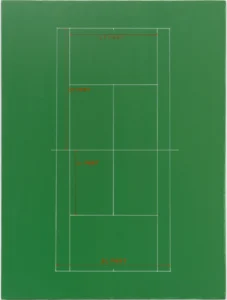
Decades later, he began to reconstruct it through paintings. To calculate the dimensions, he used an element he could measure even though the house no longer existed: the property’s tennis court, whose standard dimensions provided him with a reference for reconstructing the scale of the rest of the building. He also asked his uncles and other relatives about their memories of the rooms and consulted the documentation he was able to gather.
The first group of works was created between 2007 and 2008 for an exhibition at the Courtyard Gallery in Beijing. Postmasters Gallery subsequently presented it in New York, and Marta Cervera brought the project to Madrid in 2011. The Aresti Cervera exhibition marks the first European presentation of this body of work since then.
The paintings feature hand-drawn floor plans, property documents reproduced using silkscreen printing, Chinese characters, texts in English and Chinese, and references to specific rooms in the house. The tennis court reappears in several works as a scale for reconstructing the building. The series was not concluded in 2008: Diao later returned to Da Hen Li and created new paintings, including *All I Can Remember* in 2013.
Several works from the series are currently part of the collection at M+, Hong Kong's museum of visual culture. Confiscated (2007) depicts, against a blue background, a fragment of *Wild Swans*by Jung Chang, referring to the confiscation of large residences for official use. Demolish 1 (2007) features the Chinese character used to denote demolition. To Construct 2 (2008), on the other hand, uses the character for “to build.” Da Hen Li House opened on September 10, 2026, and is the first exhibition presented under the name Aresti Cervera.
Represented Artists
What to Do Nearby
Aresti Cervera is located on Justiniano 8, a single-block street between Santa Teresa and Orellana, in Salesas. Most of its buildings date from the 1880s. The street was laid out on land near the former Santa Teresa convent, which was confiscated in the 19th century.
For a meal, Barrutia y el 9 is practically right next door, at Santa Teresa 9. The restaurant occupies a small space with an open kitchen and offers a menu that changes depending on the ingredients available. At Orellana 6 is Casa Orellana Salesas, which focuses on Spanish dishes and serves lunch starting at noon. At Fernando VI 6, Casa Salesas occupies a space divided between a restaurant, bar, and terrace, with interior design by Lázaro Rosa-Violán and an open kitchen serving all day. From its terrace, you can see the nearby Palacio de Longoria. At Plaza de las Salesas 9 is El Dragón Lector, a bookstore specializing in children’s and young adult literature that carries a curated selection and organizes reading-related activities.
The most recognizable building in the area is the Palacio de Longoria, located at Fernando VI 4. José Grases Riera built it between 1902 and 1904 for the financier Javier González Longoria to serve as his residence and the headquarters of his bank. The two wings are connected by a circular structure that houses a grand staircase covered by an iron-and-glass dome. It currently serves as the headquarters of the SGAE.
Also located in the Plaza de las Salesas is the Church of Santa Bárbara, built as part of the Convent of the Salesas Reales, which was founded by Bárbara de Braganza in 1748. François Carlier designed the initial plans, and Francisco Moradillo developed and modified the project. The former convent became the Palace of Justice in 1870 and today forms part of the Supreme Court’s headquarters.


