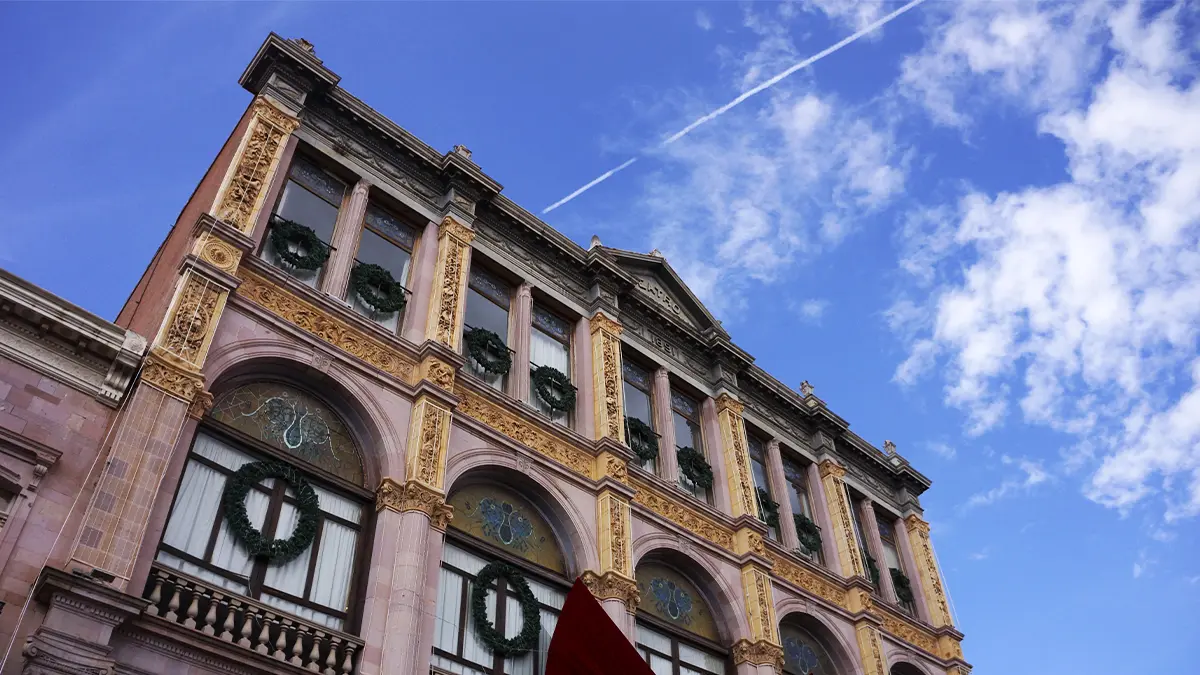

The venue is one of the architectural landmarks of Zacatecas’ Historic District. It dates back to the 19th century and is now one of the few century-old theaters in Mexico.
The history of the Calderón Theater makes it a must-see for anyone who enjoys cultural trips through the Mexican Bajío region. In addition to its aesthetic beauty, the theater embodies the history of a city that continues to preserve its heritage despite the imminent (and sometimes drastic) changes of the times.

Zacatecas: The Architecture of a Country That Fell Apart
The Historic District of Zacatecas looks much the same as it did in the pre-revolutionary era. The buildings retain the 19th-century charm of the era in which they were built. In 1993, the site was designated a UNESCO World Heritage Site.
The block where the Calderón Theater stands is the same one that is home to the State Government Palace, the Cathedral Basilica of Our Lady of the Assumption, and the González Ortega Market.
In this part of the city, the spirit of Mexico’s ancient cities comes alive: the state, religion, commerce, and culture all coexist here. Everything is bathed in pink: the stone that adorns the city center blends perfectly with the color of the sky at sunset.
The History of the Calderón Theater
The theater’s first version opened in 1833; it was built on a site that had previously been a prison. Its original name was “Coliseo,” and it served as a political and cultural forum for the city. In 1850, it was renamed after “Fernando Calderón,” a lawyer and playwright who had recently passed away.

In 1889, a fire destroyed the building and the surrounding structures. In 1891, Zacatecas Governor Jesús Aréchiga began construction on what we now know as the Calderón Theater. The venue opened in 1897.
Then came the Revolution and the Siege of Zacatecas. In 1914, the theater suffered the ravages of war: the building was damaged and left ownerless. It served as a venue for performances, political events, and movies. In 1962, the Autonomous University of Zacatecas took possession of it.
Who was Fernando Calderón?
He was one of the first Mexican Romantics and liberals. He was born in Guadalajara, but practiced law in Zacatecas from an early age.
In addition to the above, he wrote poetry and plays. He remained in contact with authors such as Manuel Payno.
He is one of the most important 19th-century authors in Mexico.
The architecture of the Calderón Theater and other century-old venues
From the outside, visitors can admire the three-story façade, which is divided into five vertical sections. At the bottom are five wooden doors with semicircular arches, above which are glass mosaics.

The venue has 708 seats, 608 of which are fixed and 100 are movable. On either side of the stage are dressing rooms where actors, politicians, or musicians can prepare for their performance.

The building is a gem of Mexican architecture from the Porfiriato era. But it’s not the only one in the country. We’re familiar with the Palace of Fine Arts in Mexico City, the Juárez Theater in Guanajuato, and the Victoria Theater in Durango. The Calderón, however, stands out for its acoustics and intimate atmosphere: the distance between the stage and the audience, no matter where you sit, is always short.

The private realm of fiction—such as theater or cinema—is a goal of the modern state. The creation of these venues is synonymous with progress and civilization. Every century-old theater represents the hope of a country looking to the future through art.
What should we do after visiting the Calderón Theater?
After visiting the Calderón Theater, it’s worth taking a stroll through the Historic District of Zacatecas. If you’re looking for a place to eat, head to Café El Acrópolis, a restaurant-gallery whose walls feature a small art museum showcasing works by the most renowned artists from Zacatecas and around the world.
Discover other great places for cultural trips in Zacatecas.
To keep exploring this thread, visit contemporary Latin American architecture.