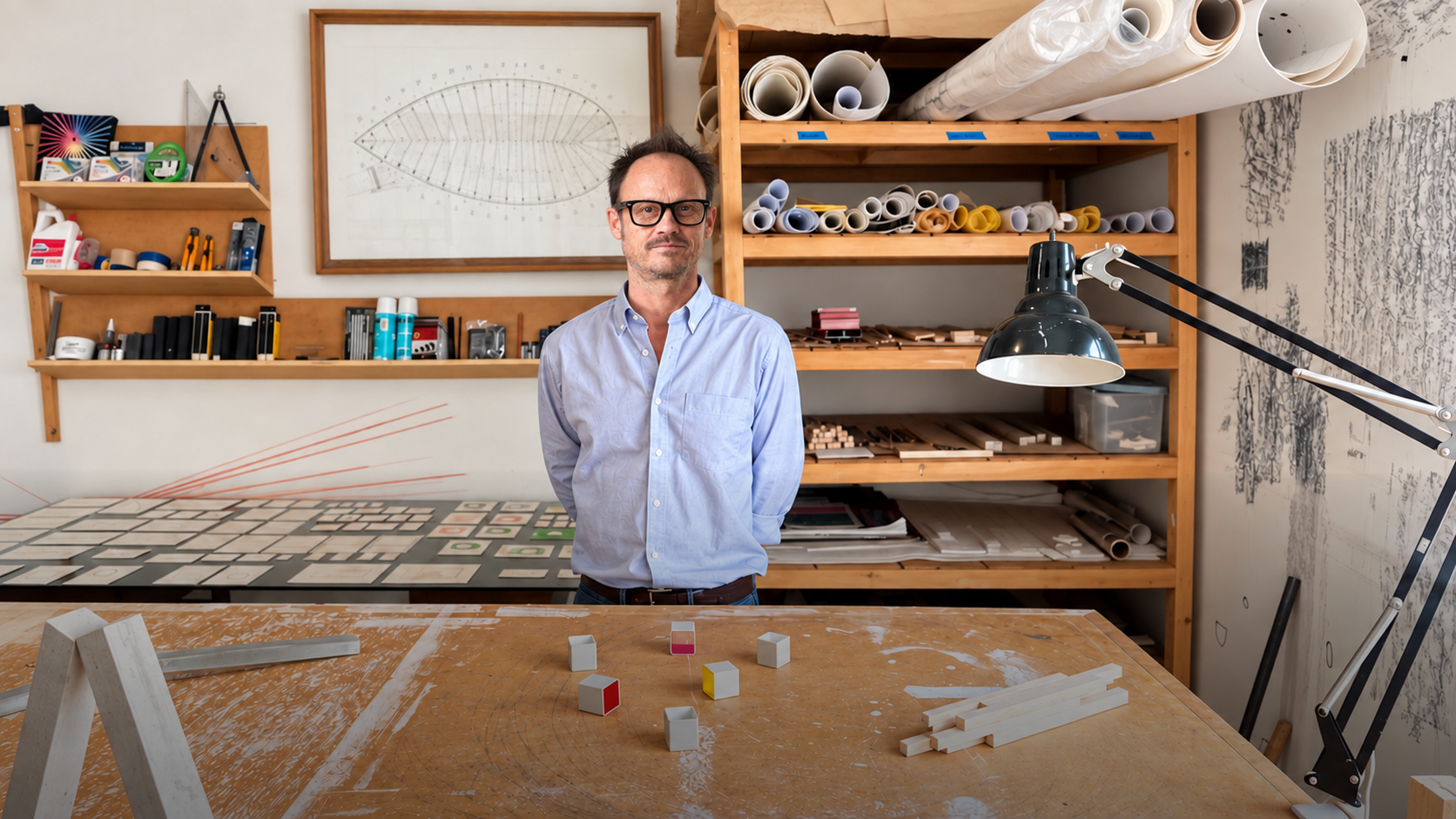
The work of Chilean artist Rodrigo Galecio blends references to 8-bit nostalgia, constructivism, and South American geometric abstraction.
Without veering into kitsch territory, Galecio’s work incorporates, for example, icons that aren’t exactly fondly remembered—such as the pixelated E.T. the Extra-Terrestrial —into the characters and geometry. A reference to what is considered the worst video game in history, which drove Atari into bankruptcy in the 1980s.

Also making an appearance is the most memorable arcade game, River Raid. All of this is blended with designs inspired by traditional Andean cultures.
Rodrigo Galecio is not just a pop culture enthusiast with a keen sense of irony; he is also an associate professor at the School of Art within the Faculty of Arts at the Pontifical Catholic University of Chile.
The artist regularly exhibits his work at venues such as the Die Ecke Contemporary Art Gallery and Galería Técnica in Santiago, Chile, as well as in group exhibitions in the United States, Australia, and Spain.
Rodrigo Galecio: Bauhaus, Chilean-Style
Galecio, who studied architecture for two years before transferring to art school, was trained in an educational discipline inspired by a spirit fundamentally rooted in the Bauhaus. “The color and composition courses I took were deeply influenced by Josef Albers,” he explains, referring to the legacy of the Bauhaus in his academic training.

In almost all the works in his series Adventure Painting , a character named Señor Plano appears repeatedly. Curiously, this icon is present in almost every culture as a totem and invariably takes the form of a triangle.
“The subject of geometry is something that’s ingrained in me. On the other hand, I’ve always been very interested in pre-Columbian textiles and Latin American abstract art,” he says.
“And not just images from the visual arts tradition, but also those from the streets and popular culture,” he says.
From the Atari 2600 to Andean popular culture
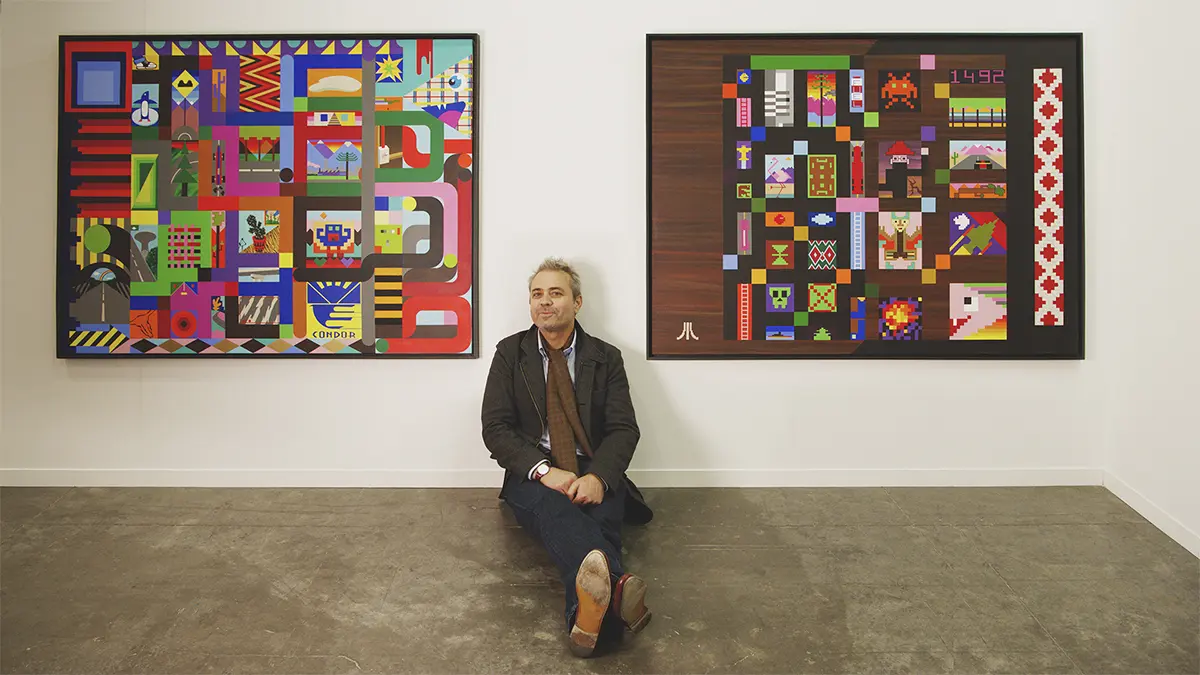
And you can really see the connection to South American pop culture. His geometric paintings feature deconstructed Atari 2600 logos and characters like the American band Devo. “Yes, all those elements feed into my work, and nostalgia is a super important factor. In this piece in particular, I focused on bringing issues related to my childhood into the picture figuratively,” he acknowledges.
“Basically, vintage video games, traditional ponchos, and columns—these are the motifs of a Mapuche textile that was in my parents’ house, along with the records…,” the artist confesses.
“What interests me is capturing in my images the degree of syncretism found in contemporary culture. This is particularly true of art in our Latin American countries, which draws heavily on indigenous traditions from both an aesthetic and cultural perspective” — Rodrigo Galecio
Language is another theme that forms the focus of his artistic reflection. “We speak Spanish using many words that are indigenous, that come from local cultures. It is inevitable that we also have a colonial cultural heritage, and that this cultural hybrid—a blend of European and Indigenous roots—is unavoidable. This is a subject that interests me greatly as a challenge to portray.”

Of course, the condor also appears in the work, though I would have expected to see a pixelated Cóndorito somewhere. It’s actually a deconstructed logo, “from a tile brand of a Chilean company from days gone by,” he explains.
“What I did was take the isotype and add the mountains and the sun to place the condor in a different context.”
Adventure Painting and the Mandela Effect in Chilean Pop Art
The result: logos that sometimes make you think you’ve seen them before, but are actually entirely his own creation—something like a “Mandela pop” effect. “For example, this angry Andean god is entirely my own invention,” he adds as he shows me the sketches.
“Chile has a bit of everything, but I can tell you there are some truly talented artists—outstanding representatives of what’s happening in our scene, especially in the fields of culture, textile art, and drawing,” he says.
Back in the day, Chilean musician Jorge González , frontman of the legendary band Los Prisioneros, took a particularly scathing swipe at the art world in his song “¿Por qué no se van?”
“Why don’t you leave the country?”
The lyrics went like this: “If you dream of New York and Europe, if you complain about our people and their clothes, if you live for the Normandie Art Cinema. If you’re an artist and the locals don’t get you, if your avant-garde doesn’t sell here, if you want to be a second-hand Westerner, why don’t you just leave?”
Rodrigo Galecio shares his thoughts on whether things have changed. “I don’t know if what Jorge said represented the artists at that time. I think back then there was a kind of discontent among a certain segment of Chilean society that longed to live in a different cultural and economic context, and Jorge would say that if you don’t want to live here, go live somewhere else, ”he says.
Adventure Painting is a series he began creating about 10 years ago and which continues today. Currently, the collection consists of twenty-four paintings. True to his pop culture spirit, the artist admits he has no problem with his work leaving the galleries and being turned into T-shirts featuring his designs.
“I’d love to—in fact, I’ve been invited to contribute skateboards and one of the guys gave the skateboard to his nephew, and he loved it,” he concludes.
To keep exploring this thread, visit contemporary Latin American art.