Groundhog Day in Mexico City: In the classic movie Groundhog Day , Bill Murray’s character is doomed to relive the sameday over and over again in an endless loop. Marmota, in the Roma neighborhood, seems to take that reference only in name: there are no repetitions here… though it’s perfectly fine to try the same dish on every visit; after all, there are already house classics.

The restaurant, inspired by the time chefs Federico Patiño and Poppy Powell spent in the Pacific Northwest—a region famous for its mountains, valleys, forests, and seas—brings a taste of Puget Sound to the Roma neighborhood.
Marmota: The Joy of Casual Dining and Comfort Food
“Marmota is a baby we created together. We met in Mexico, but she also lived in Seattle, and when I wanted to open a restaurant inspired by the Pacific Northwest, she jumped on board. She was the one who refined the concept: she helped me understand seasonality and respect the source of our ingredients. Many key decisions—such as maintaining consistency with the product and the season—went through her.” Federico is referring to Poppy, who, in addition to being his business partner, is his wife.
Federico Patiño’s culinary career began right here in Seattle, where he worked for Matt Dillon —another nod to the movies, but no, we’re not talking about the actor from The Flamingo Kid— and for the Chicano chef Ricardo Valdés. After returning to Mexico, he decided to open this place in the style of what he used to prepare back there: country-style, rustic, comfort food, “with the pleasure of informality,” he explains.

Food from the northwestern United States, Mexican-style
“It’s all about sitting down and enjoying a meal made with seasonal ingredients. I was drawn to that honesty and simplicity.”
The challenge was clear: how could we adapt that experience to Mexico using local ingredients? When it opened, many customers asked why there was no salmon at Marmota, given that the restaurant was inspired by the cuisine of the northwestern United States, where it’s a staple: “It seemed odd to me to offer a product whose closest source is 8,000 kilometers away.” The solution was simple: instead of hot-smoked salmon, they offer hot-smoked chicken.
“It’s all about sitting down and enjoying a meal made with seasonal ingredients. That honesty and simplicity really appealed to me” —Federico Patiño.
That philosophy applies to everything that comes into the kitchen: if they can’t source it locally in good quality, they don’t use it. They don’t compromise on ingredients. If it doesn’t meet their standards, it doesn’t make the cut.
One day, a customer came in looking for mussels.
—Hey, I’m here for the mussels I tried last week.
—I don’t have them today.
—Look, I can send my driver right now; I’ll get them for you, and you can cook them for me.
“I apologized and told him no.” He can’t accept a product without knowing where it came from or how it was handled.
Marmota’s Must-Try Dishes
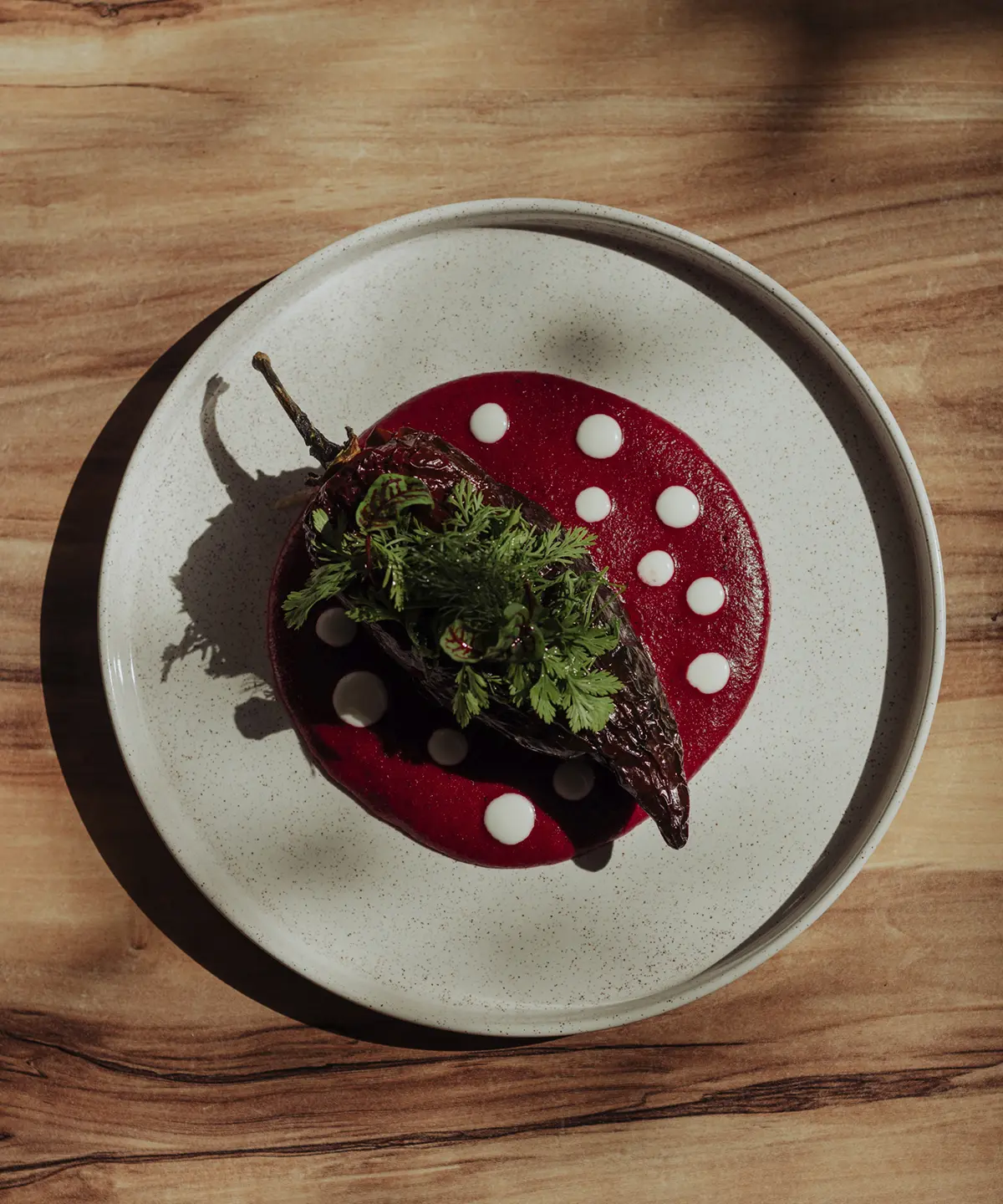
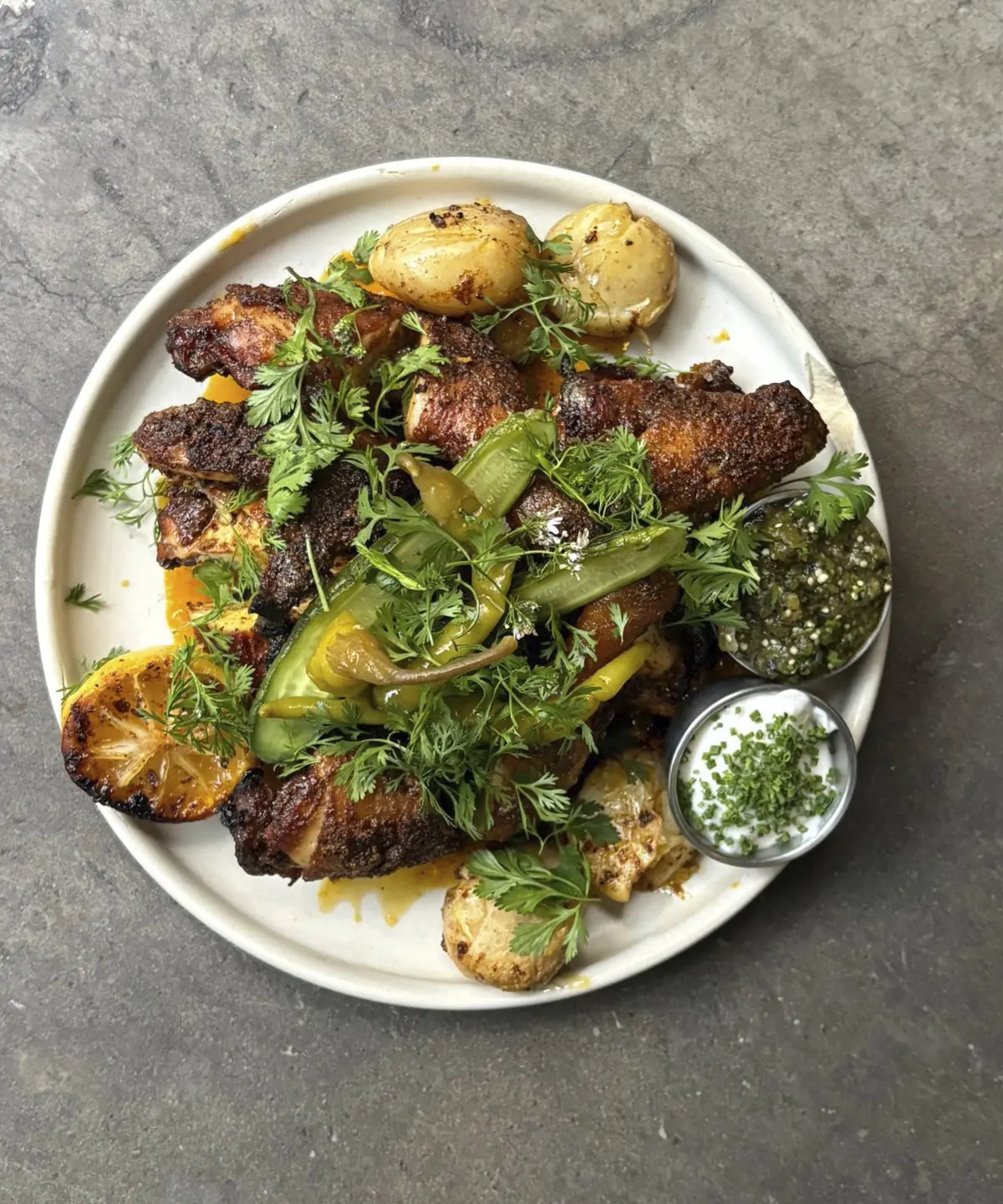
One of the restaurant’s standout dishes is its take on rotisserie chicken: Cajun-smoked chicken served with salsa verde, roasted potatoes, aioli, chiritos, and pickled chili peppers.
Among the most iconic dishes, the grilled cheese is a must-have, even though that wasn’t his original intention. Federico believes a restaurant needs a signature dish. At his last job in Seattle, the brunch grilled cheese was a sensation. He decided to include his own version almost as a statement, thinking no one would order it. Today, in his words, “it’s the dish that practically pays the rent.”
“The hamburger has also grown in popularity, and we’ve been serving wood-fired oysters using the same recipe ever since we opened six years ago. Those four dishes really capture the restaurant’s identity.”

When it comes to drinks, the cocktail menu leans toward herbal and spicy flavors. “I wanted to move away from overly sweet cocktails and explore drier, more complex flavors, in keeping with the Pacific Northwest, where nettles, fennel, and spices are widely used.” La Panchita —named after his dog, Pancha—features preserved lemon and pink peppercorns. They also offer a solid selection of ciders from Normandy and Brittany. Although these aren’t from Washington, cider is widely consumed and produced in that region, so their inclusion stays true to the concept.
Marmota: a concept that goes beyond the culinary
That focus on ingredients also defines the space. Having trained as a graphic designer before becoming a chef, Federico brings his unique vision to the restaurant. “Design and food have a lot to do with how I bring my ideas to life, with textures and colors.”
About 84 green samples were tested until the right shade was found. The architect suggested incorporating terrazzo—which was trendy in early 2020—but decided against it. He realized it was just a fad and would soon go out of style.
He was looking for a timeless space. That’s why he chose marble, concrete, wood, and brick: simple, durable materials.
“Twenty years ago, it looked the same as it does today, and in twenty years, it will look the same. That’s what I’m aiming for: a space that doesn’t go out of style just because it follows a trend. I like it when cuisine and design speak the same language.”
“The goal was always to bring the flavors of the Pacific Northwest to Mexican diners.” Over time, a small community of Seattleites has formed around Marmota. Even restaurant owners from Seattle have visited—the owner of Café Umbria was here recently—and the restaurant was featured in a Seattle magazine.
A few years ago, a chef told him, “Thank you for putting Pacific Northwest cuisine on the map in Mexico.” It was a comment that really stuck with him. And yes, “Kurt Cobainwould have liked Marmota, ”he says.
He has always looked up to his aunt, Chef Mónica Patiño. From a young age, she did an internship at Casa Virginia and worked at Taberna del León during the summers; that was her first training ground. Later, she studied design and worked in tourism development, but at night she would return to the kitchen to confirm that her passion lay there. And it did.
“I consider myself more of a home cook than a traditional chef”
“I never felt constant pressure to ‘measure up.’ Before opening the restaurant, I wondered if people would compare me to her. I talked to her, and she told me something simple: everyone is on their own path. If people like it, great; and if not, that’s fine too.”

“I consider myself more of a home cook than a traditional chef. I was always the one hosting barbecues with friends. One day I decided to open a restaurant, and here we are.” As he tells the story, the smoke from the firewood mingles with the aroma of smoked chicken, and the sizzling of the grill sets the pace of the service. You can hear the murmur of customers waiting for their dishes to arrive at their tables. “Today I still see Marmota just as I did before: I go, I cook, I come home, I cook.” And yes, even so, any resemblance to Groundhog Day is purely coincidental.
Marmota is located at 53 Plaza Río de Janeiro, in the heart of Roma Norte. A must-visit for anyone looking for a refuge with a Pacific Northwest vibe amid the hustle and bustle of the capital.
To keep exploring this thread, visit cultural travel and weekend escapes; you can also continue through destinations with soul in Latin America.