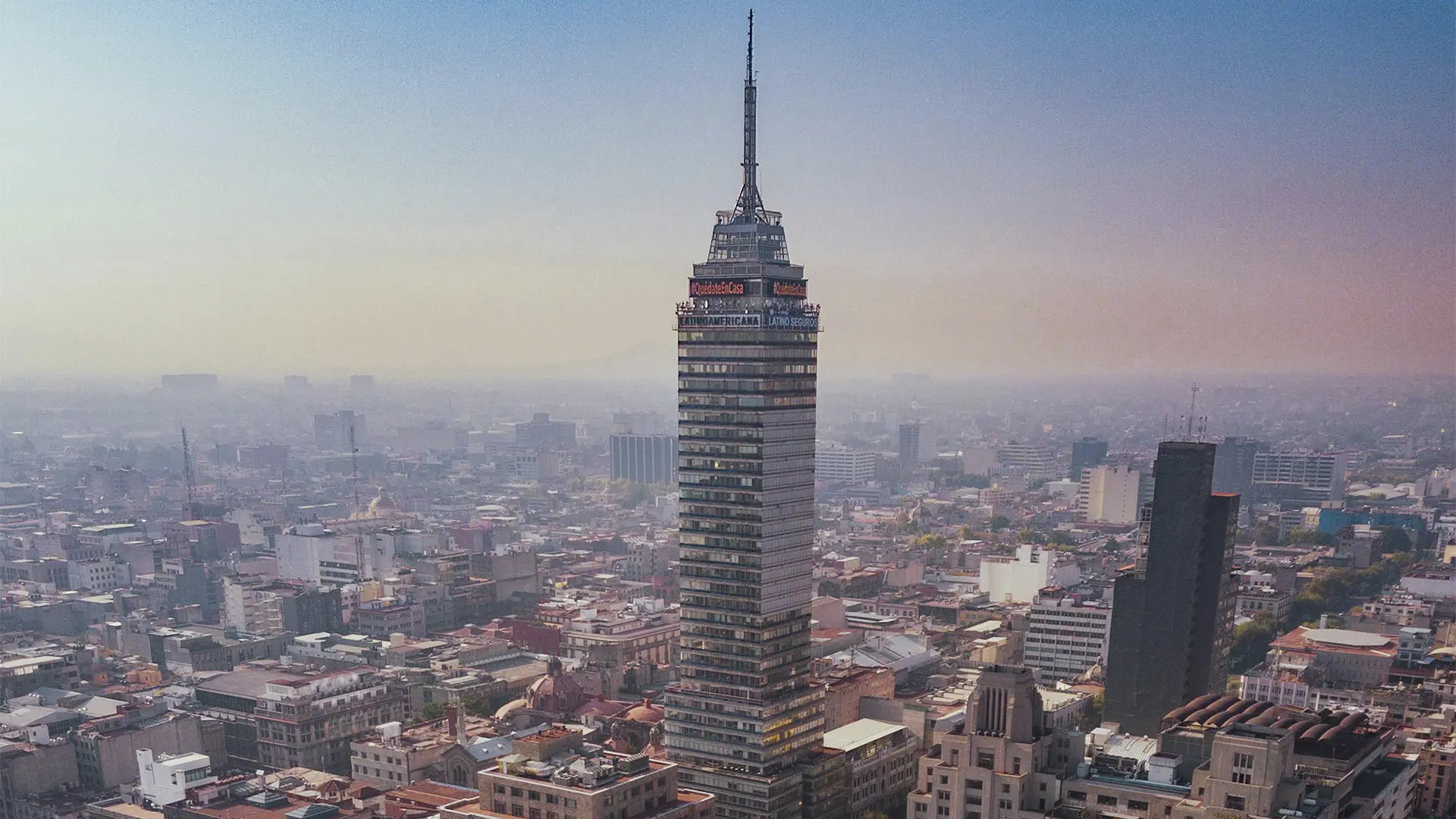

In the heart of Mexico City, a region prone to violent earthquakes, the Torre Latinoamericana has stood since 1956. It has withstood three devastating earthquakes.
Mexico City is located in an earthquake-prone area. Its recent history has been marked by seismic events that have put its residents, authorities, and architecture to the test. Over the past 70 years, three memorable earthquakes have struck the Mexican capital. They occurred in 1957, 1985, and 2017.
Amid that perpetually shifting landscape stands the Torre Latinoamericana, which has stood there since 1956. In 2026, it will turn 70, and it has weathered every tremor. It is not merely an urban and cultural icon; it is also a testament to responsible and ethical architecture and engineering—the kind that can literally save lives.
The Torre Latinoamericana, Modernity, and Seismic Activity
Construction of the Torre Latinoamericana began in 1948 and was completed in 1956. The project spanned two presidential terms: those of Miguel Alemán Valdés and Adolfo Ruiz Cortines. The building was part of the Alemán administration’s modernization drive, which had no qualms about looking to the United States as its primary urban, economic, and political model.
Since its opening, it has become the tallest building in Latin America and a symbol of modernity and progress in the city center. Its presence transformed the cityscape and completely changed the skyline of Mexico City.
Standing 182 meters tall, with 44 floors and a structure resting on 361 piles driven 33 meters deep, the tower was designed to withstand both lake-bed and seismic conditions. Its foundation, settlement compensation systems, and steel structure were not improvised solutions, but rather deliberate and conscious decisions.
One thing was certain from the outset: the building would be constructed in a complex seismic zone.

Augusto H. Álvarez and the Ethics of Design
The architect behind the Torre Latinoamericana was Augusto H. Álvarez, who was born in Mérida, Yucatán, in 1914. He studied at the National School of Architecture. From a young age, he showed a deep interest in design, models, and technical precision, as well as a remarkable passion for trains. Álvarez was also responsible for buildings such as the Benito Juárez International Airport and the Altus Tower.
Álvarez was commissioned to design the Torre Latinoamericana at the age of 34, by which time he had already established a solid reputation. Inspired by American skyscrapers such as the Empire State Building, he gave the project a more industrial character and opted for innovative materials, such as high-strength steel known as Grade 47. Above all, the tower would be a machine designed to withstand the elements.
The result garnered international recognition. The Torre Latinoamericana received an award from the American Institute of Steel Construction for being the tallest building ever exposed to such intense seismic forces.

It wasn’t just about height or aesthetics, but rather a technical achievement in an environment of extreme risk, validated by one of the world’s leading institutions in steel construction.
Three earthquakes, one tower
In 1957, one year after it opened, a 7.8-magnitudeearthquake struck Mexico City. In 1985, an 8.1-magnitude earthquake left thousands dead and caused a collective trauma that has yet to fully heal. In 2017, another 7.1-magnitude quake once again highlighted the capital’s vulnerability. Each of these events has been a challenge for the city’s residents. The authorities have not always been up to the task.

For architects and engineers around the world, the significance of the Torre Latinoamericana lies in its role as a testament to responsible and ethical design. Its resilience demonstrates that prevention, an understanding of the soil, and investment in construction quality are not luxuries, but obligations. The tower protected those inside it and prevented catastrophic damage to its immediate surroundings.
The Torre Latinoamericana can be seen as a survivor: a structure of steel and glass that has weathered decades, earthquakes, and subsidence on unstable ground, always at risk of collapsing. As the city transforms and fractures, the tower stands firm, reminding us that solidity can also be a form of memory.

Looking down on the city
Today, the Torre Latinoamericana is not only a technical and historical landmark but also a vibrant space. Its observation deck, located on the top floors, offers a 360-degree view of Mexico City. Visitors can see the Historic Center, Chapultepec, and Ajusco.

The restaurant and bar make the tower a prime destination for those seeking to understand the city from above. From there, we can gaze out over the urban landscape from a unique vantage point: a spot that has weathered the fury of a land that is beautiful yet cruel.
Discover other iconic buildings in AW Magazine.
To keep exploring this thread, visit contemporary and heritage architecture; you can also continue through heritage architecture with memory.