What would you do if you received in the mail—yes, mail carriers still exist—a piece of art in a large envelope filled with a mishmash of images and inscriptions, all folded and neatly arranged? The package includes instructions for displaying it in the relevant country, so it seems you’ll have no choice but to carry out the mission (yes, assuming you’re a gallery owner or belong to a certain art circle, of course).
Aeropostal Paintings and Globalization
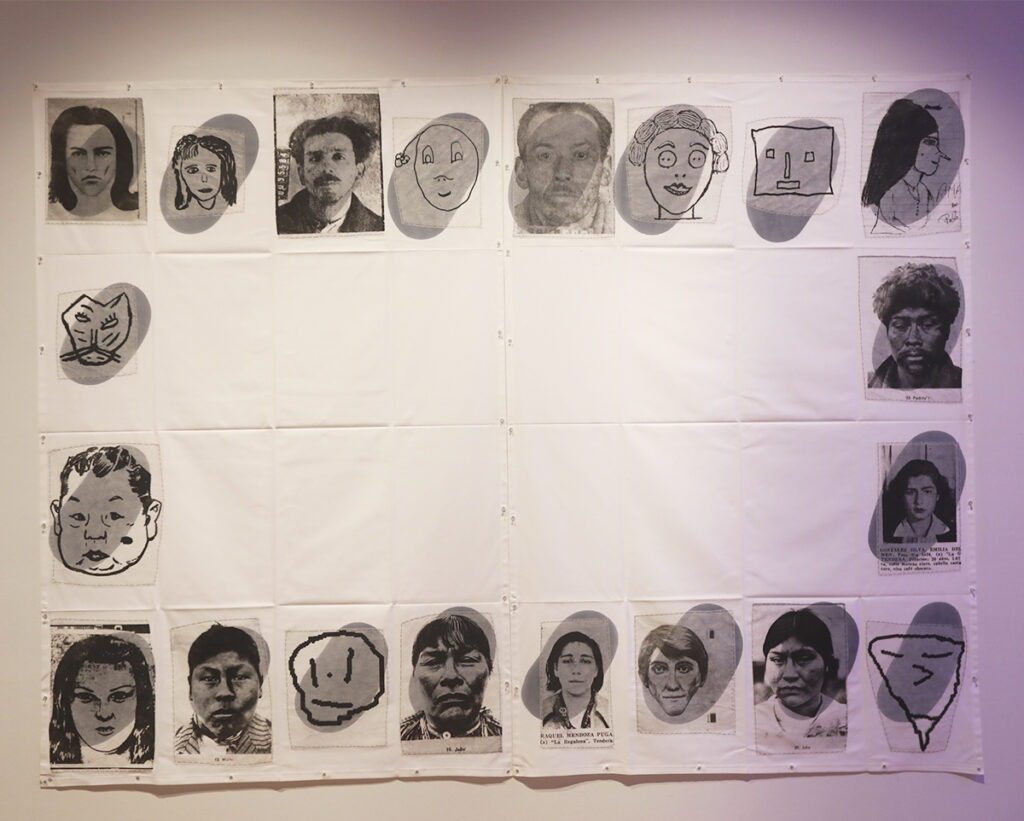
It was in the early 1980s when Chilean artist Eugenio Dittborn began working on what he himself termed “aeropostal paintings.” Highly original, and even for that era, the concept would be utterly endearing given the technological immersion we’re accustomed to today. From South America, the artist sent envelopes containing his paintings to recipients in the art world across different countries, thereby creating an intriguing pre-globalization network.
“Aeropostal paintings don’t have cycles or periods that come to an end. They are constantly being recycled—time itself,”Dittborn acknowledged in a recent interview .
“Children’s drawings, cartoons, images of people with mental health issues, police sketches, mug shots of criminals, and photographs of indigenous people from an ethnographic album. Pieces of interfacing hold an image sewn on like a patch over a wound.” That is part of the work, explains curator Justo Pastor Mellado.
Eugenio Dittborn. Stories of the Face
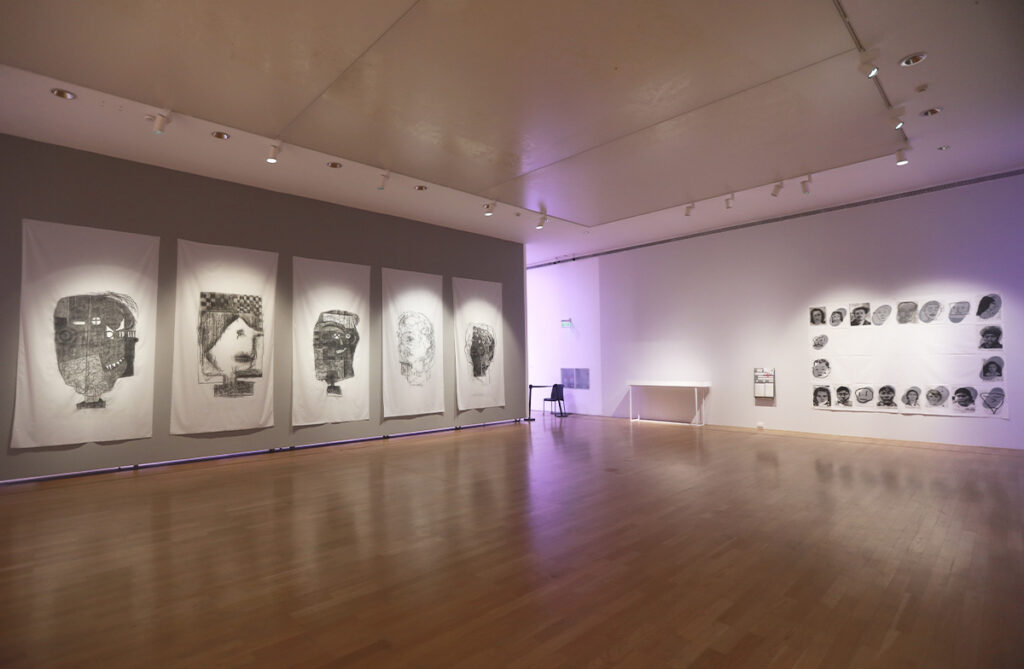
Now, as part of the celebration, a large portion of the artist’s collection is on display at the National Museum of Fine Arts in Buenos Aires in the exhibition *Eugenio Dittborn: Stories of the Face*, which is nothing less than the first solo exhibition in Argentina of this important figure in Latin American contemporary art.
The exhibition is curated by Justo Pastor Mellado himself, in collaboration with the Matta Cultural Center at the Chilean Embassy in the country. Argentina is one of the places where the artist’s work has been widely recognized, so much so that in 2002 he received the prestigious Konex Mercosur Award as the region’s best artist of the decade. In addition, Dittborn’s works are part of the collections of the Museum of Modern Art in New York, the Museo Nacional Centro de Arte Reina Sofía in Madrid, and the Tate Modern in London, among other institutions. In 2005, he was awarded the National Prize for Visual Arts in Chile, one of the most important honors bestowed in the land of Pablo Neruda.
Dittborn: A History Beyond Continental Borders
But Dittborn’s story goes beyond his aerial mail art. After studying fine arts in his home country and specializing in Madrid and Berlin in the 1960s, he returned to Santiago, Chile, and joined the Escena de Avanzada, a collective that emerged in the midst of the military dictatorship.
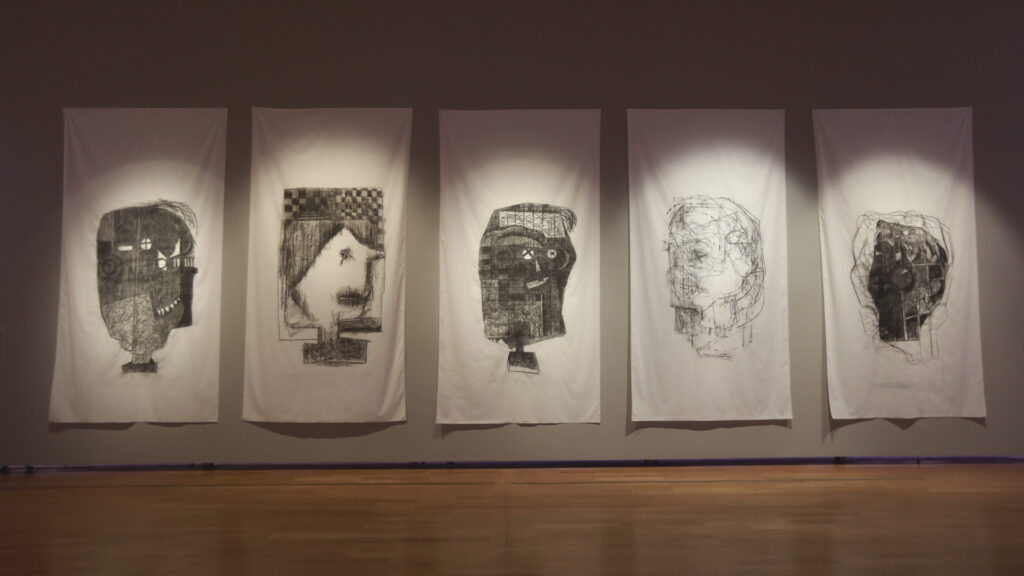
The classic body of work is complemented by a recent piece: “All the Faces of the Face, ” created as recently as 2022, which clearly demonstrates that the artist has not been content to rest on his past laurels and continues to create works that add to his body of work.
“Drawn on shrouds, these faces confront us ‘face to face,’ with their empty eye sockets, brazenly showing us their clenched teeth, their bare skulls or those adorned with curls, their pointed noses arranged in foreshortened checkerboard patterns, combining weaves that reveal the fabric’s texture,” adds Mellado in a statement about the new addition to Eugenio Dittborn’s work.
A Life in the Art World
Today, the Chilean artist, who is still active, celebrates a lifetime in the art world with this exhibition, which will be on view through May 31 in Gallery 33 on the museum’s first floor, Tuesday through Friday from 11 a.m. to 7:30 p.m. (last admission), and on Saturdays and Sundays from 10 a.m. to 7:30 p.m.
Disruptive for its time, the artist’s method—if we can call it that—reflected an era when communication was limited to the postal service. For several decades now, the advent of email, instant messaging, and streaming has redefined the way art is shared. However, it is clear to him that social media contributes to the artist’s isolation and reinforces clichés in art and other disciplines. Interestingly, his compatriot Smiljan Radić —who has just won the Pritzker Prize— has, like him, spoken out against social media at some point.
Of course, if we’re not in Buenos Aires, we can watch the play on a screen—just don’t tell them.