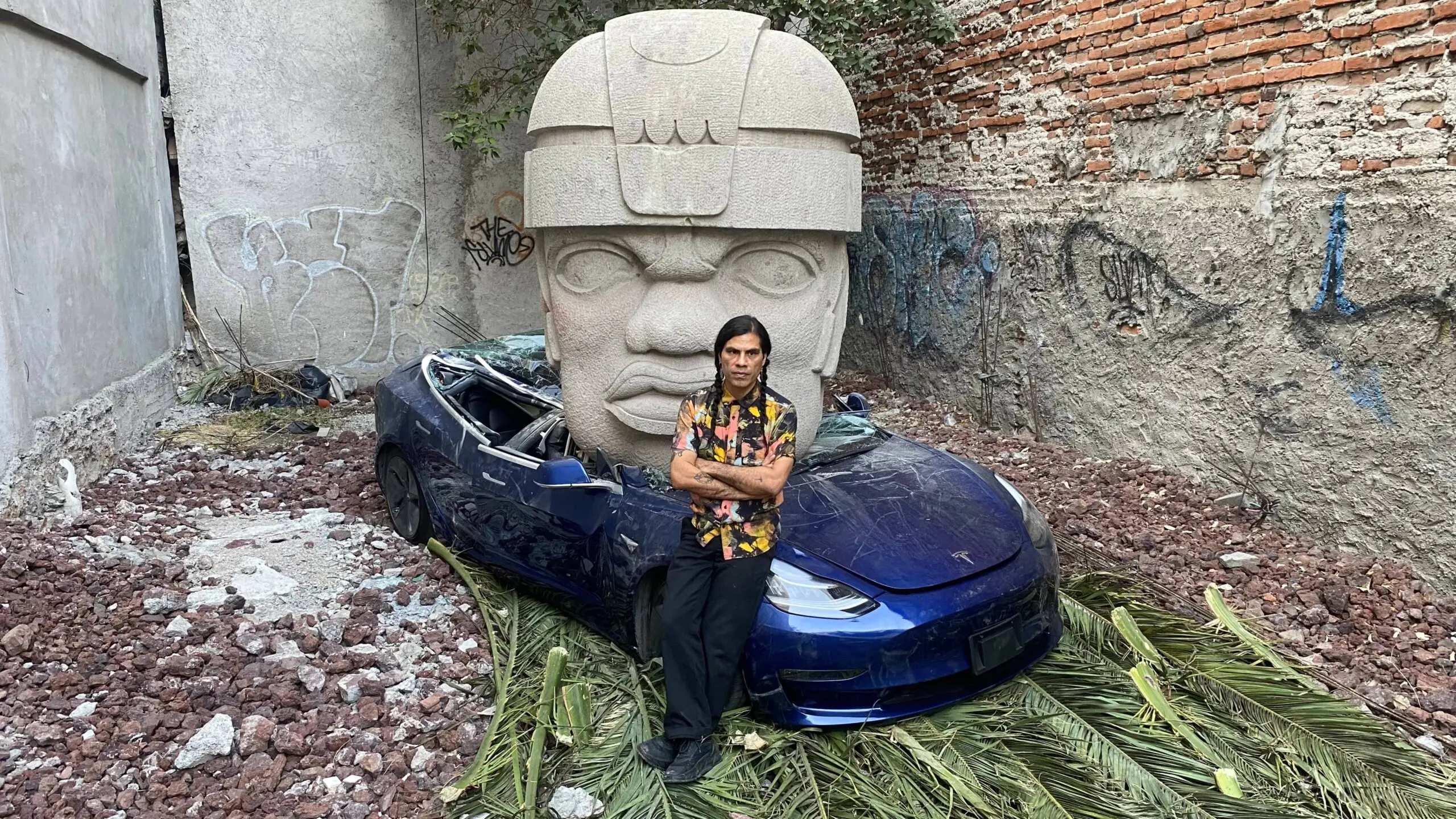

“There’s a saying that the best jokes are told at funerals. I grew up in a funeral home, and that’s where I also learned to develop a certain dark sense of humor,” confesses Chavis Mármol, the artist from Hidalgo. “I grew up with my grandmother. She took care of me because my parents were irresponsible teenagers; she ran a funeral home where I had to work to help her. Kind of like Six Feet Under, exactly. My job was to assist the person who handled the bodies, wash them, dress them, and clean the funeral home and the coffins.”

He would soon turn to a different kind of art, imbued with a sense of humor that seemed at odds with what he had been forced to do from a very young age.
In fact, even his last name seems like an unintentional joke: his last name is Mármol, and he’s a sculptor. He crushed a Tesla in the Roma neighborhood with a giant Olmec head; he created a piece that transformed an Uber Eats backpack into a pre-Hispanic figure; and he recently painted and decorated the bus that U2 used as a set to film their new music video on the streets of Mexico City. Additionally, one of his pieces fuses Señor Cara de Papa with another pre-Hispanic image, which we recently saw at Zona Maco.

Before studying art, Chavis Mármol admits that he “was completely lost in life.” He used to be a somewhat naive teenager, growing up in a small town surrounded by friends who were quite similar to him: “The plan was to follow their example, leave the funeral home, and emigrate to work in the United States.” But then, his fate changed: he was accepted into the Institute of Arts at the Autonomous University of the State of Hidalgo.
All of that was happening somewhat removed from the emerging scene that was already taking shape in Mexico City during the 1990s. So far, so good, like the title of the Wim Wenders film: the then-Federal District was just two hours away, and “every now and then, I’d slip away to visit an exhibition, a museum, or a gallery,” he says.
“What happens in Mexico City doesn’t happen in the rest of the country. And certainly not in a state like Hidalgo. Guadalajara, Monterrey, Veracruz, or Oaxaca—needless to say—are also very important cultural hubs. But governments don’t give art and culture the importance they deserve in building a sense of identity in the region.”
The artist grew up in a town called Apan, very close to Pachuca, Hidalgo, the state capital. The region is famous for its pulque haciendas and religious architecture, as well as having served as a site for a cutting-edge social housing experiment: the Apan Housing Laboratory, where various architecture firms—including Esrawe—built 32 prototypes in 2019.

Before starting his degree program, he had to deal with a few rejections, such as the one from SOMA, one of the most prominent venues for contemporary art in Mexico. “It’s true that they didn’t accept me, but it’s also true that they do great work and are an integral part of this city’s artistic community. I think they’re one of the few places focused on contemporary art that truly support artists’ careers. They must have had their reasons for not accepting me; but in the future, I do see myself teaching there, because it really is the right place. And the fact that my biography mentions I didn’t get in is more of a little joke I like to keep up.”
He later moved to Mexico City to pursue a master’s degree at UNAM. “That allowed me to visit more and more exhibitions and start becoming part of a community where, at first, I wasn’t exactly welcomed with open arms. But little by little, you carve out a little spot for yourself; and if no one wants to open the doors for you, well, you find a way to call a locksmith,” he says.
“I don’t believe, for example, in these self-made beings. And I think something that really helped me understand the way I make art was humor—that is, my approach to life. Also, consuming a lot of cultural products, feeding off everything around me—even though when I was younger I didn’t read and so I just watched TV. But that helps too. Listening to a lot of music, being a rebellious young guy in love with grunge—that also shaped my personality. And I think all of that ends up showing up in my work.”
In the art world, there are some artists who argue that art doesn’t have to reflect the outside world but rather the inner world, “but when the inner self is imbued with what one sees—which invariably happens, as in the case of the Uber backpack—it becomes an accessory that belongs to pop culture,” he says of one of his pieces that transcended the gallery space and went viral.
Which, it seems, he loves: “The works I create belong to pop culture, but even an Olmec head belongs to the pop culture of our time. In other words, even though it’s a pre-Hispanic artifact hundreds of years old, brought into the present and the iconic significance it holds for us also makes it a pop icon.”

I ask him if Elon Musk ever found out about the piece where he crushed a Tesla with an Olmec head. He’s not sure. “We’re talking about one of the most controversial figures of our generation on a global scale. A guy who would tweet anything and could influence the stock market. Plus, he’s obsessed with social media, so I have no doubt he saw the piece at some point.”
The piece went viral for days. There was no public reaction from the businessman, though Chavis suspects it bothered him. “And that was kind of the idea,” he admits. “I wanted to pull a prank, create a massive meme, to mess with and troll the most powerful man in the world.”
“ I believe that art has the power, even from a small and humble place, to be so provocative that it can reach even the most shadowy figures who pull the strings of the world.”
Assembling the car wasn’t easy either. “We’re talking about a fully functional Tesla. Brand new. At a time when there weren’t even any Teslas in Mexico.”
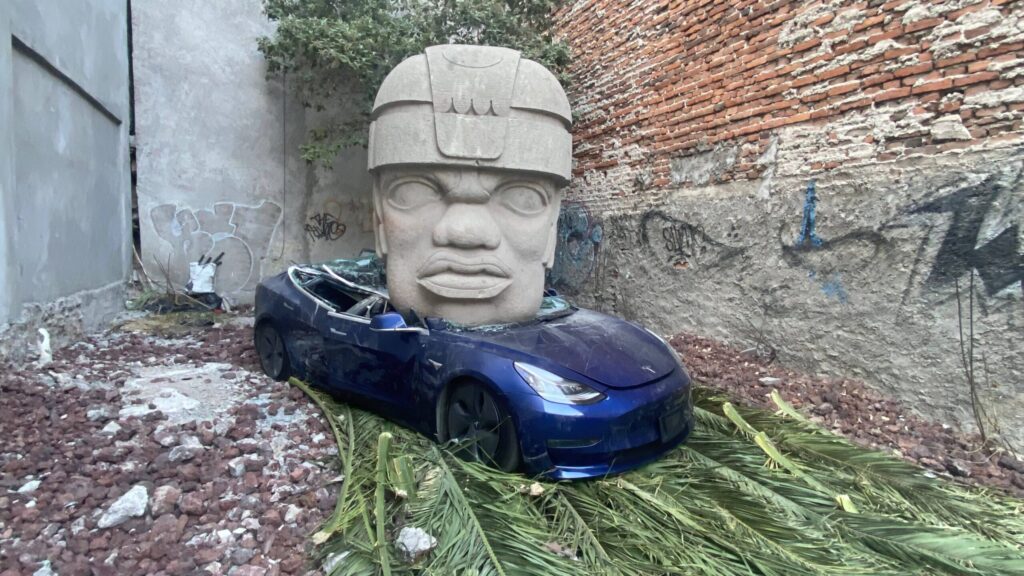
Remember that they were just starting to pop up in Monterrey, fueled by local enthusiasm for Elon Musk. “I never thought that fantasy would come true. But I also have to admit that I’m quite the star, and that I’ve had the chance to bring many of the ideas I’ve imagined to life.”
When the installation was finally finished, he felt relieved. “All right, I’m finally done. Screw this.”
He is also interested in how cultural products age. He mentions Seinfeld as an example of a show that still feels contemporary decades later. “It’s still relevant. The way it was made still feels contemporary. Even the creators themselves said it was a show about nothing: four random people to whom nothing really ever happens.” “There are musicians who avoid using sounds that are too tied to their era, and that’s why they still sound fresh twenty years later,” he says. That tension between pop culture, permanence, and the present runs through much of his work.
He also recently took part in the project involving the bus that U2 used as a set to film a music video on the streets of Mexico City, although for confidentiality reasons he is still reluctant to say too much about the project.

When Kurt Cobain committed suicide, Chavis was 12 years old. He doesn’t remember seeing the news. But when we brought up the topic of how much the grunge aesthetic—which he told me was part of his influence—continues to shape his art: “That romanticized idea of art, where blowing your brains out supposedly means you’re a genuine artist, is one of the myths that continues to, let’s say, affect our careers,” he reflects.
“In other words, my true commitment to art has also been called into question, so to speak, because once you start to achieve some kind of commercial success or become mainstream. Sometimes, the public wants to see you subjugated, to see you suffering, to see you in a precarious situation—only then are you considered a real artist. And those born with privileges are also judged: ‘Oh, that’s just a ‘nepo baby,’ that one has privileges.’”
And regarding artists who say that art comes from within, he has an answer: “What is the ‘inner self’ if not a product of everything that surrounds us? In other words, I think in a—well, my interpretation of the world is materialistic. In other words, my context, who I am, and where I come from have practically shaped my ideas and my way of understanding the world,” he says.
“So the fact that I come from a small town, grew up watching my grandmother apply makeup to corpses, and attended only public schools—well, that obviously defines the kind of person I am,” she concludes, as if in a requiem.
Discover more stories about Latin American art in AW magazine.
To keep exploring this thread, visit contemporary Latin American art.