
Despite the heat wave currently sweeping through Madrid, Eulogia Merle is enjoying a hot mate. The Argentine artist has been a nomad for a long time, but she has been living in Spain for twenty-five years. During the first decade, she divided her time between two places, spending six months in Buenos Aires and a little more in Madrid. Chasing spring, no doubt.
Motherhood led her to settle permanently in the Spanish capital more than a decade ago; her accent still makes her feel “a bit like a visitor,” she admits.

Memory as a Starting Point
As we’ll soon see from her work, the artist maintains a deep connection to her family roots, to nostalgia, and to settling outstanding debts with the past. “We all know that, in a way, the artist is like a catalyst for her environment,” she says as she takes a sip.
Today, we’re firmly rooted in the present, where there’s still mate, but also Zoom, immigration, and a globalized world. “Madrid in the summer is a tough city; I spent a short time living up north, in Galicia, where it rains a lot. But Madrid is one of the cities with the most sunny days in the world,” she says.
How to Turn a Personal Debt into an Art Installation
Eulogia Merle was born and studied fine arts in Buenos Aires; she emigrated in the midst of Argentina’s economic crisis, carrying nothing but a portfolio of illustrations based on Albert Camus’s *The Plague *. This opened doors for her at the newspaper *El País*, where she has worked on a recurring basis—a role she now alternates with contributions to *La Nación* and various publishing houses.
Described as a progressive artist who “doesn’t paint for elegant ladies, ” Merle has left her mark on projects as diverse as Madrid’s Luminaria festival and the collective tribute “Llorando a Chavela” at Casa América. Firm in her principles, this socially conscious artist prefers to describe herself simply: a plain old illustrator.

About ” Cama Adentro“
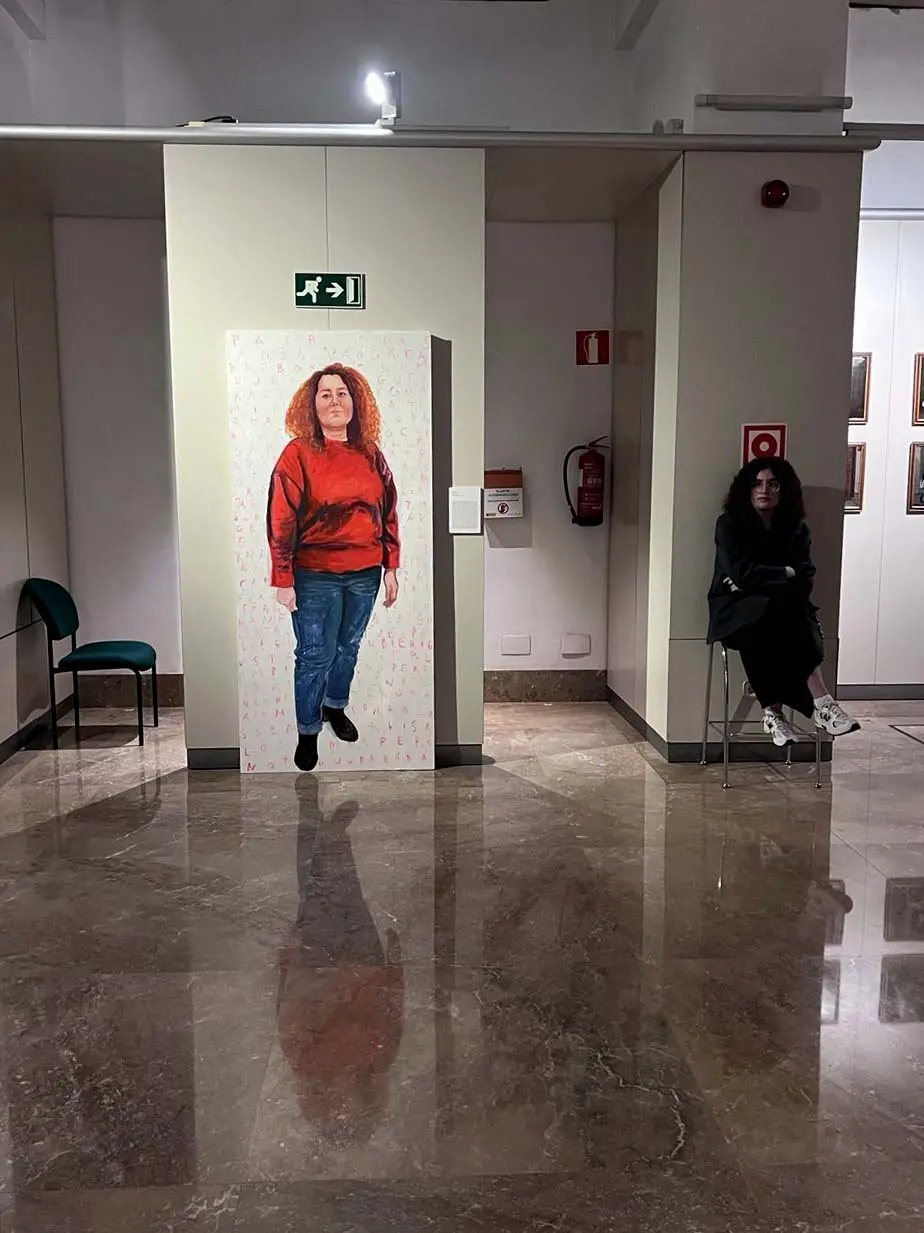
On April 30, the exhibition opened at the Museo de América in Madrid Cama Adentro, an exhibition that draws on her own personal history. The evocative exhibition consists of a series of portraits of Latin American domestic workers living and working in Spain. “We call it‘cama adentro’ in Argentina, or ‘interna’ in Spain.”
“It’s someone who lives in your house and is part of your family. It’s the person who cooks for you when you’re a child, scolds you, does your laundry, is there for you, takes care of you… but isn’t actually part of the family,” she says.
Invisible things that are never paid for
That kind of relationship—which she sees as stemming from unequal working conditions and a way of life in which some people devote their time and lives so that others can rest, prosper, and live better—always caused her conflict.
“I was a little girl raised by one of these women, a woman of Wichí descent named Juliana Díaz‘Juja,’ who worked at my grandmother’s house.” The year Eulogia became pregnant in Spain, the woman who had raised her passed away. “She never got to meet my son,” she laments.
“I felt that my family owed her a huge debt,” she confesses as she recalls her caregiver, who came from the rugged Argentine region of Chaco del Monte Impenetrable. “She gave her life to my family, and that can never be repaid.”

With an artistic tribute in mind, Eulogia contacted the organization “Trabajadoras del Hogar y los Cuidados” (Domestic and Care Workers) in Madrid, a union where she learned the reality: “Nearly 100% of the members were migrants from Honduras, El Salvador, Colombia, Paraguay, Bolivia, or Ecuador, and they face inequality that, in her view, is a continuation of colonialism, because they work Monday through Sunday, 24 hours a day,” she says.
The Invisible Stories
“Many of them are undocumented; they sleep on folding cots in the kitchen and endure prejudice and things you can’t even imagine,” the artist continues. “That’s not just an anecdote; it’s enriching a society that’s taking advantage of the situation, a society that’s receiving these human resources from migrant populations coming from the Americas.”
“They relieve them of the burden of raising children, caring for the elderly, cleaning the house, and cooking, so that they can devote themselves to other things: making money, enriching themselves culturally, or advancing in their careers.”
The project ultimately found its ideal home at the Museo de América, an institution with which the artist initially maintained a rather distant relationship.
“The very phrase ‘Museum of the Americas’ is an oxymoron. Because ‘museum’ refers to something still, stable, that preserves something, that doesn’t move; and ‘the Americas’—the first thing that comes to mind—is something alive, dynamic.”

“The artist spent many years living in Madrid and had never been to the Museo de América ‘because I knew I wouldn’t like it, especially from a discursive standpoint,’ she says.”
When she finally decided to explore it, her suspicions were confirmed when she came across what she saw as outdated narratives: works vaguely labeled as “found art” or taken out of context “within narratives laden with prejudice,” she says. “It was as if history were told only by the victors. It seemed as though the Americas were a place that had been frozen in time since 1492,” she observes.
The Museum of the Americas Today
It was during one of the guided tours, while he was openly criticizing the site’s colonial perspective in front of the visitors and the guide, that a man in the group approached him and said, “I’m the museum director. Come on, come into my office and tell me what can be done—make me a proposal to exhibit something here.”
The institution was operating under a new policy that sought to “decolonize” its discourse, eliminate outdated narratives, and reorient the permanent collection to bring it in line with the present day.
The office of the director, Andrés Urquillo, became the birthplace of Cama Adentro. The artist’s response to the challenge was clear: to create life-size, full-body portraits of women looking straight ahead, “in a dignified pose,” she states.

“I thought they were going to object because I was venturing into complex territory,” Eulogia admits. “It’s no longer just a folkloric ‘look how pretty this is’—it’s a direct demand: take responsibility for this colonial legacy, for this relationship, today, now, here, and with real people.”
After receiving approval, the artist began working on the portraits in her studio. The women eagerly came on their days off, not only to pose but also to talk, driven by a deep need to speak and be heard. Some even went to the beauty salon beforehand. As a result, the formal structure of the work transcends technique, and next to each large-format piece is a text with a brief biography summarizing the experiences of the women who participated.
Stories of Resistance
It tells the story of people like Dina. After fleeing Honduras with her baby in an attempt to reach the United States, she was apprehended by immigration authorities and deported first to Mexico and then back to her home country. There, she faced gender-based violence at the hands of her husband, the father of her children.
To save herself, Dina decided to leave the children in her mother’s care and migrate to Spain. Four years have passed since then; four years during which the father, who has settled in Honduras with the children, has not allowed her to see them again or speak with them by phone. Dina perseveres from afar, waiting for them to turn 18 so they can seek her out of their own free will and hear her side of the story.
History repeats itself
She trusts that they will understand her, since the same thing happened to her own mother: she fled because of domestic violence and was reunited with Dina when she was already an adult. The story repeats itself, tragically and cyclically.

“Those connections blew my mind with their lessons in humanity, with their boundless empathy and generosity,” Eulogia reflects on her conversations in the workshop. Many of them find an almost mystical justification in their dedication to their work—the certainty that justice will prevail at the end of the road.
Art can also heal
“In this world we live in today, where psychopaths are the most rewarded and have the best chances of climbing the ladder because of the way power relations are structured, these women—who are at the bottom of the pyramid—possess an invisible greatness. They have the ability to feel empathy in situations so messed up that neither you nor I could handle them,” he declares.
“Sometimes I think it has to do with those people who find enlightenment while in prison or in extreme situations like war,” he concludes. “In those same photographs, the families who own the houses often behave in a pathetic, sleazy, clingy, and petty way. In contrast, these women—who have nothing and are going through extremely harsh circumstances—manage to bring forth a truly special energy.”
A New Generation of Creators
But this artistic intervention is not an isolated event. Eulogia is aware that she is part of a much more dynamic phenomenon. After spending years in Madrid, the artist enthusiastically observes the emergence of a new generation of creators, most of whom come from Latin America.
“Now we’re the ‘neo-Madrileños,’ or I don’t know what to call us. There isn’t a precise term for it yet, but that generation already exists and is the most active. We’re out there, we recognize each other, and we’re eager to tell stories.”
This is a group of artists who are actively fighting for a space to breathe life into contemporary culture in Madrid, breaking away from old labels. “Before, we were always confined to a somewhat folkloric, picturesque, or ethnic niche,” explains the artist.

Seven Portraits, Seven Stories of Resistance
Eulogia created this series through interviews with this group of domestic workers who live and work in Madrid—women with names and faces: Delia, Melba, Elsy, Patricia, Dionisia, Mónica, and Dina. Their full-body portraits burst into the passageways of the Museo de América, right in the middle of the usual tour route, challenging the institution’s solemnity with the forcefulness of their gazes, the immensity of their dignity, and the echo of a community demanding its right to tell the story of the present.
The exhibition will be on view through September 27 at the Museo de América. Av. de los Reyes Católicos, 6, Moncloa – Aravaca, 28040 Madrid, Spain.
Discover more about art history and migration in AW Magazine.