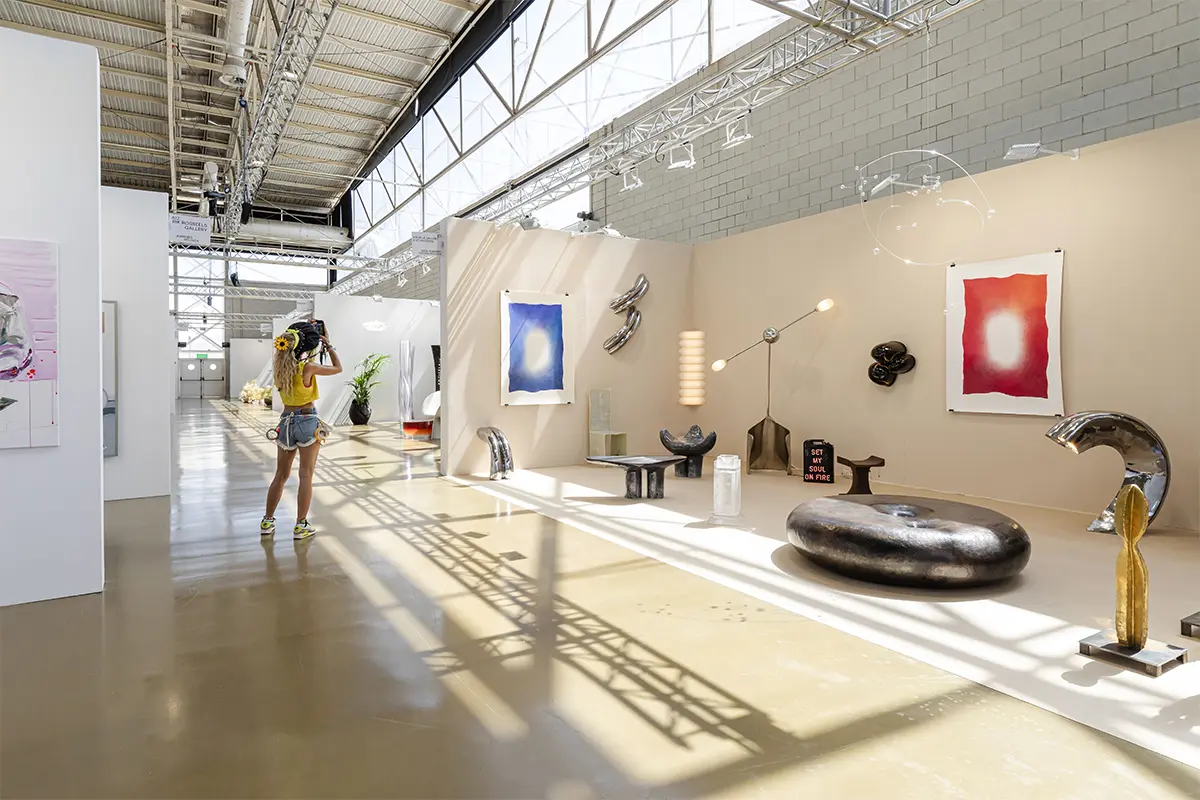

The fifth edition of the CAN Art Fair Ibiza took place. The event confirmed what had already become evident at other recent fairs: that the growing presence of Latin American and Ibero-American participants no longer occupies a peripheral role within contemporary art fairs beyond Spanish-speaking countries.
The Latin American presence was a highlight of the fifth edition of the CAN Art Fair Ibiza
In total, there were 38 international galleries from Spain, Europe, the Americas, and Asia. The program reveals that several of the most prominent names at this year’s event were linked to Latin America—particularly Mexico—consolidating the region’s position as one of the most visible voices in art and collecting today.

From Leonora Carrington’s Surrealism to Stefan Brüggemann’s Conceptual Art
Among the historical figures mentioned, Leonora Carrington stood out as one of the leading figures of Mexican surrealism. Although she was born in England, the artist spent most of her career in Mexico, a country with which she forged a distinct identity.
Its presence at the CAN Art Fair served as a bridge between the history of modern art and the new contemporary works on display at the Spanish art fair.

Another notable name was that of Mexican artist Stefan Brüggemann. In addition to being part of the fair’s selection through Gathering Gallery, the conceptual artist unveiled his permanent public sculpture, *Hashtag*, in Ibiza, installed as part of CAN’s public art program.
His remarks underscored the fair’s commitment to expanding its program beyond the exhibition grounds and turning the urban space into yet another venue.
The Latin American contingent also included Peruvian photographer Mario Testino, whose work was presented by Patricia Low Contemporary. According to a press release from the fair, “Testino was among the artists whose works were at the center of some of the edition’s most notable sales, confirming his influence in the international art market, beyond the editorial and fashion photography that have made him famous.”

Mexico at CAN Art Fair 2026
Mexico was also well represented institutionally thanks to LA BIBI Gallery, which has locations in Palma de Mallorca and Morelos. Its participation highlighted the growing dialogue between Europe and Latin America through venues that develop programs on both continents.
Among the works on display, the piece by David Oliver (Grip Face) stood out; it was acquired by Paradores de Turismo de España to be included in the public collection of a new Parador in Ibiza.
Latin American representation was also evident through artists represented by international galleries. Gathering Gallery presented works by Stefan Brüggemann himself and Iván Estrada, while Georgina Pounds Gallery included Chilean artist Mónica Figueroa in its lineup.

But the dialogue between Ibiza and Latin America extended beyond the fairgrounds. CAN Art Fair’s OFF program featured a series of interventions spread across various heritage and cultural sites on the island, where the landscape, architecture, and memory became points of convergence.
Among them, “Existir es transitar” by Uruguayan artist Ana Grajales (Montevideo, 1991), presented at the Five Flowers Formentera Meliá Collection, stood out. Based in Mallorca, Grajales works with natural fibers and traditional textile techniques “to construct a poetic cartography that intertwines the memory of her native Uruguay with her life in the Balearic Islands,” according to the press release.

The OFF program brought contemporary art to Ibiza’s historic sites
As if that weren’t enough, the OFF program also featured works by artists with deep ties to the Balearic Islands. At Sa Punta des Molí, Marina Marón presented *Lugar de lugares*, an exploration of island architecture and the simplicity of forms inspired by the landscapes of Ibiza. At the Ses Coves Blanques Lighthouse, Catalina Julve and Federica Furbelli presented *Pertenencia*, an exhibition that reflects on the fragility of home, the landscape, and the concept of “non-place.”
Another highlight: at Es Polvorí, Antonio Villanueva, who has lived in Ibiza since the 1970s, presented *Ibiza & Love Letters*, an exhibition that traces the island’s cultural evolution through a body of work marked by experimentation. Meanwhile, Mercedes Balle took over the Jesús Cultural Center with *Muros de hormigón* (Concrete Walls), a site-specific installation constructed from scaffolding mesh salvaged from local construction sites that questions the impact of urban development, the housing crisis, and the tensions between tourism, landscape, and identity in the Balearic Islands.

Overall, the Latin American contingent was led by Leonora Carrington, Stefan Brüggemann, Mario Testino, Iván Estrada, Mónica Figueroa, and Ana Grajales, with LA BIBI Gallery also participating as one of the galleries with a direct presence in Mexico. The concentration of Mexican artists was particularly significant, positioning the country as the Latin American delegation with the greatest visibility at this edition of CAN Art Fair.
Spain strengthened its presence both at the trade show and beyond
Undoubtedly, the Latin American presence takes on greater significance due to the fair’s selection model itself. CAN Art Fair does not operate through an open call, but rather through an invitation-only curatorial process led by critic and curator Saša Bogojev.
It is worth noting that Spanish artists played a decisive role both at the fair itself and in its OFF program. Artists such as Javier Ruiz, Ubay Murillo, Oriol Enguany, Jesú Moratiel, Chema López, Ella Fidalgo, Pep Llambías, and David Oliver (Grip Face), several of whom were featured in the Solo Projects and were acquired by the Government of the Balearic Islands and Paradores de Turismo.

Given this context, the 2026 edition of CAN Art Fair Ibiza confirmed that Latin America and Spain continue to strengthen their presence on one of the most important stages of the international contemporary art scene. The participation of established artists, well-known creators, galleries with a presence on both continents, and offerings from the OFF program demonstrates that the region is no longer merely a territory of representation, but rather an active and decisive part of the aesthetic and conceptual conversations that shape the course of global contemporary art.
Discover more news and contemporary art fairs in AW Magazine.