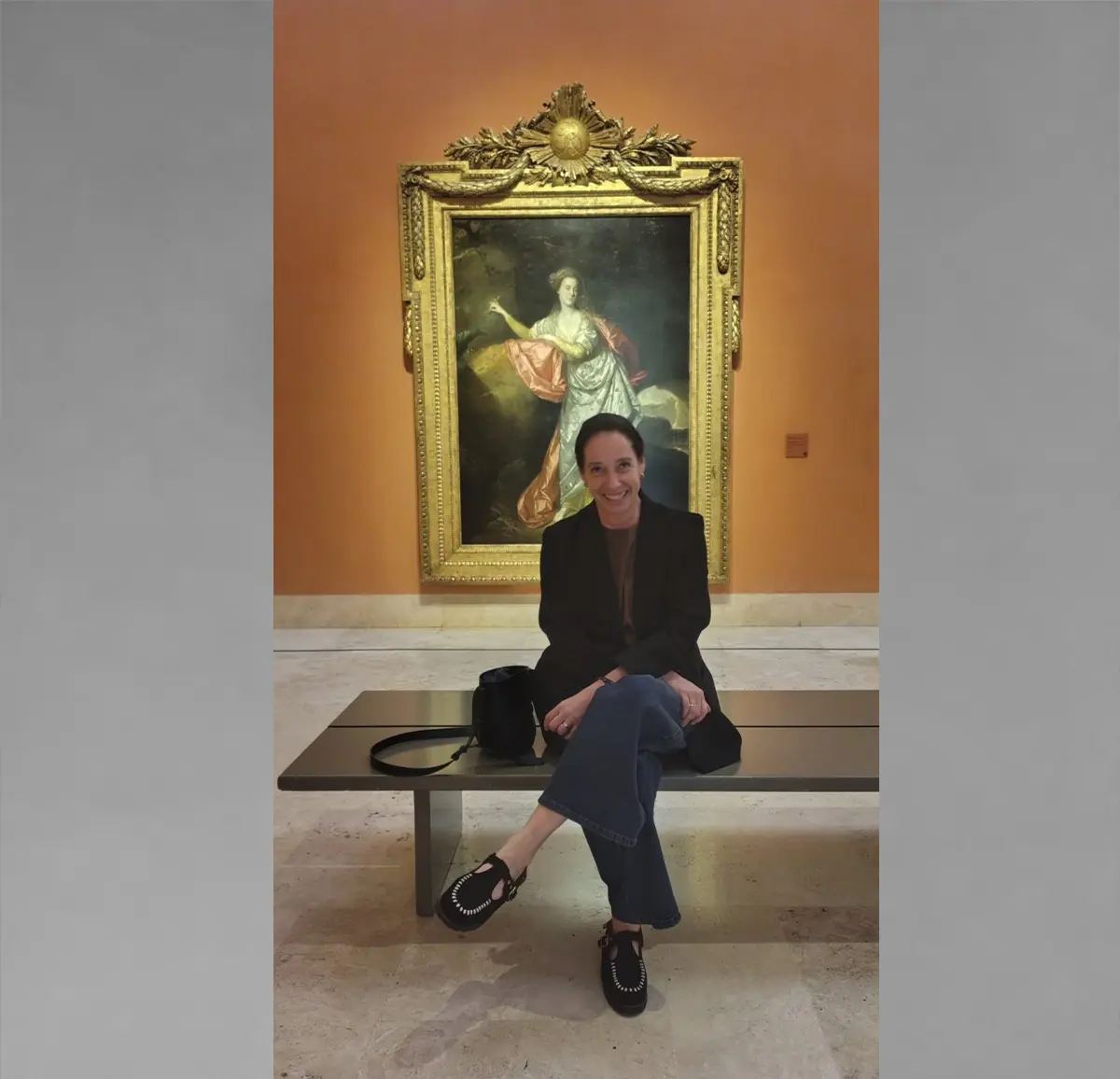

The myth of the cultured, sophisticated art thief who “leaves a bottle of champagne in place of the piece they took” is merely a romanticized portrayal of these characters. This is one of the first things our “jack-of-all-trades” interviewee, the Cuban-Argentine journalist Claribel Terré Morell—who is also an author, lecturer, and consultant specializing in art crime, collecting, and cultural communication—makes clear to me.

Why do you think art theft and forgery are romanticized so much?
Art thieves are often thought to have a different kind of sensibility—that’s always the case. Some may have it, but very few have stolen purely out of passion. Most do it for money. That’s the truth, and we can’t romanticize it either.
Is art theft ever committed on impulse or for aesthetic pleasure?
Yes, there may be someone who took advantage of an opportunity, who had the desire and decided to take something as part of an artistic project and then return it later. There are also those who have stolen to have a piece of art in their home so they can look at it all the time. But most are organized gangs looking for money. Think about how many works of art have been lost because they were stolen. Those are gone forever.
“Movies have contributed a lot to that image, but art thieves don’t look like George Clooney, and things don’t happen the way they do in the movies.”
How did the book Traidores del arte and your interest in investigating art-related crimes in Latin America?
I’d had the idea for many, many years. When podcasts first started, I created one because it seemed like a faster and easier way to tackle these topics by interviewing different people. Then the newspaper Clarín contacted me to offer me a column. The public loves the topic, and every time there’s an art theft, we all follow the story to find out what happened and who was involved. However, often the incident is reported, but then nothing is said about the thieves.
Which cases did you start with?
I began by telling different stories: some I already knew, others I was just learning about, and still others I was investigating, always on the lookout for new leads. I even interviewed people who had stolen artworks—without condoning the crime. Some of them had later regretted their actions, and the pieces had been recovered. Several of the cases featured in *Traidores del arte*—about five—took place in Mexico. Now another book, *Crímenes de arte*, is set to be published by Planeta, which also includes Mexican episodes. With thefts and forgeries, it often happens that you have a closed case, and, after a while, it turns into a different one: because the artwork didn’t belong to the person we thought it did, because it turned up, because a thief confessed to something previously unknown, or because it surfaced on the secondary market, among antique dealers or somewhere else.

Does the reopening of cases happen more often in Latin America, or is it something that happens everywhere?
It happens everywhere. It depends on many factors: whether a stolen work turns up or new information comes to light. There are lists where stolen works can be reported, such as those maintained by Interpol. There are also people who will never report that they’ve been robbed. Sometimes someone provides information, an investigation is launched, and a case is reopened.
What happened to the student who stole a Rodin sculpture in Chile?
He took the sculpture *Adèle’s Torso*. He was twenty years old and a student. His name is Emilio Onfray Fabres. He was on his way to the restroom when he saw the sculpture—which had been on loan for an exhibition—stuffed it into his backpack, and took it with him.
Since he was studying art, he said it was part of an exercise to, in a way, mourn what was no longer there. The visit to the empty pedestal where the sculpture had stood drew a huge crowd. Later, he returned it. That was also the explanation given by his defense, although we have no way of knowing what he was really thinking.

How did they find out?
He turned himself in. At first he said he had found her in a park, and then he admitted that he had taken her. He returned her two or three days later.
When a piece went missing from the most important exhibition currently on display in Chile, people began speculating about an organized gang and that the piece had already been smuggled out of the country. However, it turned out to be a student. The case also highlights security flaws. One thinks of certain museums and wonders how a theft could have taken place there so easily.
Besides security, what other factors make art theft easier?
The lack of proper cataloging. Sometimes people don’t even realize that a piece has been stolen from them. This happens in museums, institutions, and also in private homes. Art theft takes many forms. When someone steals a well-known work of art, the problem is that it’s almost impossible to sell it.
So why steal a work of art that can’t be sold?
In some cases—very few—to prove that it can be done. In others, to extort money from the owner, the museum, or the insurance company through shady practices. There are also thefts where the motive is purely material gain. Think of Cattelan’s golden toilet: it was connected to the plumbing, so the thieves had to rip it out, and the place where it was on display was flooded.
When gold, copper, or bronze are stolen, the pieces often never resurface because they are immediately taken to a place where they are destroyed to recover the metal.
How prevalent is the theft of religious art in Latin America?
A great deal of religious art is stolen. It happens in large cathedrals and churches, but also in small-town churches, which have virtually no security. Churches are open to the public and are places where it is easier to steal. In my research, I found that the Virgin of Guadalupe is one of the images that appears most frequently in these cases throughout the Americas.
In addition, there was a time when homes were decorated with sacred objects. Some were replicas, and others were authentic. There was a significant flow of these pieces throughout Latin America and to Europe.
Does the value of the materials also explain these thefts?
Yes. Gold and silver are part of the appeal, but they also take copper and bronze. Many of those pieces are lost forever, and those who stole them receive very little money. I’ve also read about cases of people who stole out of hunger: they’d break into a village church, take something, and sell it on the street corner to buy food. That’s how so many works of art and ceremonial objects have been lost.

Are there also cases where thieves end up helping to recover the artworks?
Yes. Many of them later help track down the works they stole. For example, Erik the Belgian, who stole a lot of religious art and later cooperated. These are things that sound like something out of a movie, but they happen in real life. There are also people who stole once and then went on with their lives. The young Chilean man featured at the beginning of the book was twenty years old when he did it and said it had been part of an artistic project. He wasn’t a habitual thief.
Do you think that art law is well developed and enforced in Latin America?
Art law is very broad: it includes inheritance, issues related to owners and collectors, and the right to culture. Part of it deals with theft and convictions. My impression is that the sentences are so short that many prefer to serve them rather than talk. Then they’re released. I understand that work is being done on some aspects, but sentencing is just one part of a much broader field.
The book also includes stories such as the one about the supposed “third father” of Cubism. What was that story about?
It’s one of the most spectacular and entertaining stories to have unfolded in Mexico. A figure named Jusep Torres Campalans appears out of nowhere—he was supposedly found in Chiapas. Everyone starts talking about this painter, who was said to have been a close friend of Picasso’s. There are even photographs of him with Picasso. And so, a whole story is woven: that he had a German girlfriend, that he had rebuilt his life in Chiapas, that he lived with two sisters as his wives. Various public figures play along and talk about him. Exhibitions of his works are held; people go to see them and buy them. There are still pieces on the secondary market. Later, Max Aub reveals that it had all been a big prank in which his friends had taken part.
Even the paintings had been done by Aub himself, and no one knew he was a painter. It’s a hilarious story, especially because people from different countries were involved.
It’s a very cinematic story. Do you know if a movie has been made about it?
As far as I know, no. That surprises me because it’s such a cinematic story. Aub, by the way, was a Spanish writer who later died in Mexico, and this story is part of the great body of work he left behind.
Mexico has a well-known case: that of Brígido Lara. What interests you about that story?
The scope of forgery is vast. Brígido Lara created many pieces that underwent various examinations and were deemed authentic. He later collaborated with the authorities to identify forgeries. That happens, too: people who were on one side end up helping to solve cases from the other.

When it comes to pre-Hispanic artifacts, how are collecting, looting, and forgeries related?
The laws have changed, too. There were times when buying certain items wasn’t prohibited in the same way it is now. You could go to a market and find a small idol without knowing whether it was new or old. So-called “huaqueros” would dig up artifacts and give them to other people to sell.
In addition to major frauds, there are also small-scale scams: someone offers an artifact supposedly found near an archaeological site. How can you tell a replica from an original?
It is important to distinguish between a copy—which can be sold as such—and an item falsely presented as an original. Recently, there was a raid here targeting items advertised as very old. It turned out that they had been purchased recently at a market in China. The person who brought them was able to prove this with photographs, videos, and information about the location.
They were excellent copies. It can become increasingly difficult to distinguish them without conducting specific tests, which are also becoming more and more sophisticated.
In addition, there are forgeries created during the same period as the work they are intended to imitate, but attributed to someone else. There are also misattributions and paintings that feature some element different from the original, around which an entire story is constructed.

When it comes to digital works, what role can technologies such as blockchain play in identification and provenance?
Provenance is a very important issue. Works attributed to artists sometimes appear that are not actually theirs. This happens with artists who have already passed away and also with living artists. These technologies offer possibilities for identifying a work and documenting its provenance. It’s a complex topic that has been explained to me several times, yet I still find it puzzling in some respects. When you buy a piece, you have to ask if it’s cataloged, if it’s certified, and if the signature belongs to the artist. For many years, these precautions weren’t always taken. There were collectors who didn’t catalog their works; there were also times when works weren’t signed or were signed on the back. Now we constantly see family members on social media saying, “That piece isn’t by my father; contact us to verify it,” or the artists themselves identifying forgeries.
Where does your personal interest in gathering information on these topics come from?
I started with a collection I inherited from my grandfather. Then I began organizing it and adding to it. I have a large collection of books on theft, forgeries, and collecting, and I always try to find physical copies of them. When I travel, I come back with a suitcase full of books.
In addition to investigating art-related crimes, you work on topics related to collecting. What interests you about that world?
I’m interested in collecting from a positive perspective. I coordinate an event called “A Collector’s Secret.” I invite four collectors, and we ask them how a collection is built, what they recommend doing, what their best practices are, and what advice they can share. It’s been very successful in Buenos Aires. It’s always packed, and curators, other collectors, and artists attend.

How have the internet and social media changed our relationship with artworks and the art market?
They have contributed greatly to the market. Now I can buy a piece of art in Mexico after seeing it online. Before, you had to go to an art fair to see an artist’s work; today, many artists have a huge impact through their own social media channels. Digital magazines can also have more readers than an established newspaper. These are new conditions we’re seeing, and they require us to do serious work. On the other hand, viewing a work up close is different from seeing it on a screen.
What do you think is important to make clear about the new trend in collecting?
We need new collectors. There’s a trend among young people who, when they buy their first home, choose to purchase a work by an emerging artist instead of a poster. That way, they support the artist and their country’s culture—and they also have something valuable in their home. That’s fantastic, and we need to build on it: encouraging people to buy and enter this market for early works. Building a major collection isn’t within everyone’s reach. The space available to display it and many other factors also play a role. But acquiring an early work is valuable in itself. As long as it’s for the sake of culture and beauty, it’s worth it. We’re surrounded by so many horrible things. Even if governments don’t always provide enough support, culture is what saves us and what endures over the years.
Discover more stories about the art world in Latin America in AW Magazine