
Alantl Molina is adamant: he claims to have been censored by Spotify, in a situation that perhaps not even Philip K. Dick himself could have imagined in his futuristic stories from the last century.
The case also touches on one of the fears of the modern creative industry: that an inquisitorial algorithm will make decisions about someone’s work without there being any way to hold it accountable.

It was in 2023, when he was feeling a bit burned out from his work creating contemporary art and film scores, that the artist decided to take a break and record an album. The conflict began just as he tried to upload some songs to digital platforms, as requested by a website that was going to interview him. As he recalls: “I received an email from Spotify that said: ‘We’re not going to do business with you again, we don’t want to hear from you ever again, we’re going to confiscate the songs you’ve already created, we’re going to take all your music down from the platforms, and don’t ever write to us again.’” To this day, he doesn’t know whether it was a machine or a person who sent him the message.
Alantl—the suffix came from a joke his friends made when he was studying Nahuatl—replied (whether to the machine or the person, it didn’t matter) asking what had happened, but he never received an explanation, so he decided to use another aggregator, but there they told him they couldn’t accept any of his songs because he was on a blacklist. “If they do that to me, they’ll ruin my life,” one of his musician friends confessed when he found out.
So his friend, somewhat concerned, started investigating and discovered that Spotify had tightened its rules for music aggregators; basically, it told them, “If you submit music from someone who is plagiarizing another artist’s work, we’ll terminate our business relationship.” Alantl wasn’t plagiarizing anything. His friend’s theory was that it had all been a programming error: software like Shazam—the app that identifies which song is playing—was glitching and getting it wrong all the time. Since aggregators work with hundreds of thousands of musicians worldwide, the potential financial penalties could amount to millions of dollars.
Art vs. Algorithm

According to Alantl, the algorithm began to sideline musicians in favor of recordings made by session “artists.” With the arrival of ChatGPT and other artificial intelligence models, he argues, the problem took on a whole new dimension: producing music without even involving people. Not even the Terminator dared to go that far.
“The algorithm that used to help you discover music you might like is now being used to steer you toward music that makes them the most money and, most likely, to push real musicians into the background.”
In his view, this particularly affects small bands and those who haven’t yet built a solid fan base. Artists like Bad Bunny, he says, have such “media magnetism” that it would be “impossible to erase them.”
In his case, the suspicion that the software was malfunctioning arose when his friend began testing Shazam. When playing the song that had apparently triggered the crash, the app identified it as a different song each time.
“They were all names I’d never heard of, and most of them were ambient-style tracks,” he recalls.
But is there a name for this problem that rendered so many musicians invisible? “If you search for ‘Takedown 2024’ or ‘Spotify Takedown,’ there are articles from Variety from that year. This happened a lot and was reported on extensively, but in those first few months, nobody knew anything about it. When my friend looked into it, he realized that was what it was. Still, it was just a theory—we didn’t know for sure.”
Let’s Give the Robots a Round of Applause
There’s an irony to the story that sounds like something out of a movie: according to Alantl, the song that allegedly triggered the block was called “Let’s Give the Robots a Round of Applause.” It was a kind of bolero celebrating the robots that were going to rule the world.
The problem with these companies, Alantl says, is that even though they operate globally, they don’t have customer service departments. So when things go wrong, there’s no way to fix them, and the “witch hunt”—as he describes it—is inevitable.

“But one day at one of those gatherings of musicians, I jokingly said—since I was into contemporary art at the time—:
‘I’m going to turn this album into a work of contemporary art and sell it for thousands of dollars at a gallery.’”
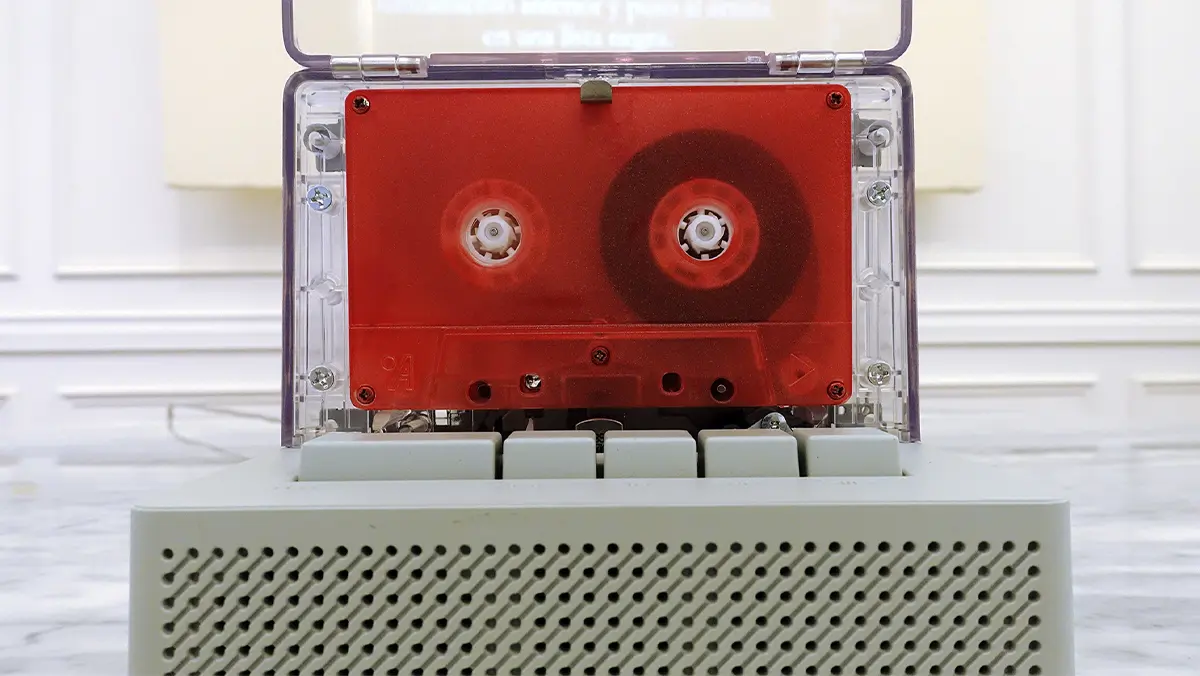
And then I said, “Why not?” It occurred to me to do it as a form of protest, you know? And I turned the album into a limited-edition cassette, complete with a really cute player and everything. The album was called The Rhythm Method, but the track was called Manumisión.”
“So, to be honest with you, I did it as a way of standing up to them and to say, ‘This was unfair,’ but I never thought it would actually happen,” he admits.
The price was very high. The first copy cost $1,000, and with each sale, the price went up by $500. The first cassette sold before the exhibition even opened, and the most recent one sold for $2,500.
“When it sold, the news spread like wildfire among my friends, because everyone was saying, ‘You made more money from that than you ever would have made in your entire life on Spotify’ or ‘than I’ve made in ten years on Spotify.’”
“There’s a girl from Al Jazeera who made a 17-minute documentary about the case. And then it was sold again, and again, and again. So, four of the five copies were sold.”
And that was the end of the matter, but this November the Yucatán Biennial, an event where Yoko Ono will also be present. The gallery Alantl currently works with, 54 Galería, has had a branch in Mérida for years. The gallery owners were going to include it in a group exhibition with other artists during the Biennial. Alantl suggested they take advantage of the presence of collectors from around the world to sell the last copy of the cassette at a record price.
“What streaming platforms have done is devalue the work of musicians. We want to make a symbolic statement and say, ‘Look, the work of musicians is valuable—and it’s incredibly valuable.’”

Has Spotify commented on this? “No, because technically it wasn’t an action taken by Spotify, but by the aggregator,” he says.
Manumisión’s latest piece at the Yucatán Biennial
Manumission consists of five copies on cassette. The last one will be presented on November 25 during a party attended by collectors. The intention is to offer it through an auction, with no limit on the price it may fetch.
The piece that each collector receives includes the cassette with its box, inside special packaging. It also comes with a certificate, as is often the case with contemporary artworks, but here Alantl played a little game with the document that attests to its authenticity: he turned it into a certificate of manumission.
“It was what slaves were given when they were freed, so that if they were stopped on the street, they could say, ‘No, no, I’m a free man.’ So, the certificate of manumission reads: ‘This certifies that you helped free a musician from slavery in the music industry.’”
Since it’s no longer common to own a cassette player, they also include one as a free gift. “It’s a really nice player. Technically, it’s not part of the set, but we give it to people who buy it.”

The case brings to mind the ironic song by the Spanish band Aviador Dro, “Qué vanguardistas somos” (“How Avant-Garde We Are”), which played on that competition to push experimentation ever further: releasing a single copy of an album or wrapping it in sandpaper so it would get damaged when taken out. In Manumisión, the intersection between music and art is also evident in the object the collector receives: a cassette in a special box, accompanied by a certificate that is part of the protest.
And after the protest, could the music return to a platform? Alantl doesn’t rule it out, though he’d first like to wrap up the project and speak with those who bought the cassettes.
“I know two of them, and I know who the others are. If I were to say to them, ‘Hey, the performance is over, it went well—we can put the song somewhere that isn’t sleazy, like Bandcamp or something like that,’ he says—and no, he doesn’t consider it an act of betrayal.”
Alantl hopes that the November 25 auction will take the conversation to a whole new level: how much a musician’s work is worth, and who decides that value. For now, a cassette tape has helped him make more of a splash than he might have expected.
Discover more connections between music, art, and algorithms in AW Magazine.