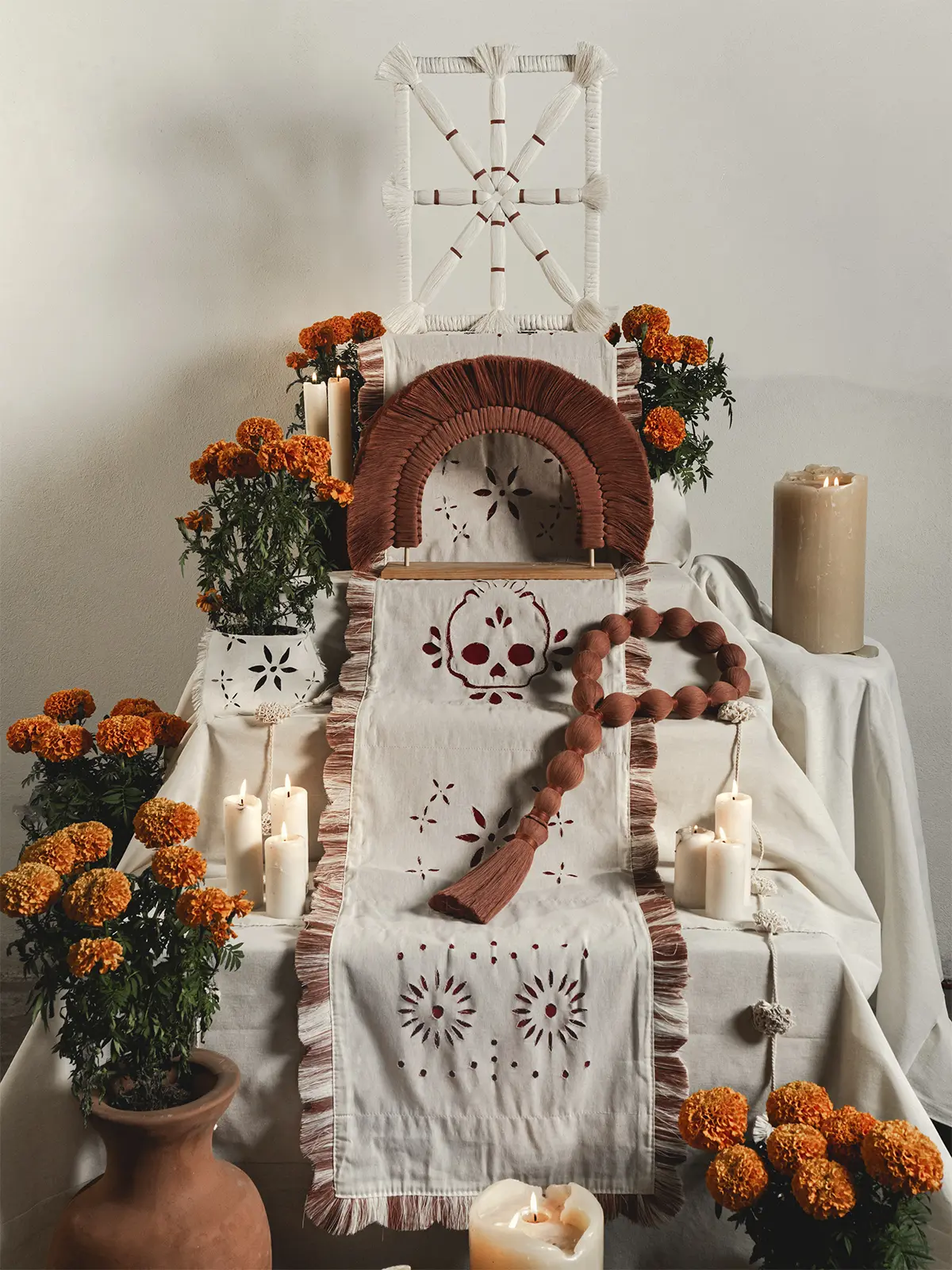

A sculptural rosary, cotton skulls, and a terracotta-colored fringed arch are the focal points of the offering created by the Mexican studio for the Hotel San Fernando.
The Day of the Dead is celebrated, paradoxically, with style and a tradition that takes an unconventional turn. On the Day of the Dead altar at Lounge Fernando , a large sculptural rosary coexists with a cotton path formed by skulls, seasonal flowers, and a colorful arch of terracotta fringe. On this designer altar, threads take on volume, and objects symbolizing remembrance and devotion to loved ones who are no longer with us find a unique and evocative material expression.
Without a doubt, CARALARGA, the Mexican textile design studio, has succeeded in bringing a fresh twist to the tradition of the Day of the Dead offering in the third edition of this colorful initiative.

A place steeped in this tradition: the Hotel San Fernando, in Mexico City’s Condesa neighborhood. Designed by CARALARGA, the venue continues to weave stories around a collaboration meant to endure. In this installment, it broadens its horizons with the goal of continuing to feature studios and artists who, from their own perspectives, engage with the Mexican tradition of the altar for the faithful departed.
This year, the installation focuses on designs using natural fibers and handmade techniques: the weaving, the knots, and the repetition of shapes come together to form a composition dedicated both to those who have passed away and to the crafts and customs that live on among the living. If this isn’t art, then perhaps nothing is.

Memory as a Starting Point
“CARALARGA approaches the Day of the Dead from the perspective of continuity. Absence finds a form of presence in repeated gestures, preserved objects, and customs passed down from one generation to the next. From this perspective, the altar offers a place to acknowledge the bonds that outlive those who created them,” states the official press release.
And yes, it’s clear that the design studio is embracing—in a positive sense—this conversation and presenting this tradition in an original format that’s perfectly tailored to its textile language and concept.”

The details, textures, and patterns that make up the pieces are designed to coexist with and complement the elements that define the Day of the Dead tradition. Celebration, remembrance, devotion, and longing are evident in the creation of the altar.
“The choice of fabric also draws attention to the work that makes each object possible. The bundles of cotton, the surfaces covered with yarn, and the exposed ends of the fibers allow us to recognize the decisions and manual gestures involved in their creation,” the press release adds.

Four pieces to assemble the offering
The installation consists of the following pieces: Rosary, Path of the Dead, Altar Arch, and Purépecha Frame. These four pieces, taken together, create a unique interplay between structure, ornamentation, and volume.
In *El Rosario*, an object associated with contemplation and memory takes on a sculptural scale. Its beads are made from spheres of reclaimed textile material, covered with yarn. The sequence of terracotta forms culminates in a long tassel that extends the piece’s movement. The repetition preserves the recognizable rhythm of the rosary, while the fiber alters its texture.
*El Camino de Muertos* features a composition on natural cotton. Flowers, skulls, and borders are arranged across a surface framed by fringe, where the ornamental motifs evoke the festive nature of the celebration. Within the ensemble, the piece serves as a visual journey that connects the various components of the offering.
The Arco de Altar draws its strength from a semicircular silhouette formed by layers of dense, terracotta-colored fringe. The concentric arrangement accentuates the volume of the fringe and creates variations in depth, light, and shadow.

For its part, the Purépecha framework consists of bundles of light-colored cotton arranged in an open structure. The contrasting ties and the ends that leave the fiber exposed make the union between materials a central part of its expression.
At Lounge Fernando, memory is also woven, tied, and covered in yarn. CARALARGA puts its textile language at the service of a tradition that brings us together each year with those who are no longer with us. Amid skulls, flowers, and terracotta fringes, the design finds its place in the offering.
Discover more art, crafts, and design in AW Magazine