
Spencer Tunick talks about “Gran Spectrum,” the photographic installation he will create on July 26 in Gran Canaria, Canary Islands.
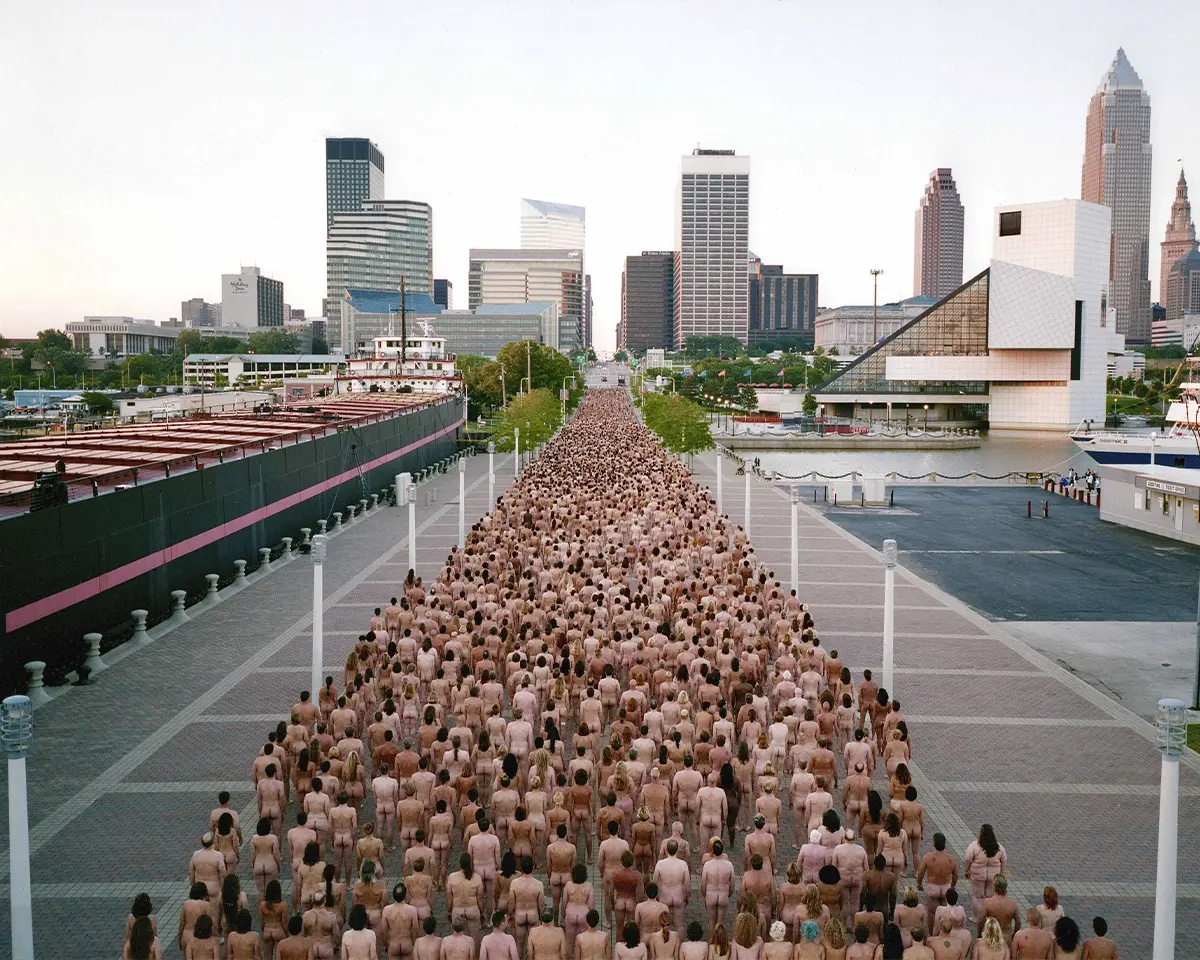
It’s rare to find someone who hasn’t seen one of his photographs, even if they don’t remember his name. The American photographer has been taking pictures of hundreds or thousands of nude people for three decades.

“When the organizer told me he’d like me to use the colors of the LGBTQI+ flag, I thought there were only six or seven colors; when they told me there were 11 colors, I couldn’t believe it. So I spent the whole summer testing out the shades of body paint on people. My wife got furious because all our clothes, the floor, and my studio were covered in paint,” he says.
Spencer Tunick asks me about a song playing in the background (which is Bryan Ferry); and that gives him a chance to tell me a little about his favorite music: “This year I’ve been listening to Mike D from the Beastie Boys. He has a new album, and I really like his song ‘Switch Up,’ he tells me, while also confessing his devotion to classic American indie-rock bands like R.E.M. and Pavement.”
“In my early years in the art world, I listened to a lot of alternative music,” he tells me, “I would incorporate musicians who appeared in the installations while the audience, at the same time, played the piano. “There was an Afro-Hungarian band that appeared in the frame while people took their clothes off for the photos, of course…” he recalls.
But when his photographic installations began to become more controversial and there was a risk that they would all be arrested, the musicians stopped showing up. Perhaps their love of art wasn’t that unwavering? Or maybe they simply didn’t want to be arrested by the police. It was the late ’80s and early ’90s, a time when art and music were in full swing. Against that backdrop, Tunick presented his first, much-discussed group works. “Those times have changed,” he tells me.
All of the projects he has undertaken in Latin America have come about through invitations from people in those countries. In the case of São Paulo, as well as Mexico City, the invitation to work came from a curator named Mireya Escalante, who showed a deep interest in his work and kept the project moving forward until it became a reality.
The process took about three years, since it was necessary to wait for a change in government. Once conditions were favorable, the project was unveiled to the public and received significant media coverage—at least from those who aren’t afraid of nudity, we assume.
“The cityscape is different now, because everyone is afraid of terrorism,” he says. “After the attempt to bomb the World Trade Center, the city began to fill with large barriers. The way people move around on the streets is different now, because many urban restrictions were imposed in New York due to concerns about violent individuals.”

Gran Spectrum aims to be “a collective image of visibility, diversity, and equality to recognize the fundamental rights of the LGBTIQ+ community.” The photo installation will take place next to Culture & Business Pride.
He expects that, in just 20 minutes, some 4,000 people covered in body paint will form a new photographic composition.
“Nudes are still something subversive, something that makes conservative people very uncomfortable. But when you combine art with the body and bring it into the public space, it’s like an explosion of life.”
For him, working in a new country is not a right, but a privilege that depends on an invitation from those who live there. “I wait patiently and hope that invitations will come from places I haven’t been to,” he explains. He believes that when a performance piece takes place in a new context, “it’s truly beautiful,” because it connects people with art, pluralism, and a shared experience that he describes as “a euphoria.”
When discussing the state of civil liberties around the world, he argues that there is a clear imbalance and that social media is making it increasingly visible. As an example, he cites the case of an Iranian singer who, he notes, was punished for appearing in public without a hijab. “This isn’t a form of conservatism. I think it’s a form of madness,” he says. Although he acknowledges that religion can bring people together, he warns that it can also become a source of violence when taken to extremes.

With regard to the United States, she expresses deep concern about the political and social climate. She asserts that “the government is spreading misinformation about the trans community” and that this has contributed to creating a hostile environment toward that population. “People who lack education and empathy create this idea that the trans community is dangerous, when it isn’t,” she laments.
That same stance explains her decision to leave the X platform. “I left that social media platform because its owner, Elon Musk, is spreading a lot of misinformation, and because of the way he treats his transgender daughter,” she says. He even questions the presence of cultural institutions on that social network: “I can’t believe why museums would still be on X. It’s crazy for a museum to be there.”
Regarding possible misunderstandings surrounding his work, he believes that the best way to understand it is to see it in an exhibition. “The only time people can truly understand my art is when they see it in a museum or a gallery,” he says. He explains that, in that context, the work “fades into the background” and begins to follow the rules of contemporary art: the viewer stops in front of it, observes it, and establishes a direct dialogue with it.
On the other hand, he believes that this experience is lost when the work circulates solely on the internet or through platforms like Wikipedia, where everything tends to be reduced to information or documentation (no, we didn’t consult that website for this article—I wanted to tell him that… but I didn’t). That’s why he’s tried to make his website as simple as possible— “like a gallery”—so that the public can engage with the work in the same way he conceives it. “If you go to my website, that’s how I see it. Or if you go to an exhibition, it’s the same thing.”

She clarifies that she is referring to the results of her work and not to the live performance itself, since she considers them to be two distinct dimensions of her artistic practice. “There are two sides to my work. One is the live performance installation, which is a bit violent and magical. And then there’s the photographer, which is like a diorama.”
That comparison with a diorama sums up the way he understands his images. “When you go to a museum and see a diorama behind glass, my work has that same value. It has that quality of a piece meant for contemplation,” he explains. In some cases, he adds, he also finds parallels with color-field painting, where the experience “arises from prolonged observation rather than an immediate narrative,” he concludes. In the end, we talked a bit more about music, and he convinced me to give the former Beastie Boys member’s new album a listen. Although what might never convince me is appearing in one of his photographs.
More news from the world of photography and art in AW Magazine.