
The Karen Huber Gallery has championed contemporary painting from a non-conformist perspective: as a field of formal, material, and critical inquiry. Based in Bucareli, its program brings together Mexican and international artists who view painting as a medium, a body, an image, an object, a memory, and a conversation.
Gallery Profile
The Karen Huber Gallery was founded in 2014 with a clear goal: to dedicate a gallery to contemporary painting at a time when much of the artistic discourse seemed to be turning toward other media. Painting continued to be produced, but it was burdened by long-standing suspicions: too marketable, too historical, too closely associated with the canvas. Huber transformed that tension into a sustained line of work based in Mexico City to explore what painting could achieve when it allowed itself to be influenced by other forms.
The inaugural exhibition was a solo show by Ad Minoliti at the Vizcaya building. That beginning did not position painting as a conservative territory. Minoliti was already working with geometry, feminism, design, video, silkscreen printing, and political fiction; her practice allowed for an understanding of the painting as an expanded form, capable of addressing body, space, and identity. From there, the gallery began to develop a program in which painting did not have to defend itself as a “pure” medium, but rather serve to raise formal and conceptual issues.
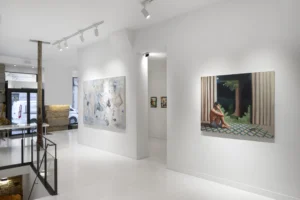
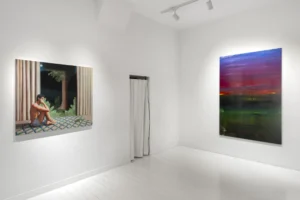
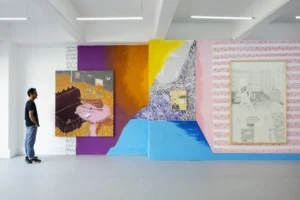
The current group of artists represented by the gallery confirms this direction. Lucía Vidales explores painting through fragmented bodies, material accumulations, and historical imaginaries that affect both form and surface. Allan Villavicencio conceives of the painterly process as metabolism, incorporating assemblages of materials, textile fragments, and residual landscapes. Christian Camacho works with the precision of square brushes, pictorial mosaics, and industrial landscapes linked to Monterrey. Marc Breslin incorporates the camera as an aid to painting, not as a departure from painting.
The international dimension broadens the conversation without obscuring its Mexican focus. Eva Vanderhorst-Ayache works across painting, installation, writing, and performance; in her current exhibition, she uses worn sheets and metal structures to explore forgetting, presence, the body, and Franco-Algerian postcolonial memory. Ian Grose, born in Johannesburg, has been featured in the gallery’s fairs as part of dialogues between Mexican and international painting. Kanako Namura, Keke Vilabelda, and Endy Hupperich are part of this same expanded painting scene, where the medium, composition, and materiality carry as much weight as the image itself.
Our conversation with the gallery owner provides a better understanding of Huber’s position. Her defense of painting is not a rigid mantra, but rather a form of public discourse. Hangouts, discussions surrounding each exhibition, and an interest in collaborating with curators, institutions, art fairs, and artists are all part of the project. Her interpretation of the Mexican art scene also becomes evident here: a powerful ecosystem, comparable in ambition to other capitals, but still in need of more robust criticism, institutions, and public collections.
The anniversary exhibition, *All This Time, All This Painting*, showcased the accumulation of eleven years of work. It brought together artists who had been involved from the beginning, collaborators from different stages, international figures, and new additions. It was not just a celebration; it also took stock of a commitment: to uphold painting when it seemed secondary and to witness its reemergence, years later, as one of the most vibrant areas of contemporary art. César Rangel Ramos, with *Señora Lapislázuli*, appears there as part of an exploration of support, mounting, and his own techniques.
“From day one, from the very first exhibition, we’ve been committed to painting.” — Karen Huber, Art Weekends, 2026
This statement encapsulates a determination, but also a sense of responsibility. Karen Huber has treated painting as an uncomfortable refuge, as a practice that requires dialogue, context, and a direct relationship with artists and audiences. That is why her gallery stands out in Mexico City. It presents works and creates the conditions for viewing them with greater precision. On Bucareli Street, this approach takes on a concrete urban scale, situated at the intersection of archive, transit, and public memory.
Why Go
It’s worth visiting because Galería Karen Huber offers insight into one of the most persistent debates in the recent Mexican art scene: what painting can still be when it is no longer limited to the canvas or to recognizable gestures. Its program does not treat the medium as a source of nostalgia, but rather as a working territory that encompasses installation, textile media, photography, ceramics, architecture, the body, and memory.
Since her inaugural exhibition with Ad Minoliti—whose practice spans geometry, video, silkscreen printing, feminism, and political fiction—Huber has interpreted painting as a practice capable of extending into other media. That perspective remains evident in artists such as Lucía Vidales, who works with painting as body and matter, or Allan Villavicencio, who takes it into the realm of assemblages, fragments, and residual landscapes.
Its location on Bucareli is also significant. It is neither within the more tamed circuit of Roma Norte nor at an elegant distance from Polanco. It is situated in a transit zone between Centro, Juárez, and La Ciudadela, where painting is surrounded by archives, commerce, public architecture, political history, and street life. That urban friction suits a gallery that presents painting not as a refuge, but as an active arena for discussion.
What to Expect
The tour begins on Bucareli, an avenue that doesn’t make for a gentle introduction. There’s traffic, shops, buildings from different eras, offices, uneven sidewalks, and it’s right next to La Ciudadela. The gallery occupies the first floor. You have to go upstairs, step away from the noise for a moment, and accept that the space appears with an almost domestic discretion, far from the more recognizable layout of the galleries in the Roma neighborhood.
Once inside, the gallery invites visitors to observe how each work is constructed. In Karen Huber’s work, the painting appears not only as a hanging surface, but as an altered support, a used canvas, a chromatic structure, an object akin to an installation, or an image filtered through other media. The viewing experience typically requires both distance and closeness at the same time: taking in the overall composition, returning to the details, measuring the edges, following the material, and noticing how the work occupies the wall and what space it leaves to breathe around it.
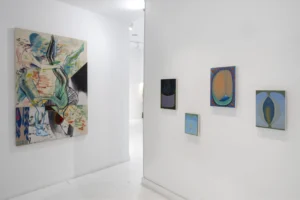
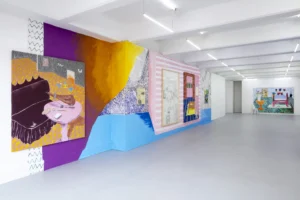
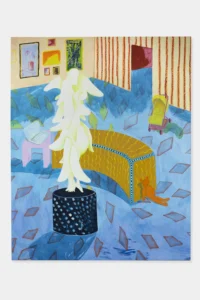
The current exhibitions confirm this breadth. Marc Breslin works from a relationship between the camera, visual memory, and painting; he himself has noted that he uses the camera to support his painting practice, not to define himself as a photographer. Eva Vanderhorst-Ayache, on the other hand, extends the image to include used sheets, the body, oblivion, repair, and installation. The coexistence of these two exhibitions allows us to understand how the gallery broadens the scope of painting without reducing it to an empty phrase.
Karen Huber’s program benefits from a slow pace, from delving into the logic of each exhibition, and from letting Bucareli play its part. Upon leaving, the area offers a rare sense of continuity: an archive, a library, murals, old-fashioned cafés, nearby museums, and streets where the city still retains a blend of wear and tear, intensity, and public memory.
Represented Artists
What to Do Nearby
After visiting Karen Huber, it’s worth stopping by La Ciudadela. Across the street, the Biblioteca de México offers a chance to extend the visit through a different medium: not fabric, but books, archives, and personal collections. The personal libraries of Carlos Monsiváis, José Luis Martínez, Jaime García Terrés, Alí Chumacero, and Antonio Castro Leal transform reading into a tangible experience: furniture, notes, organizational systems, and volumes collected over a lifetime. This stop complements a gallery focused on how a space can carry memory.
From there, it’s a pleasant walk along Bucareli toward the Chinese Clock, a reminder of the city’s former urban ambition—an avenue that is now more complex than it is monumental. The area has a somewhat untamed beauty: administrative buildings, hotels, small restaurants, workshops, traffic, and street corners where you can still feel what the city center was like before it became a postcard-perfect scene. For a meal or a coffee, Café La Habana serves as a historical respite rather than a novelty: located at the corner of Morelos and Bucareli, it features tables perfect for long conversations, café con leche, after-dinner chats, and a literary legacy that needs no decoration.
The route may wind its way toward the Alameda, with the Diego Rivera Mural Museum serving as a direct contrast: after a gallery dedicated to contemporary painting, *A Sunday Afternoon Dream in the Alameda Central* shifts the scale of the image toward public narrative, national history, and the crowd. If you still have energy left, the Museum of Folk Art on Revillagigedo reveals another material layer of the city: textiles, papier-mâché, ceramics, wood, paper, color, and craftsmanship. The complete sequence—painting, library, café, mural, material culture—prevents Bucareli from becoming merely a stop along the way.


