
Kurimanzutto transformed the landscape of contemporary art in Mexico by envisioning a gallery rather than a building: nomadic projects, artists at the center, and a local dialogue capable of reaching beyond its walls. On San Miguel Chapultepec Street, its headquarters maintains that tension between experimentation, institution, the art market, and the city.
Gallery Profile
Kurimanzutto was founded in 1999 with the idea of creating a gallery for a generation of artists who needed structure and freedom but did not yet fit into a precarious local market. Mónica Manzutto and José Kuri developed that vision with Gabriel Orozco, who saw the urgency of opening a space for contemporary practices that lacked sufficient support in Mexico. The first exhibition, Market Economy, lasted less than twenty-four hours in a rented stall at the Medellín Market, almost like a futurist manifesto.
That nomadic origin explains the gallery’s character. During its early years, Kurimanzutto staged exhibitions in markets, parking lots, fairs, homes, restaurants, shipping containers, and other venues where the traditional gallery space could not be taken for granted. The gallery learned to respond to specific projects rather than the other way around. That reversal of hierarchies—the artist before the building, the situation before the showcase—established an ethic that still shapes its program and its day-to-day working methods.
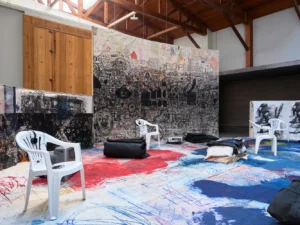
The program brings together artists who have made displacement a way of thinking. Gabriel Orozco, Abraham Cruzvillegas, Damián Ortega, Minerva Cuevas, Rirkrit Tiravanija, Allora & Calzadilla, Haegue Yang, Leonor Antunes, Nairy Baghramian, and Gala Porras-Kim, among many others. The list encompasses conceptual practices, installations, archives, painting, sculpture, film, performance, institutional critique, and forms of social relations. As a whole, kurimanzutto has understood representation as an accompaniment to trajectories.
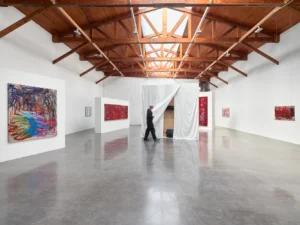
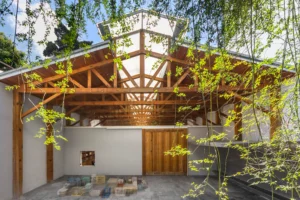
The San Miguel Chapultepec location cemented that legacy. Housed in a 1949 building that once served as a lumberyard and industrial bakery— and renovated by Alberto Kalach— the gallery retains its wooden ceilings, abundant natural light, and a spacious layout that doesn’t try to masquerade as a museum. Its location matters. It is not in Roma or Polanco, but in a neighborhood where art coexists with modernist architecture, cantinas, quiet houses, and an urban landscape somewhat less saturated by the dominant cultural spectacle and gentrification—though we don’t know for how long.
Kurimanzutto helped expand the scope of what is possible for a Mexican gallery. Its presence at international art fairs and its New York office have reinforced the idea of a gallery as a flexible structure, capable of fostering risk-taking and dialogue. In a scene where global circulation can render spaces interchangeable, kurimanzutto preserves a memory of adventure: the sense that an exhibition can still change the rules of the place where it appears.
"We created Kurimanzutto not as a business, but as a way of life"—José Kuri, co-founder of Kurimanzutto, in an interview with AD magazine
To keep exploring this thread, visit contemporary Latin American art; you can also continue through contemporary art galleries in Latin America.
Program
“Contracorrientes,” by Dr. Lakra and Miguel Covarrubias, blends drawing, cartography, ceramics, and visual culture through a Pacific-centric lens.
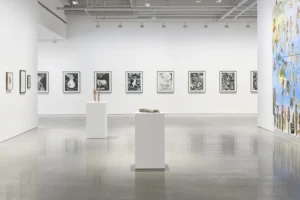 Series: “Contracorrientes” by Dr. Lakra and Miguel Covarrubias – kurimanzutto Gallery.
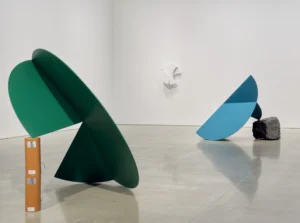
Your cost-bJanfit calculations de GApriel Kuri:(January – March, 2026)
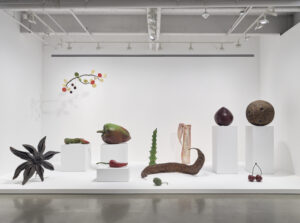
midnite porridge: ming fay (November – December, 2026)
Why Go
Kurimanzutto is well worth a visit because few galleries offer such a clear insight into a pivotal aspect of contemporary art in Mexico: the transition from a scene with limited infrastructure to an international dialogue sustained by artists, art fairs, institutions, collectors, and far-reaching projects.
Its significance lies not only in the names it represents—a list that is both extensive and compelling—but also in the way it has supported practices that do not always fit neatly into conventional categories: archive, performance, installation, research, institutional critique, expanded painting, film, sculpture, social relations, and forms of production that vary according to context.
It is also worth visiting for its location. In San Miguel Chapultepec, the space functions neither as a neutral container nor as a decorative gesture; it retains an industrial heritage that compels the works to engage with scale, light, wood, and empty space. A visit helps one understand how a gallery can be a marketplace, a platform, a laboratory, and a meeting place without entirely losing the restlessness of its nomadic origins.
What to Expect
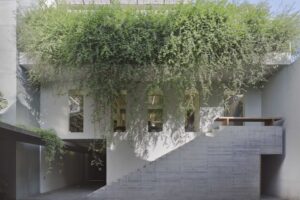
The visit to kurimanzutto begins with a tension between the neighborhood and the project. San Miguel Chapultepec feels like a realistic setting (and somewhat gentrified as well). It retains low-rise houses, tree-lined streets, small local shops, and a proximity to Chapultepec that makes walking through it feel greener. The gallery is housed in a former industrial building, whose understated design avoids any showy gestures. Even before entering, one gets a sense of its mission: art is not separated from the city, but rather fits within an architecture that still retains the memory of the artistic craft.

Inside, the spaciousness changes the pace. The main hall allows visitors to view the works from a distance, and the wooden beams, the light, and the volume serve as a reminder that every project must adapt to a specific space. This is not a gallery to be walked through like an inventory, because it works best when the visitor understands the difficulty of a curatorial installation—which is also important—and that an exhibition can foster conversation, dialogue, and even, why not, surprise and confusion.
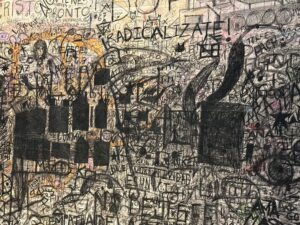
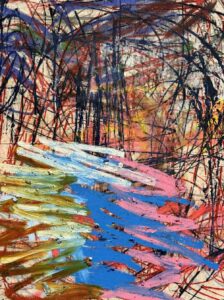
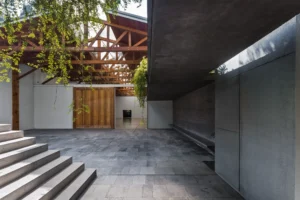
The program can shift from sculpture to the archive, from the relational to institutional critique, from painting to practices where the object matters less than the situation it creates. In its recent exhibitions, research takes various forms. Museums and conservation in Gala Porras-Kim’s exhibition; drawing and visual culture in Dr. Lakra’s and Miguel Covarrubias’s. The experience demands attention, but no extensive academic background is required. It is best to take your time, let the works raise questions, accept areas of ambiguity, and not rush to a definitive conclusion.
As you leave Kurimanzutto, you’re left with a sense of a scene in motion. Mexican and international artists, a history born without a fixed home, and an architecture that now preserves that memory without turning it into a museum of itself. The gallery serves as a highlight on a tour of San Miguel Chapultepec, but also as a reminder that some private institutions have shaped the way the city engages with contemporary art. The best way to experience it is to walk around and let the neighborhood breathe life into your experience of the exhibition.
Represented Artists
What to Do Nearby
After leaving Kurimanzutto, San Miguel Chapultepec is well worth a leisurely stroll. The route can continue on foot to the Enrique Guerrero Gallery, where the neighborhood offers a different scale of exhibition spaces and a more subdued engagement with painting, installation, and intergenerational dialogue. If you want to expand your range, LABOR is located on the other side of Constituyentes, near Daniel Garza. The change in neighborhood shifts the tone and fosters a strong dialogue with contemporary practices of high conceptual density.
To take things down a notch, Café Papagayo serves as a natural break. If the day calls for architecture, the Luis Barragán House and Studio emerges as an almost inevitable extension of the itinerary—an opportunity to reflect on art and a different way of understanding how a space shapes the experience. And if the tour stretches into the afternoon, Bar El Bosque shifts the tone with its cantina atmosphere, salt-baked fish, and that neighborhood energy that keeps the tour from becoming too polished.


