
Regardless of his personal life or political convictions—and his own human contradictions—history tells us that Diego Rivera was a deeply altruistic artist, both in his work and in his public engagement, always focused on uplifting the masses.
More than 150,000 pieces are being added to the Anahuacalli collection, drawing on a history that predates the museum’s own legacy
That is why it is particularly significant that one of his grandsons, Juan Rafael Coronel Rivera, decided last month to donate more than 150,000 pieces—157,300 to be exact—to the collection of the Anahuacalli Museum, an institution with which he shares, at the very least, a strong blood tie. And this is despite the fact that he himself has stated that he never felt close to that environment and was never even considered part of the Diego Rivera and Frida Kahlo Museums Trust (FMDRFK), created by Rivera himself to preserve both the Blue House (Frida Kahlo Museum) and the Anahuacalli Museum.

Juan Coronel is a poet, photographer, storyteller, and art historian; he is also a curator, ethnologist, and editor. He has carved out his own path; in fact, he has never devoted himself to painting, much less muralism. Apparently, he does not make a living by caressing and bringing utopias to earth like his famous ancestor.
“Diego Rivera was an idealist; he believed that human beings could have a very clear perspective, like a kind of renaissance. He believed in a reevaluation of humanity and the context in which he viewed indoctrination; it was the possibility of moving toward equality—not only economic but also metaphysical,” he revealed in an interview.
Juan Coronel Rivera is the son of Ruth Rivera, who is the daughter of Diego and the writer Guadalupe Marín.
Between legacy issues and an idea ahead of its time
Regarding his legacy, he once stated, according to the Mexican federal government’s official website, that he had, in fact, Diego Rivera bequeathed a legal problem that had been ongoing for more than 20 years, “while he created a private trust—an unthinkable act for his time—to ensure the preservation of his collections, including paintings, drawings, studies, and photographs, as well as pre-Columbian artifacts.”
That is why this donation, which is now official and irrevocable, is so significant. At a press conference, Colonel Rivera presented the documents certifying the notarized donation contract and emphasized that, like the trust established by his grandfather with the Bank of Mexico, there is no set expiration date.

At the same event where the ceremony took place, Perla Labarthe Álvarez, director of the Frida Kahlo Museum – Casa Azul, highlighted the visionary nature of the trust created by Diego Rivera, adding that it not only ensured the preservation of properties, collections, and archives, but also laid the groundwork for their long-term sustainability and their role as public heritage.
He noted that both the Casa Azul and the Anahuacalli Museum stem from the same conviction: to share with the public a collection built on the artists’ collecting practices, cultural identity, and daily lives.
He also emphasized that the collection assembled by Juan Coronel Rivera opens up new possibilities for research and interpretation: “It’s not just about adding pieces to the collection, but about generating new perspectives on Mexican art and its cultural processes.”
A collection conceived as a story in motion
Coronel Rivera’s collection is no small feat. It is not a random collection of pieces, but rather the result of years of curatorial obsession, research, and a personal perspective on Mexican art. Let’s say it is a living archive of works and objects rooted in personal taste, yet with a perspective that allows us to understand how art has evolved in Mexico over time.
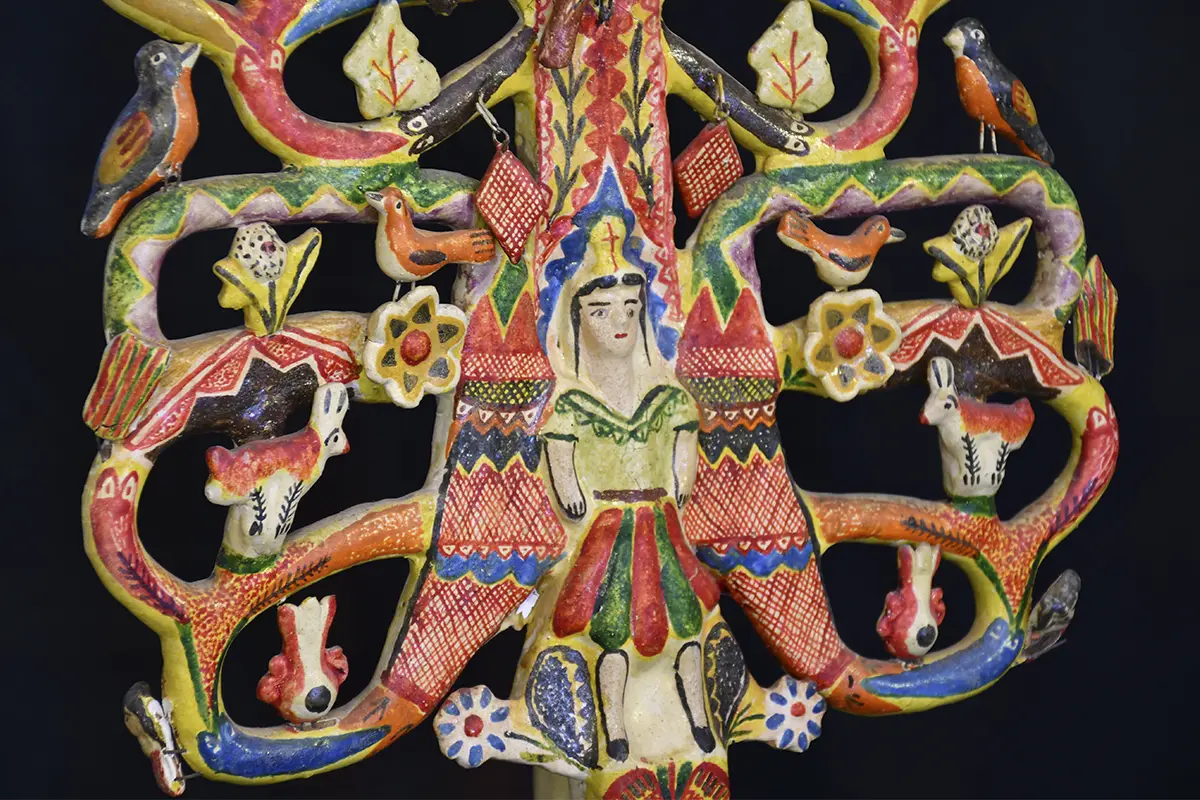
The collection spans different eras and formats, ranging from ceramics and textiles to personal archives, correspondence, photographs, and working materials. It is not a collection designed for display cases or Instagram, but rather a broad map of relationships, influences, and cultural processes.

Also included is his own body of photographic work, developed over the years—a body of work that engages with everything else and ultimately reinforces this concept of the archive as something in motion. Now that it is part of the Anahuacalli, this collection will not only add to its volume but also contribute significantly to the way art history in Mexico is researched, exhibited, and told.
As Colonel Rivera himself explained, the donation process is expected to be completed later this year. He also clarified that the collection does not include works of art by his grandfather, Diego Rivera, or by Frida Kahlo, who was his step-grandmother.
The Anahuacalli: A museum conceived as a cultural horizon
The Diego Rivera Anahuacalli Museum is not just any space, but a project that was conceived from the outset as more than just a museum: a place where art, architecture, and landscape come together. Built with volcanic stone from Pedregal and designed by Rivera himself alongside Juan O’Gorman and Ruth Rivera Marín, the building blends seamlessly into the surroundings of southern Mexico City. It houses the pre-Hispanic collection that Rivera assembled throughout his life, understood not as relics, but as a source of knowledge about Mexican cultural roots and identity.

In recent years, the space has increasingly embraced contemporary projects that connect the collection to current issues, reinforcing its role as a place where the past is not frozen in time but is in constant dialogue with the present.
This donation also paves the way for reviving one of Diego Rivera’s most ambitious ideas for that site: the so-called “City of the Arts,” a project that sought to bring together various cultural spaces in the Anahuacalli and which, in recent years, has begun to be revived with the collaboration of architect Mauricio Rocha.

Undoubtedly, beyond the symbolic and personal significance of this donation, the gesture means a great deal to Mexican cultural life. Not only because of the sheer volume, but also because of the historical significance of the pieces assembled by a curator who has always had privileged access to works of that scale and caliber. And also because, in a way, it reveals that altruistic connection and, to some extent, reconciles Juan Coronel Rivera’s relationship with his own past.
To keep exploring this thread, visit our spaces with soul section; you can also continue through homes and spaces with a story.