
The Historic Center of Zacatecas seems untouched by the passage of time. The pink stone has retained its original hue for over a century, and the facades have barely changed.
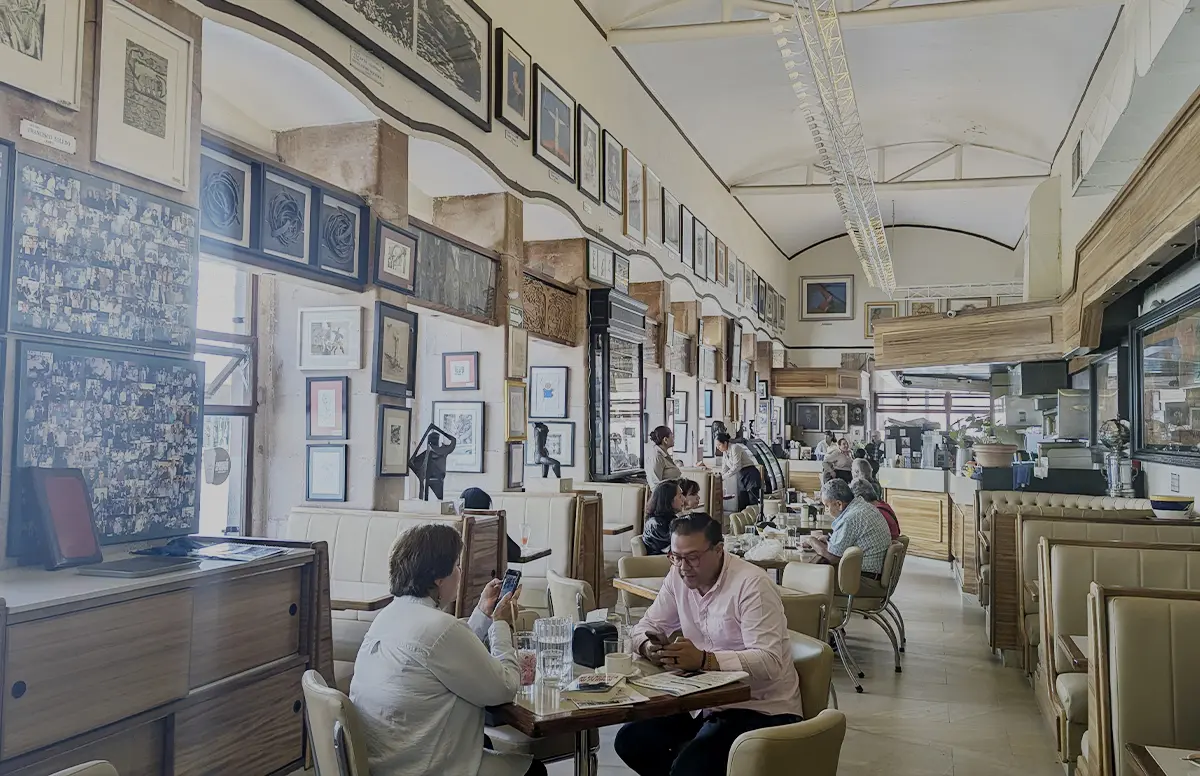
The highlight of the area is the Acrópolis restaurant, the city’s most legendary and sought-after café. It’s not just a place to eat; it also serves as a small art gallery and a gathering place for local political and cultural figures.
Its history began in 1943, more than 80 years ago.

Three generations, one vanilla ice cream
A man in his mid-forties is walking down Hidalgo Avenue with his three-year-old son. The father was born in Zacatecas, but the boy is Zacatecan only by heritage. The two are visiting the city of their grandparents. The heat is relentless and is beginning to take its toll on both of them. The boy is begging for an ice cream.
They enter the Acropolis, where they are greeted warmly. The boy looks at the old coffee machines with curiosity. The two of them sit down; the boy is given his ice cream, and the father looks around.
At the neighboring tables sit some unmistakable figures: the old hands of the local left, the professors emeritus, the lifelong politicians. It’s an afternoon like any other. That’s the Acropolis: a generational crossroads where people of all ages come together within the same walls and under the same paintings.

Syria, Paris, Zacatecas
The story began in 1943, when Said Samán Farah, a Syrian immigrant who had previously lived in Paris, opened a café in a city where only taverns were to be found. The young entrepreneur was looking for a place where men, women, and children could sit and socialize.
The store was always located on Hidalgo Avenue, but at three different locations. At first, it was located where the El Paquín stationery store stands today; later, in a space across from it; finally, in 1983, Acrópolis moved into the González Ortega Market. From that point on, it became one of the most important landmarks in the Historic District.
Today, it is located across from the Cathedral, the Government Palace, and the Calderón Theater.

Eating while the construction is underway
Over time, the walls began to fill with works of art. The best-known story goes that one day Rufino Tamayo gave a drawing to the restaurant’s owners. The piece found its way onto the restaurant’s wall. This gesture encouraged other artists to do the same. The collection continues to grow , even today.
Today, you can see paintings by Francisco Goitia, Manuel Felguérez, Pedro and Rafael Coronel, and many others. There are also works by Pablo Picasso and Joan Miró. Visitors can enjoy a milkshake or a cup of coffee while viewing pieces that, in other settings, would be on display in a museum.
The Acropolis is both a restaurant and an art gallery. There’s no need to approach these works with solemnity; all you have to do is look up.

Tables and History
Mexico has a long tradition of historic establishments that have welcomed generations of visitors. La Acrópolis belongs to the same family of venues as the Danubio restaurant and the Chiandoni ice cream shop, both of which are still open to the public.
For more than 80 years, the Acropolis has been a gathering place for families, politicians, and artists. Its tables are not only set with coffee and milkshakes, but also with conversations, agreements, discussions, and memories that eventually become part of the city’s daily rhythm. Every customer leaves something invisible behind: a brief story that adds to so many others.

There are few places capable of maintaining that continuity without becoming static relics. The Acropolis succeeds in this because it does not live off the past, but rather integrates it. The works on its walls are not lifeless pieces; they engage in a dialogue with those who view them. The generations that pass through its halls do not break with those that came before; they overlap.
The boy finishes his vanilla ice cream and looks at the coffee machines again. His dad pays the bill. The center of Zacatecas awaits them. Perhaps, in the future, the boy will return to this place as a student, an adult, or a parent.
To keep exploring this thread, visit our architecture coverage; you can also continue through buildings with history in Latin America.