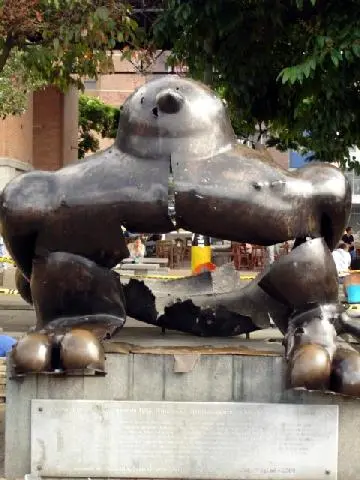
Elvira Moreno Gallery is based in San Felipe, Bogotá, and focuses on contemporary exhibitions and research into Latin American artistic legacies. The gallery opened in 2019 and solidified its structure in 2021, following the disruption caused by the pandemic. Its program offers visitors the opportunity to explore both historical works and recent installations, accompanied by documentation on the artists and their creative processes.
Gallery Profile
Elvira Moreno opened her independent gallery in Bogotá in 2019. The pandemic halted the project’s progress just a few months later, and the gallery itself dates the start of a more structured phase to September 2021. Moreno initially studied design and later specialized in the appraisal and valuation of artworks and antiques in Madrid. Francisco Arévalo directs the artistic program.
The programming in those early years already combined contemporary artists with historical retrospectives. In 2020, it presented *Geometries and Abstractions: A Tribute to Negret*. In 2021, exhibitions such as *Constructive Forms, Origins, and Progression* by Jorge Riveros and *Utopias of the Immaterial*, curated by Francisco Arévalo, were held. In 2022, these were followed by *Diáfana, Gramátical* by the Cuban artist Ernesto Leal and the group exhibition *Ethos*.
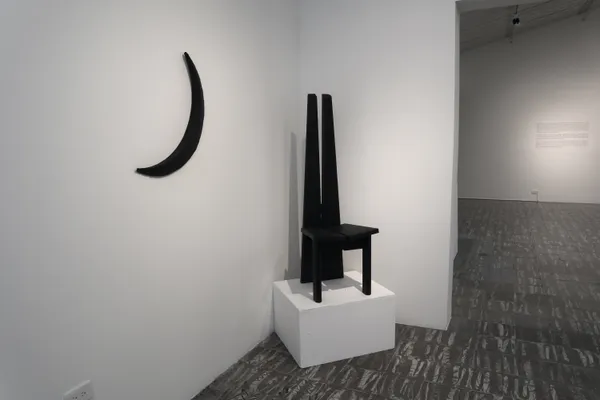
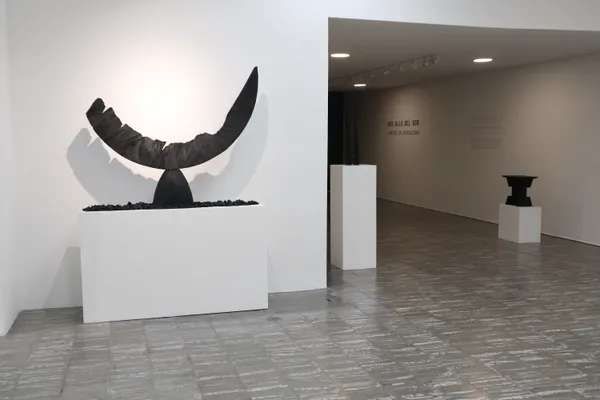
Ana María Rueda (Bogotá, 1954) is currently one of the artists represented. Her career began in painting during the 1980s, and she later incorporated photography, video, and installation. In 2026, the Museum of Modern Art in Bogotá dedicated *El caos sensible* to her, curated by Eugenio Viola—a retrospective exhibition that brought together more than forty years of her work. Miler Lagos (Bogotá, 1973) works with materials such as paper, books, and wood. In *La Reserva*, presented by Elvira Moreno in 2024, he began with a fragment of a century-old tree felled in the Rosales neighborhood of Bogotá and left the marks made by the chainsaw visible in several pieces. Miguel Cárdenas (Bogotá, 1973) studied at the Rhode Island School of Design and later earned an MFA from Columbia University in New York. He has worked with painting, sculpture, drawing, and animation and has exhibited in Colombia, the United States, the United Kingdom, Mexico, and Ecuador.
The gallery’s international expansion began to take shape in 2023, when it participated for the first time in the main section of ARTBO. In 2024, it took part in Zona Maco and the Opening section of ARCO Lisbon. It then returned to Zona Maco and ARTBO and participated in Art Basel Miami Beach. In September 2026, it once again took part in ARTBO.
The program also includes artists whom the gallery has exhibited without representing them on an ongoing basis. Feliza Bursztyn (Bogotá, 1933–Paris, 1982) incorporated scrap metal, motors, and movement into Colombian sculpture beginning in the 1960s. Ana Mendieta (Havana, 1948–New York, 1985) created performances, films, and photographs during the 1970s that were initially linked to her body and later to the silhouettes she created on the ground.
Mira Schendel (Zurich, 1919–São Paulo, 1988) produced thousands of monotypes and drawings on Japanese paper during the 1960s, many of which were composed of letters and symbols. Delcy Morelos (Tierralta, Colombia, 1967) moved from painting to large-scale installations using earth and organic materials and participated in the 2022 Venice Biennale. Paolo Gasparini (Gorizia, Italy, 1934), who has lived in Venezuela since the 1950s, has spent decades photographing architecture and urban life in Latin America.
Program
Why Go
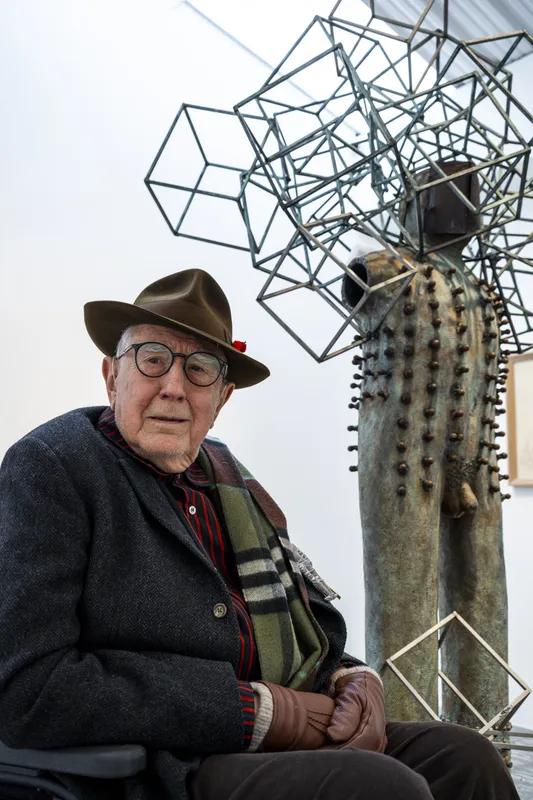
Jim Amaral ’s current exhibition comes on the heels of a particularly extensive public review of his work. Between December 2022 and March 2023, the Museum of Modern Art in Bogotá presented *Jim Amaral: etcéteras*, a retrospective featuring more than 250 works spanning six decades. The exhibition occupied spaces in the Torre Atrio and became one of the most-visited exhibitions of that season.
Diego Garzón Carrillo wrote in *Cambio* that Amaral’s work “doesn’t make it easy for the viewer” and pointed out the ambiguity of sculptures in which recognizable figures coexist with associations drawn from dreams, mythology, and scenes that are difficult to reconstruct. El Tiempo described *Etcéteras* as a journey through more than 260 works and highlighted the public’s response, with nearly 10,000 visitors during the first few weeks. Between November 2024 and February 2025, MoMA included Amaral’s work in *Vital Signs: Artists and the Body*, an exhibition of more than 100 works focused on different ways of representing and conceiving the body during the 20th century.
ARS CORPORA ARS takes a very different approach from the MAMBO retrospective. Instead of spanning six decades, it focuses on a ten-year period, from 1969 to 1979. Some works from that period already have an institutional history of their own: *Untitled*(1971) and *Study for a Love Poem*(1972) belong to the MoMA collection, which included Amaral in *American Drawn and Matched* in 1977 .
Miguel Cárdenas comes to Elvira Moreno after several projects in which painting and sculpture have appeared together. In 2022, he presented *Mystic Animals and the Juggling of Hot Stones* at Kendall Koppe in Glasgow, where viewers could observe his diverse techniques—paintings featuring animals, ruins, and constructed scenes alongside bronze sculptures mounted on wooden bases. In 2024, *Shadow Garden*, presented at Margot Samel in New York, once again brought together painting and sculpture. A year later, *Memorias del Colapso* took over Espacio Continuo in Bogotá. A review published by Cerosetenta specifically highlighted some of the sculptures and the coexistence of animals, teeth, geometric forms, and other objects in the gallery. *Estrella fugaz* is Cárdenas’s first solo exhibition at Elvira Moreno. It does not consist of a historical selection like Amaral’s, but rather a installation created specifically for this space in 2026.
What to Expect
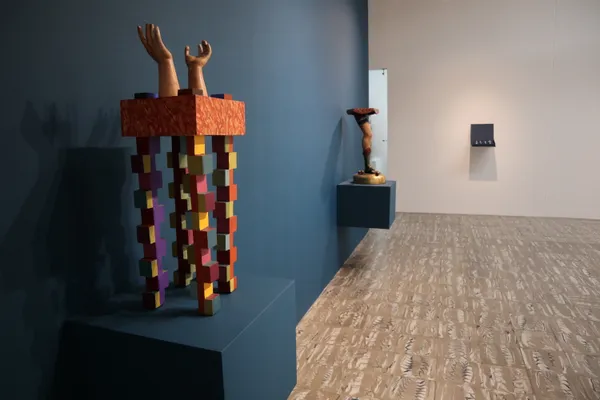
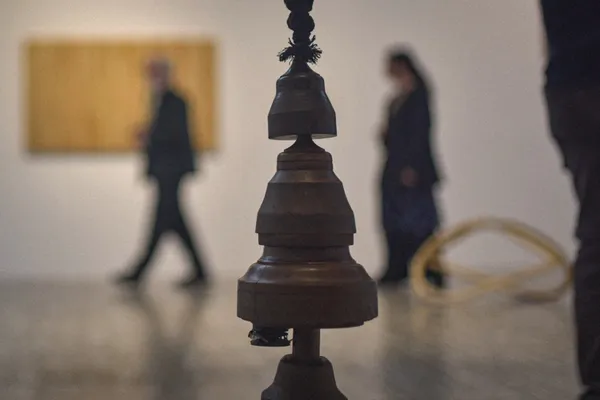
"ARS CORPORA ARS " brings together drawings, sculptures, and reliquaries created by Jim Amaral between 1969 and 1979. The works on paper include *A Listening Hand Ringing a Bell* and *The Happy Prince*, both from 1969; *Untitled*, from 1971; *A Delicate Friend* and *A Soldier Portrait in September*, from 1974; *Sketch of Isabella d’Este*, from 1975; *Wrap a Box*, from 1976; *Androgyne III*, from 1978; and *Quiet Flower, Plate No. 60*, from 1979.
The figures do not always conform to a complete anatomy. There are isolated hands, torsos, limbs, and bodies in which Amaral alters the proportions or combines human parts with objects. Androgyne III incorporates the coexistence of sexual traits into the title itself, while A Listening Hand Ringing a Bell turns a hand into the subject of an impossible action. Sculptures and reliquaries translate some of these forms into three-dimensional works.
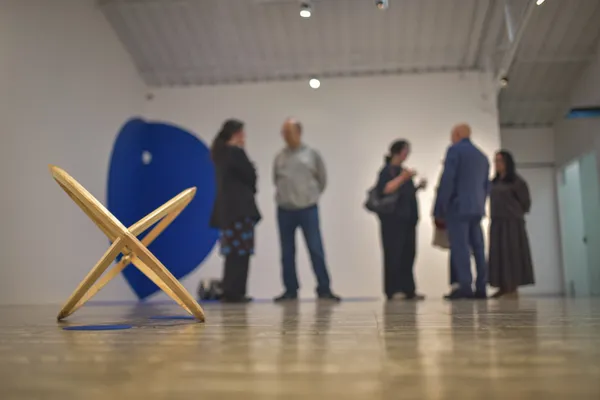
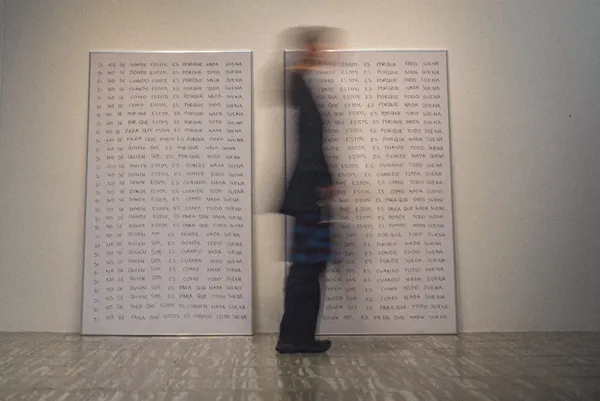
"Shooting Star " occupies another room and was conceived by Miguel Cárdenas as a site-specific installation. A monochromatic mural covers the space and serves as a backdrop for paintings, drawings, and sculptures. The exhibition also includes digital animation. Cárdenas has used painting and sculpture together in previous projects, but here the works have been arranged against a mural created specifically for Elvira Moreno’s gallery.
What to Do Nearby
From the gallery, you can continue on to Quinta Camacho, one of the neighborhoods where you can still see some of the residential architecture that transformed northern Bogotá during the first half of the 20th century. Amid tree-lined streets, brick houses with sloping roofs and front yards still stand, many of which have now been converted into restaurants, bookstores, and cafés.
Tremé is located in a house that’s over a hundred years old at Carrera 10A #70-50. The restaurant specializes in Cajun and Creole cuisine from New Orleans: the menu features gumbo, jambalaya, Louisiana-style shrimp, and other dishes from the southern United States. Some nights there is live music, mainly jazz, blues, and Dixieland.
Librería Wilborada 1047 is very close by, at Calle 71 #10-47. The bookstore is housed in a multi-story building and features a mix of literature, essays, art, and works from Colombian publishers. It’s a great final stop to browse the tables and shelves at your leisure before leaving Quinta Camacho.