
<p>The BAT Alberto Cornejo Gallery opened its doors in Madrid in 1986. Since then, it has developed a program that combines emerging artists with established artists. Its history includes participation in art fairs such as ARCO, Art Basel, Art Chicago, Estampa, and Arte Santander. In 2005, it was one of the 18 founding galleries of Art Madrid, an art fair with which it maintains close ties. . </p>
Gallery Profile
Located at María de Guzmán 61 in Chamberí, the BAT Gallery operates under the direction of Mariam Alcaraz and Alberto Cornejo. Its program encompasses painting, sculpture, photography, drawing, and printmaking, and brings together artists from different generations.
Galería BAT’s selection of artists offers a journey through several generations of Spanish art from recent decades. Among the artists born in the 1960s and later are Xurxo Gómez-Chao (A Coruña, 1960), whose paintings explore expressive and symbolic territory; Pedro Sandoval (Ciudad Bolívar, Venezuela, 1964), whose work employs an abstract and gestural language; Carlos Albert (Madrid, 1978), a sculptor who works primarily with iron and steel; and Marta Aguirre (Tudela, 1983), whose practice spans painting and graphic art.
The gallery also features works by artists whose pieces help shed light on some of the key developments in Spanish art during the second half of the 20th century. Luis Feito (Madrid, 1929–Rascafría, 2021) and Rafael Canogar (Toledo, 1935) were members of El Paso, a group founded in 1957 and closely linked to the development of Informalism in Spain. Juan Genovés (Valencia, 1930–Madrid, 2020) developed a style of painting with strong social and political content, while Eduardo Arroyo (Madrid, 1937–2018) took figurative art in the direction of a critical and ironic language. Manolo Valdés (Valencia, 1942) began his career as a member of Equipo Crónica before pursuing a solo career marked by the reinterpretation of images from art history.
Joining this lineup are Julio Juste (Beas de Segura, 1952–Granada, 2017), a painter and multimedia artist who was closely associated with Granada for much of his career, and Ouka Leele (Madrid, 1957–2022), a photographer and visual artist whose work was closely linked to the cultural revival of Madrid’s Movida.
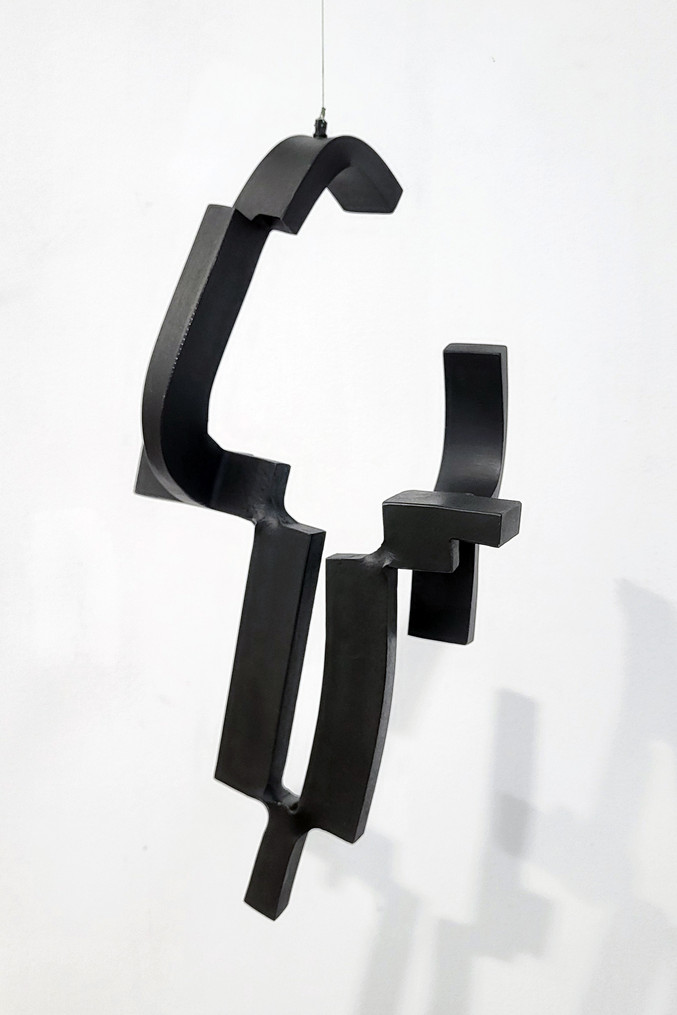
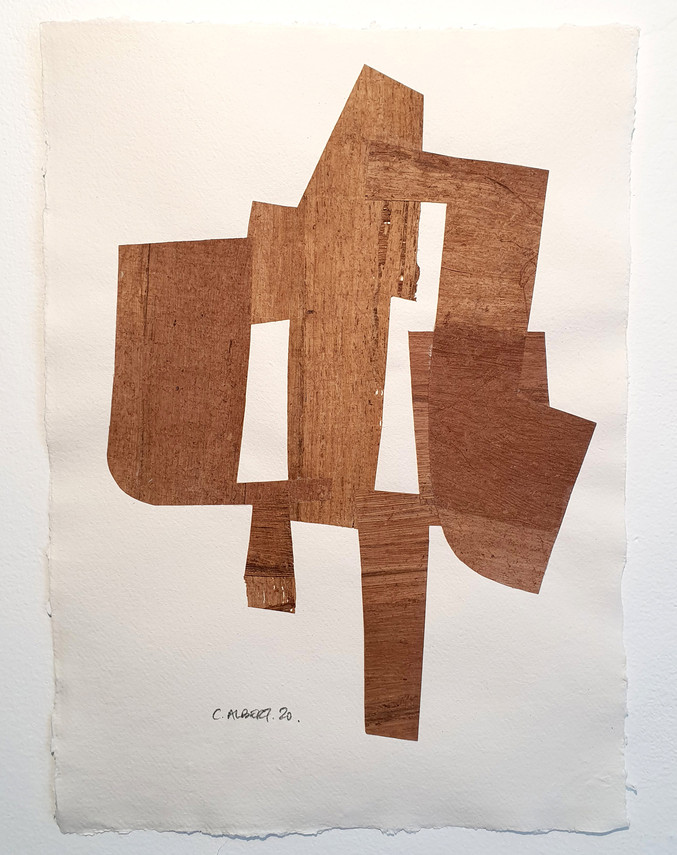
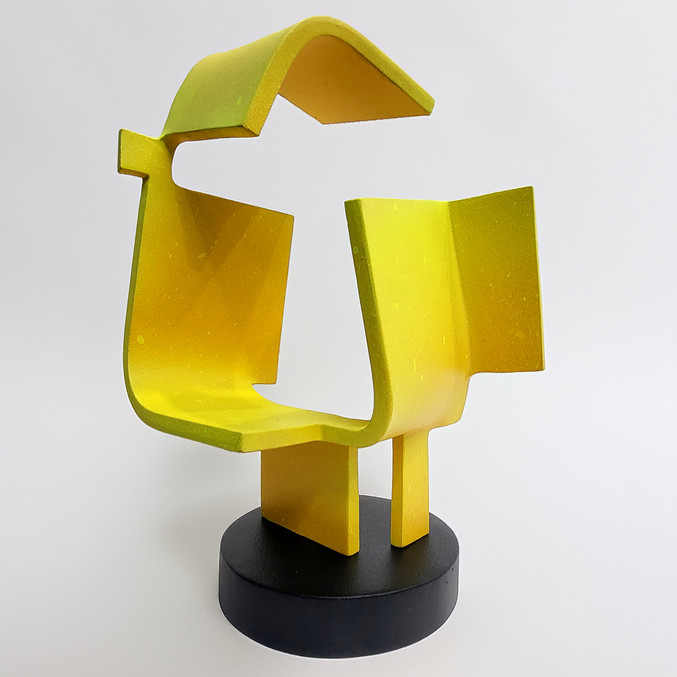
In “ECO,” Carlos Albert returns to Galería BAT Alberto Cornejo twenty years after his first exhibition at this venue. Curated by Alfonso de la Torre, the exhibition brings together sculptures, drawings, and collages that explore some of the central themes of his work: balance, movement, emptiness, time, and the relationship between form and space.
In *Eco*, by Carlos Albert, the exhibition focuses on metal sculptures. Curves, openings, and shadows are part of the composition, and the viewer’s perception shifts as they move around each piece. A frontal view reveals only a part of it; from other angles, tensions emerge between volume, void, and light. Distance also alters the interpretation of the forms and their internal relationships. The artist himself relates his work to nature, water, wind, and light—a reference that can be contrasted with the physical presence of the pieces. The exhibition also coincides with the gallery’s 40th anniversary and can be viewed in Madrid from September 11 to October 31, 2026.
Carlos Albert is a sculptor with a career spanning nearly three decades. His work explores the relationship between matter, void, and space, primarily through iron and steel, and ranges from small-scale pieces to monumental installations linked to architecture and public space. His work has been exhibited in various international contexts, and in 2023, the Reina Sofía Museum hosted the launch of the publication *Carlos Albert: Toward the Unknown*.
Program
Why Go
One of the reasons to follow BAT’s programming is the continuity of projects that go beyond the solo exhibition. Since 2016, the “Dialogues” series has brought together the work of two artists in a single exhibition, structuring the show around the connections and differences between their artistic languages.
In 2026, it held its nineteenth edition, featuring Borja Barrajón and Teresa Carneiro. The gallery’s history also shows a willingness to incorporate external curatorial projects such as “Overbooking.” “Consequences of Hyper-Tourism,” developed by students in the Master’s in Art Market program at Nebrija University, brought together six artists to explore the effects of mass tourism and included an acquisition award for the university’s collection. This combination of gallery exhibitions, curatorial projects, and collaborations offers a variety of initiatives throughout the year and makes BAT a destination worth revisiting more than once.
What to Expect
BAT occupies the ground floor at María de Guzmán 61, in Chamberí. The entrance directly off the street leads into a bright space where wall-mounted works and three-dimensional pieces can be displayed alternately. The surrounding area combines residential buildings, offices, and shops, so the gallery is integrated into an everyday part of Madrid rather than a street dedicated exclusively to art.
What to Do Nearby
The Geominero Museum, located on Ríos Rosas, offers a continuation of the theme after viewing Carlos Albert’s sculptures. Its display cases of minerals and fossils, along with the interior architecture, shift the focus from worked metal to other ways of observing materials. The walk from María de Guzmán takes you through a part of Chamberí characterized by residential buildings, offices, and shops.
The Rafael Alberti bookstore opened its doors in Madrid in November 1975, and half a century later, it remains one of the city’s longest-running independent bookstores. It boasts a collection of more than 20,000 titles and hosts a busy schedule of book presentations, gatherings, and book clubs. For its “Encuentros en Alberti” series, which has brought together more than 400 writers, poets, and essayists, it received the Cultural Bookseller Award in 2004. In 2019, it was also honored with the Liber-Boixareu Award for Best Bookstore.
For a meal after your visit, Lakasa, located in Plaza del Descubridor Diego de Ordás, is one of Chamberí’s most established dining destinations, featuring cuisine based on seasonal ingredients. On Alonso Cano Street, Sala de Despiece puts a contemporary spin on fresh ingredients and tapas, while Allégorie, on Bretón de los Herreros Street, offers a different experience with its French-inspired menu. All three are less than a twenty-minute walk from Galería BAT. For accommodations in the area, the NH Collection Madrid Abascal, on José Abascal Street, lets you stay in Chamberí and offers good connections to downtown and the Castellana corridor.

