
<p>Rafael Pérez Hernando directs this gallery located at Orellana 18, in Madrid's Salesas neighborhood. The space is spread over two levels: the main galleries occupy the ground floor, and on the lower level, La Cripta functions as a separate gallery. This layout allows visitors to view two exhibitions separately within the same venue. </p>
Gallery Profile
Rafael Pérez Hernando (Madrid, 1953) studied law before pursuing a career in art. For seven years, he worked alongside his father on the restoration of the Cistercian monastery of Santa María de Bujedo in Burgos, a project that received a Europa Nostra Award in 1982.
In 1996, he began organizing exhibitions in a small space on Claudio Coello Street. In those early years, he selected specific periods in the careers of Spanish artists and paid special attention to works on paper. Antón Lamazares (Maceira, Lalín, 1954) was the focus of an exhibition in 1997 dedicated to his work from 1981 to 1983. The following year, he presented works on paper created between 1970 and 1990 by Bonifacio Alfonso (San Sebastián, 1933–2011); and in 1999, it selected works from around 1966 by Manuel Hernández Mompó (Valencia, 1927–Madrid, 1992). On November 10, 2004, the Orellana 18 location opened with an exhibition by Joan Hernández Pijuan: Works on Paper: 1987–2002.
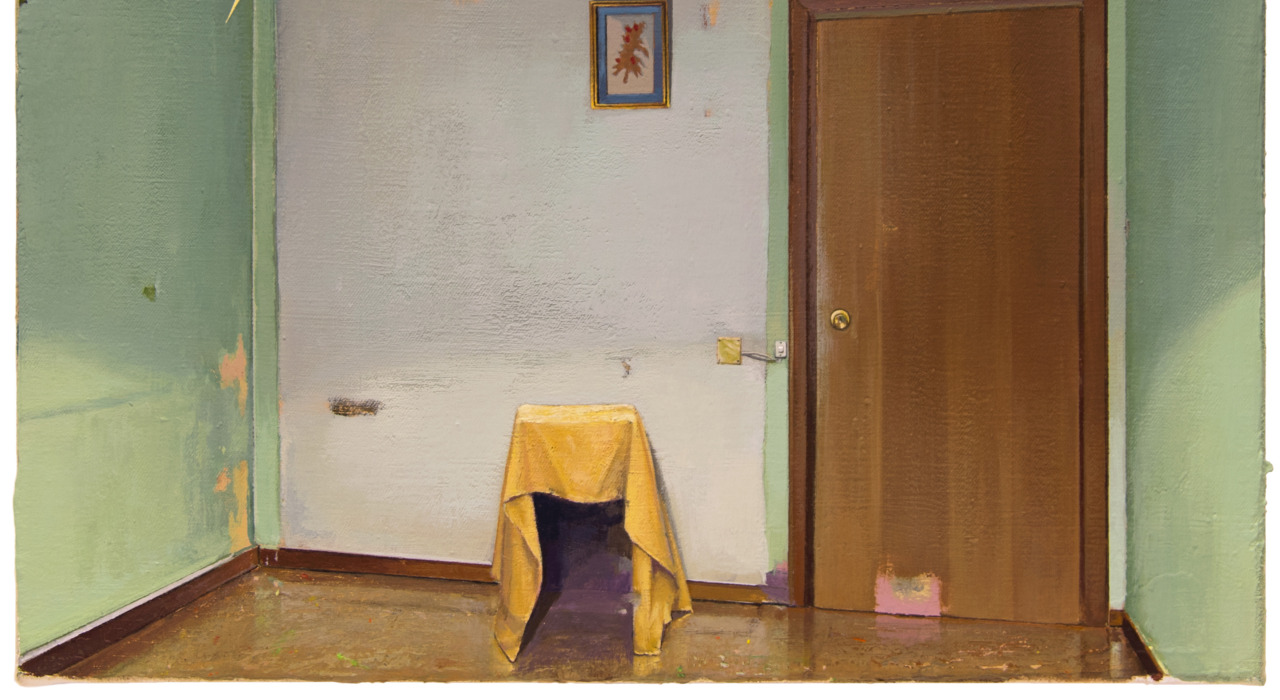
Art fairs are part of that journey. At ARCOmadrid 2016, the Spanish Association of Art Critics awarded Rafael Pérez Hernando the prize for best gallery of that edition for the presentation at his booth. In 2026, he participated again in ARCOmadrid with a group project in Hall 7. The gallery remains headquartered at Orellana 18 and also participates in ESTAMPA Madrid.
Program
Why Go
Rafael Pérez Hernando typically structures his exhibitions around specific groups of works. He did so even in his early years at Claudio Coello and continued to follow this approach when he opened Orellana 18. The exhibition that inaugurated the new venue was dedicated to Joan Hernández Pijuan (Barcelona, 1931–2005). *Works on Paper: 1987–2002* brought together fifteen years of drawings by one of the Spanish painters who, during the second half of the 20th century, took the reduction of represented elements to its furthest extent.
Hernández Pijuan trained in Barcelona and Paris. Beginning in the 1970s, the landscape surrounding his home and studio in Folquer, La Noguera, became a major source of his subjects. Houses, trees, leaves, and plots of land began to appear with fewer and fewer elements. Drawing and paper allow us to follow this process particularly well.
In 2003, a year before that exhibition in Madrid, MACBA had organized *Returning to a Familiar Place*, 1972–2002. The retrospective brought together nearly 140 paintings, drawings, and prints and later traveled to the Musée d’Art et d’Histoire in Neuchâtel and the Malmö Konsthall. After the artist’s death in 2005, Rafael Pérez Hernando continued to exhibit his work. In 2023, he dedicated the exhibition *Absence, Presence* to him.
Another artist who helps illustrate the type of exhibitions the gallery organizes is Giorgio Griffa (Turin, 1936). In 2025, Rafael Pérez Hernando brought together works by Griffa created from the early 1970s through the present. Griffa abandoned the stretcher frame in the late 1960s. He works on unprimed canvases that he stretches as he paints and then hangs directly on the wall. Once taken down, he folds them for storage. When they are exhibited again, the creases left by those folds remain on the canvas.
In 2021, Griffa donated eighteen works to the Musée National d'Art Moderne in Paris. The Centre Pompidou presented a selection the following year and commissioned a new piece from him. *La Recherche*, created for the museum, consists of twenty-four canvases and was inspired by Marcel Proust’s *In Search of Lost Time *.
What to Expect
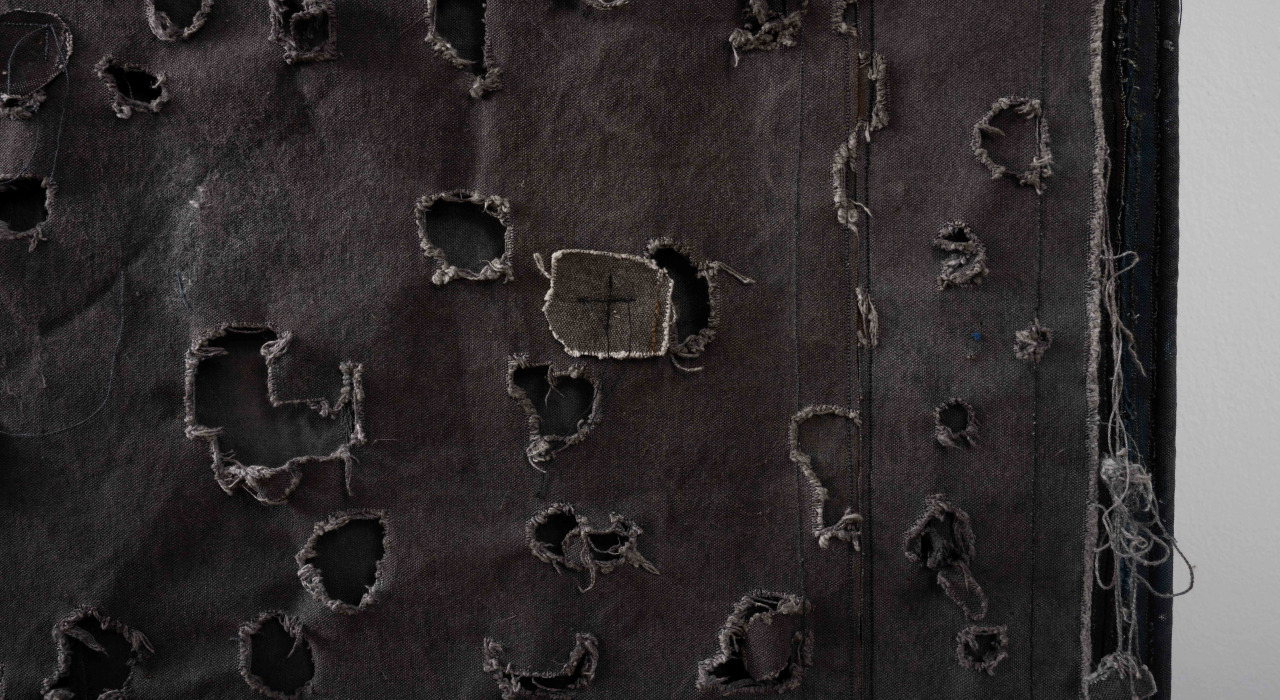
The main galleries feature “Blue and Black Puncture Paintings,” an exhibition by Simon Callery (London, 1960) consisting of works created specifically for Madrid.
For some of these paintings, Callery worked on the Thames riverbed at low tide and in the estuary near her studio in Essex. She spread the canvases out on surfaces covered with stones and debris deposited by the river and pierced them right there. The holes created during that process remain in the pieces. Back in the studio, he applied color to the canvases and worked on some of them with new cuts, seams, and patches.
The origins of this procedure lie in an experience that began in 1996. Callery was invited to work alongside archaeologists from the University of Oxford who were excavating prehistoric and Roman-era sites along The Ridgeway, an ancient route that winds through the chalk hills of southern England. For seven years, he accompanied the team on excavation campaigns at Segsbury Camp, Alfred’s Castle, and Marcham-Frilford. There, he began placing his materials directly on the excavated ground and preserving the marks produced by that contact.
On the lower level, La Cripta presents a selection of works by Susana Solano (Barcelona, 1946) inspired by her travels through sub-Saharan Africa. Solano began focusing on sculpture in the early 1980s. Her career includes Documenta 8 and 9, the Venice and São Paulo Biennales, and the National Prize for the Visual Arts, which she received in 1988.
Traveling through Africa and Asia has been part of his work for decades. In 2003, the Reina Sofía Museum presented an exhibition at the Abbey of Santo Domingo de Silos featuring sculptures created following some of those trips. In several of those works, he combined wicker with iron and incorporated place names and references he encountered during his travels.
For *La Cripta*, Solano has chosen not to provide an explanation that would dictate how the pieces should be interpreted. The gallery includes a brief text by the artist in which she asks that viewers not seek a meaning in the works that can be directly translated into words.
Represented Artists
What to Do Nearby
Rafael Pérez Hernando is located at Orellana 18, between Fernando VI and Génova. From the gallery, you can walk through much of Salesas, where other art spaces, bookstores, small shops, and restaurants are concentrated.
The National Museum of Romanticism is located at San Mateo 13, about a ten-minute walk away. It is housed in the former palace of the Marquis of Matallana and features 19th-century paintings, furniture, photographs, musical instruments, personal effects, and decorative arts. The collection allows visitors to explore rooms reconstructed to reflect the functions of a residence from that era, ranging from the ballroom and dining room to the study and bedrooms. Following emergency renovations carried out in 2026, it is advisable to check in advance which rooms are open.
Panta Rhei is located at 7 Hernán Cortés Street. Ingrid and Lilo Acebal opened the bookstore in 2001 and focused it on art, photography, illustration, design, typography, and visual culture. In addition to books and magazines, it features a small exhibition space and hosts presentations and workshops.
For a sweet treat, La Duquesita is located at Fernando VI 2. The bakery opened in 1914 and still operates out of its historic location. It closed in 2015 and was revived that same year by pastry chef Oriol Balaguer, who kept some of its traditional specialties and added his own pastries, chocolates, and baked goods. It also features a tea room.
Saddle, located at Amador de los Ríos 6, is about a fifteen-minute walk away. It occupies the space formerly occupied by Jockey, one of Madrid’s historic restaurants. The dining room retains services that are rare these days, including carts of bread, cheese, and spirits, as well as dishes prepared right in front of the diner. As of 2026, it has one Michelin star and two Repsol Suns.


