
EL CHICO is a young gallery in Madrid founded in 2021 based on an unusual approach: starting with conversation, podcasts, and the local scene rather than the traditional model of representation. From its location at 16 Ronda de Toledo Street, it works with emerging and mid-career artists through exhibitions, art fairs, podcasts, and projects that view Madrid as a network of connections rather than a showcase.
Gallery Profile
EL CHICO opened its physical space in January 2021, at Ronda de Toledo 16, Unit 9, but its origins were not exactly those of a conventional gallery. Javier Aparicio, born in Mexico City in 1985, initially conceived the project as a podcast designed to capture what was happening on the Madrid scene. The space came later, almost as a natural outgrowth of that need for conversation and the discovery of a building that already housed a budding cultural community.
Aparicio arrived at EL CHICO with early experience in contemporary art: as an artist’s assistant, independent curator, manager, gallery employee, and consultant. This background helps explain why the project doesn’t stem from a romanticized vision of a young gallery, but rather from experience gained in the sector’s less visible areas: production, dialogue, support, sales, management, and relationships with artists. EL CHICO did not emerge from outside the system, but rather from someone who understands its workings and has decided to try a different scale.
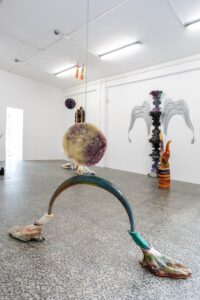
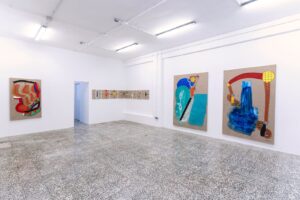
That origin still defines the way they work. The gallery presents itself not only as a place to display artworks, but as a platform where exhibitions, dialogue, podcasts, performances, and collaboration are all part of the same system. In its early years, the project was interpreted by various media outlets as a fresh take on the gallery scene, more interested in supporting emerging art scenes than in immediately replicating the conventions of an established gallery.
The building also tells part of the story. Ronda de Toledo 16 is neither a shopping street in the traditional sense nor a luxury showcase. It is a former industrial complex from the 1960s, located near Puerta de Toledo, where design studios, artists, publishers, photographers, galleries, and independent projects have gradually gathered. EL CHICO fits into this context as a space that understands that a gallery needs not only clients, but also neighbors, conversations, a rhythm of work, and a sense of camaraderie.
The program has taken shape around emerging and mid-career artists, with a special focus on the Spanish art scene, though without limiting itself to it. The current list includes Abel García, Álvaro Chior, Casa Antillón, Cristina Stolhe, Elián Stolarsky, Estefanía B. Flores, Esther Merinero, Irene Anguita, Marina Roca Díe, Maya Pita-Romero, and Silvia Olabarría, as well as collaborators such as Alejandro Guijarro, Concha Ybarra, Jose Casas, Juaki Pesudo, Pepe Domínguez, and Sofía Salazar Rosales.
The project’s involvement in art fairs has brought it increasing visibility. In 2025, it participated in ARCO Madrid Opening with Maya Pita-Romero and Cristina Stolhe, and in Salón ACME México with Casa Antillón. In 2026, it presented Elián Stolarsky at Feria Material Vol. 12 in Mexico and returned to ARCO Madrid Opening with a dialogue between Irene Anguita and Estefanía B. Flores. This presence confirms that EL CHICO is no longer merely a local experiment: it is beginning to occupy a recognizable position on the map of emerging galleries.
“I didn’t want a gallery—I wanted a podcast.” — Javier Aparicio
That sentence sums up the difference behind EL CHICO quite well. The gallery doesn’t reject the market, but it seems to remind us that the market arrives too late if there isn’t already a scene, a language, trust, and conversation in place. Its focus is on building a small yet porous structure, capable of supporting artists at a decisive moment in their careers and championing a less immediate vision of success. In a city currently enjoying a surge of cultural attention, its survival will depend less on trends than on the network of relationships it is able to sustain.
Why Go
It’s worth visiting because EL CHICO offers insight into a very specific aspect of the recent renewal of Madrid’s gallery scene. It didn’t start out as a white cube gallery seeking to fit into the established circuit, but rather as a platform for conversation that eventually found a physical space in an industrial building on Ronda de Toledo. That background is evident: the gallery works with emerging and mid-career artists without making a strict distinction between exhibitions, dialogue, podcasts, performances, and community.
The program brings together artists whose names are already making a strong impression in Madrid and at international art fairs. The exhibition is of particular interest because it showcases works from a stage in the artists’ careers that is still evolving—a time when a gallery’s support can influence not only an exhibition but also the way an artist connects with audiences.
It’s also significant because of its urban location. EL CHICO is near Puerta de Toledo, between La Latina, Embajadores, and the arts corridor leading to the Reina Sofía, La Casa Encendida, and Doctor Fourquet. But it’s not just about being close to that cultural hub: it’s part of a more informal scene, woven together through courtyards, studios, publishing houses, workshops, and up-and-coming galleries. At a time when Madrid is receiving a lot of cultural attention, EL CHICO reminds us that a scene is sustained less by immediate glamour than by the continuity of its relationships.
What to Expect
A visit to EL CHICO doesn’t begin with a stately facade. You arrive at Ronda de Toledo 16, an industrial building from the 1960s organized around a courtyard where traditional crafts, design studios, artists, publishing houses, galleries, and cultural projects coexist. That entrance sets the tone for the experience: even before seeing the exhibition, visitors already understand that the gallery operates as part of a working community, not as an isolated entity within the neighborhood.
The space maintains an intimate scale, without excessive pomp. EL CHICO does not feel the need to turn every exhibition into a monumental statement; its focus is on how it supports emerging processes, evolving practices, and projects that can span painting, photography, sculpture, text, performance, or conversation. The gallery draws attention to small details: how a work is positioned, its relationship to the gallery’s archive, and the kind of dialogue it establishes with artists who have exhibited there before.
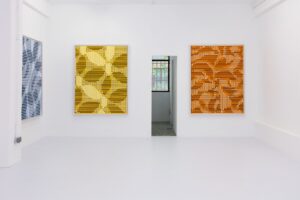
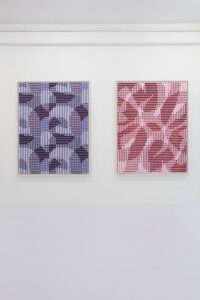
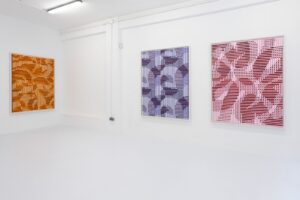
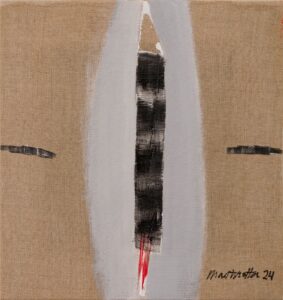
The gallery’s recent programming reflects this breadth. In 2026, the gallery has transitioned from Fernando Mastretta to Estefanía B. Flores, and from Alejandro Guijarro to Cristina Stolhe, in addition to group projects and appearances at art fairs such as ARCO Madrid and Material in Mexico. This variety is not seen as a lack of focus, but rather as a way to support evolving art scenes, where the local and the international intersect without compromising the project’s identity.
It’s best to approach it with a different mindset than you would a large institution. EL CHICO is best understood when you accept its platform’s scale: the exhibition matters, but so do the podcast, the local artists, the courtyard, the building, the conversations, and the ecosystem surrounding the gallery. The visit may be brief in terms of square meters, but rich in insight; it helps you understand how a generation of gallery owners and artists is experimenting with new ways of operating in the market without losing touch with the scene that sustains them.
Represented Artists
What to Do Nearby
After leaving EL CHICO, there are endless artistic, publishing, and culinary possibilities to explore between Puerta de Toledo, Embajadores, and Lavapiés. The building at Ronda de Toledo 16 is worth a stop in itself: it’s home to EL CHICO, Galería Picnic, the publishing studio This Side Up, artist and architect Luis Úrculo, designer Clara Sancho, and other projects that have transformed a former crafts building into a small cultural hive. It’s not just a place to pass through; it’s a scene in miniature.
If you want to keep exploring art, La Casa Encendida is just a short walk away and has an active program in June featuring *Inéditos 2026*, *Drift* by Yann Gross, *Kumusta na kayo? *, and intervention projects such as *El Canal del Parto* by Andrés Fernández. A little further on, the Reina Sofía Museum offers a change of pace with exhibitions such as Felix Gonzalez-Torres: Sweet Revenge, Aurèlia Muñoz: Entes, Dumile Feni: African Guernica, and a new interpretation of the contemporary collection.
The culinary tour can begin at El Boquerón, located at 14 Valencia Street, a tavern in Lavapiés that’s been open since 1949, featuring a seafood bar with shrimp, anchovies, razor clams, and that old-school, homey atmosphere that still lets you enjoy your meal without turning your visit into a spectacle. From there, the walk toward Argumosa Street changes the vibe: more outdoor seating, longer evenings, and more neighborhood chatter.
In Argumosa, Hermanos Vinagre is a great spot for beer, pickles, and casual conversation; its Lavapiés location is at number 12 and offers a modern take on a traditional tavern. Further down the street, La Caníbal, at Argumosa 28, offers natural wines, craft beer, market-fresh cuisine, and a cheese menu that’s earned its own reputation. That street—bustling and somewhat chaotic—makes it clear why Lavapiés can’t be reduced to a postcard: it’s a mix of bars, locals, visitors, noise, outdoor tables, and an energy that shifts dramatically between weekdays and weekends.
For reading, La Fugitiva remains a great neighborhood spot: a bookstore, café, and place to stop by before or after exploring Lavapiés. On Sunday, the route can veer toward El Rastro and the Ribera de Curtidores, where the objects, stalls, antique shops, clothing, books, and bars restore the area to its most down-to-earth character. For a place to stay, I’d avoid seeking out isolated luxury: it makes more sense to stay near Atocha, Lavapiés, or Barrio de las Letras, with easy access to the Reina Sofía, La Casa Encendida, Doctor Fourquet, and the Matadero.


