
The Elba Benítez Gallery belongs to the generation of venues that established Madrid as a contemporary art scene with an international presence. Since 1990, it has maintained a program focused on installation, image, architecture, performance, and projects that extend beyond the gallery space, while remaining committed to working rigorously with artists.
Gallery Profile
The Elba Benítez Gallery opened in Madrid in 1990, at a time when the Spanish art scene was consolidating new market structures, collecting practices, and institutional circulation following the cultural expansion of the 1980s. Its location on the ground floor of a 19th-century building is no minor detail: the gallery operates from a space that preserves the urban scale of the city center, far removed from the “white cube” concept of absolute neutrality. The space has been an integral part of its identity because it allows architecture, artwork, and the visitor’s journey to maintain a visible relationship.
Its program has been curated around artists who do not fit into a single formal category. It includes painting, sculpture, photography, installation, video, performance, and collective action, but the most accurate interpretation emerges at the intersections. Carlos Garaicoa and Cristina Iglesias have approached sculpture from very different perspectives; Ignasi Aballí has explored language, absence, and the archive; Carlos Bunga has transformed fragile materials into temporary architecture; Dora García has integrated text, performance, and intellectual history into a practice where interpretation becomes action. The gallery has managed to preserve these differences without reducing them to a single style.
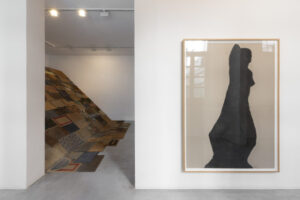
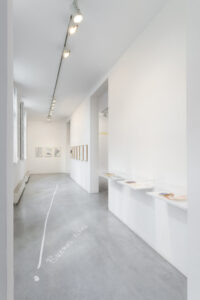
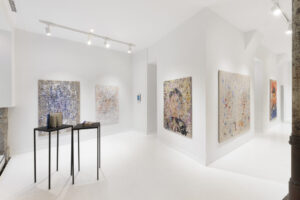
In an interview, Elba Benítez reveals an approach to her work that extends beyond art fairs and immediate sales. The gallery owner speaks of being more selective about where to participate and of returning to a focus on study, research, and specific projects for the artists. This idea also emerges in projects outside the gallery space, such as “Revisitar Canarias,” developed with guest artists to explore territory, identity, and visual stereotypes produced by tourism. This reveals a central aspect of her program: creating context, not just exhibitions.
His relationship with Latin America is not defined by a rigid label either. Benítez has argued that these artists should not be viewed as a regional bloc, but rather as creators rooted in a specific era and an international dialogue. This perspective helps explain the presence of figures such as Carlos Garaicoa himself, Vik Muniz, Ernesto Neto, and Nicolás Paris within a Madrid gallery that has looked toward Latin America without turning it into a niche. Location matters, but it is not limiting; it serves as a source of questions, materials, and imaginaries that circulate beyond a single geographical area.
“What matters most is that they are artists with strong artistic visions, not merely producers of objects…” — Elba Benítez, Arte al Día, 2021
Today, the gallery remains relevant because its history is not viewed as a closed archive. The current exhibition by Karim Noureldin—the artist’s first at the gallery and his first in Spain—aligns with this history of spatial focus: drawings, textiles, lamps, and a site-specific installation explore perception through surface and architecture. At Elba Benítez, a visit is not an easy one. It proposes a way of seeing in which each exhibition invites viewers to construct their own vocabulary, with the gallery serving as a supporting structure rather than a mere container.
Why Go
Visiting Elba Benítez offers a glimpse into a type of gallery that does not separate programming, research, and production. Its significance does not rest solely on the names it represents—even though the list is extensive and includes artists with strong institutional presence—but rather in its commitment to showcasing works that do not always fit into convenient formats or lend themselves to quick interpretations.
The gallery has worked with artists for whom space is essential to their thought process. Miroslaw Balka, Miriam Bäckström, Ignasi Aballí, and Jorge Ribalta do not propose a single way of experiencing the exhibition. They invite viewers to look at materials, words, architecture, memory, images, and the body with a focus that shifts from one exhibition to the next.
It is also noteworthy for its location within Madrid. It does not function as a neighborhood showcase, even though it is in an area with a rich cultural life. Its space on San Lorenzo Street, between Chueca and Alonso Martínez, retains a layout featuring a courtyard, an interior, and a gallery that encourages visitors to engage with works that require time to appreciate. On a tour of the Justicia and Salesas neighborhoods, it offers a stop where visitors can truly immerse themselves.
What to Expect
Arriving at San Lorenzo 11 feels a bit like entering through a side entrance into the heart of Madrid. The street is part of that area where Justicia, Chueca, and Salesas intersect without merging into a single entity: 19th-century facades, small shops, trendy restaurants, bookstores, and unassuming building entrances. The gallery opens onto a courtyard, rather than facing the street directly. This transition changes the rhythm of the visit. Before even looking at the artworks, visitors have already left some of the outside noise behind and enter with a different mindset.
Inside, the scale does not impose a monumental interpretation. The galleries allow visitors to move slowly, gauge distances, and return to a work without feeling that the space is pushing them toward the exit. The gallery’s history is evident in this confidence in the exhibition design: not everything happens on the wall, nor is everything understood at first glance. Some pieces invite you to walk around them; others are best appreciated in relation to the floor, the light, or the empty space. The architecture does not disappear; it remains an active part of the experience, without demanding the spotlight.
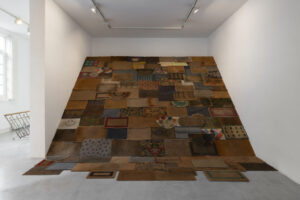
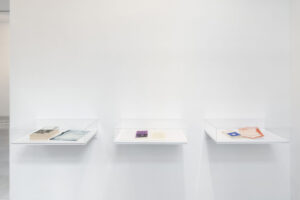
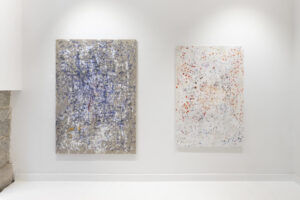
The program typically brings together works that require a perspective capable of embracing different registers. At BREA, Karim Noureldin works with drawings on paper, hand-painted pendant lamps, floor textiles, and a site-specific installation for the gallery. The exhibition confirms a recurring theme in Elba Benítez’s work: practices in which surface, object, space, and perception are not organized into rigid categories. Visitors enter an exhibition that does not seek to impose itself through accumulation, but rather through relationships of scale, color, and movement within understated rooms, without unnecessary emphasis.
Leaving the gallery, you return to the neighborhood, where the atmosphere has changed. Just a few steps away are the Museum of Romanticism, the Madrid branch of Travesía Cuatro, and several possible routes toward Salesas, Barquillo, or Malasaña. The gallery serves as a good starting point for a tour because it focuses your attention before allowing it to wander. It can also serve as the perfect way to wrap up an afternoon of exhibitions, when your eye is already well-trained and you need a space where each work can breathe on its own. In both cases, the visit calls for time and a mindset that’s less about rushing to see as much as possible and more about taking your time, paying close attention to the journey and the neighborhood.
Represented Artists
What to Do Nearby
After leaving the gallery, I would first walk toward San Mateo Street. The Museum of Romanticism is very close by and completely shifts the mental scale of the route: from the contemporary gallery, you move to an 18th-century mansion that preserves 19th-century furniture, paintings, and domestic life. Just a few minutes away, Travesía Cuatro lets you continue your gallery tour without leaving the neighborhood, while Casado Santapau, on Piamonte, opens up another detour toward Salesas. For reading, Panta Rhei on Hernán Cortés serves as a natural stop: art, graphic design, photography, illustration, and publications that keep the conversation going without turning it into a souvenir.
The route is best if you head toward Fernando VI. La Duquesita offers a sweet taste of Madrid on a street that still blends historic shops with the neighborhood’s new vibrancy; a coffee and some puff pastry can set the tone for the afternoon before continuing on to Barquillo or Plaza de las Salesas. For a meal that stays true to the vibe, Casa Macareno, in San Vicente Ferrer, revives the concept of a traditional Madrid tavern with a bar, stews, and an atmosphere that’s more down-to-earth than formal. Between San Lorenzo, San Mateo, Hortaleza, and Salesas, the area lets you view art, buy books, eat, and stroll without turning your outing into a checklist of places to visit.


