
MAISTERRA marks a new chapter for a key gallery on the Madrid art scene, founded in 2007 by Pedro Maisterra and Belén Valbuena and known for years as Maisterravalbuena. From its location on Calle Hospital in central Madrid, the gallery works with Spanish and international artists, established figures, and estates, representing names such as Silvia Bächli, Antonio Ballester Moreno, Miguel Ángel Campano, Patricia Gadea, Sarah Grilo, Regina de Miguel, Soledad Sevilla, Daniel Jacoby, and A Kassen.
Gallery Profile
MAISTERRA marks a new chapter for a gallery that the public has known for years as Maisterravalbuena. Founded in 2007 by Pedro Maisterra and Belén Valbuena, the gallery established itself in Madrid at its first location on Doctor Fourquet Street, which for a long time served as one of the city’s recognizable hubs for contemporary art. The name change does not erase that history: it distills it and channels it into a more refined structure with a more direct identity.
The current website defines the project as a platform for promoting Spanish and international art, with a special focus on intergenerational dialogue. That phrase may sound broad, but at MAISTERRA it has a specific meaning: contemporary artists, historical legacies, estates, and long-term collaborations. It’s not just about bringing together big names, but about fostering relationships capable of producing exhibitions, new interpretations, and context for works that belong to very different eras.
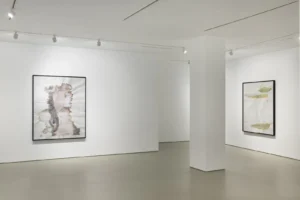
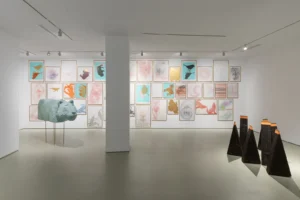
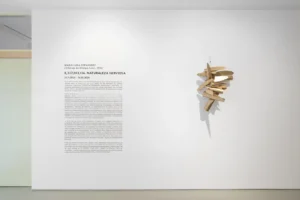
The move in February 2023 marked a turning point. After more than fifteen years at Doctor Fourquet, the gallery opened a 500 m² space at Calle del Hospital 8, just a little further up the street and right next to the Reina Sofía Museum, featuring a new architectural concept designed by Carbajo Hermanos, a firm with extensive experience in designing exhibition spaces. The art press interpreted this move as a statement of philosophy: a place where the storage area, the offices, the exhibition hall, the façade, and the reception area are not secondary elements, but rather integral parts of a unified approach to running a gallery.
That focus is very clear in the program. The gallery represents or works with artists such as José Luis Alexanco, Silvia Bächli, Antonio Ballester Moreno, Miguel Ángel Campano, Jacobo Castellano, Jerónimo Elespe, María Luisa Fernández, Patricia Gadea, Sarah Grilo, Daniel Jacoby, Regina de Miguel, Lucio Muñoz, Néstor Sanmiguel Diest, Soledad Sevilla, and B. Wurtz. This list reveals a focus on painting, drawing, language, installation, memory, and the areas where history becomes visible once again.
There is also a sustained international presence. The gallery participates in ARCO and maintains a presence at fairs such as Frieze London and Art Basel Miami Beach. MAISTERRA does not view the Spanish art scene as a closed circuit, but rather as a conversation that needs to go out into the world, return, compare, correct, and become more complex. Based in Madrid, its program brings together local artists, European figures, Latin American artists, and American artists.
“The gallery owner’s goal is to work with the artist.” — Pedro Maisterra
That statement aptly sums up the difference between a gallery understood as a showcase and a gallery understood as a craft. MAISTERRA has built its reputation on a combination of continuity and reinvention: artists it has worked with for years, legacies that require careful stewardship, contemporary projects that cannot be fully appreciated in a single visit, and a new space designed to give physical form to the conversation. Its significance lies in that consistency: knowing how to observe, accompany, and create the conditions for a work to find its audience.
Why Go
It’s worth a visit because MAISTERRA offers a solid glimpse into Madrid’s recent gallery scene: a gallery that began in 2007, grew over more than fifteen years on Doctor Fourquet Street, and in 2023 opened its 500 m² space on Hospital Street. This is not a young gallery still trying to find its footing, but rather a project that has maintained long-standing relationships with artists, incorporated key figures from the art world, and maintained a consistent presence at international art fairs.
The program is grounded in its balance between generations. This blend demonstrates how a gallery can engage with the present without severing the dialogue with a history of Spanish and international art that still requires reinterpretation. The current venue is also worth a visit, as it does more than simply expand the floor space. It incorporates conversation areas, a storage space that’s visible as part of the exhibition route, offices, and a lounge that reinforces the idea of the gallery as a place for direct interaction. MAISTERRA advocates a way of working where exhibitions, relationships with artists, collecting, and conversation all occupy the same space.
What to Expect
A visit to MAISTERRA begins in a part of Madrid where art is no longer confined to a single street. The gallery is located at Hospital 8, near the Atocha-Antón Martín-Reina Sofía Museum corridor, but with a more open presence toward the neighborhood than the old Doctor Fourquet layout. Its façade, with its large openings, creates a direct connection to the street: even before entering, you can sense that the space wants to reveal something of its inner life.
The interior is on a scale that is unusual for a Madrid gallery: 500 m² organized so that exhibition, storage, work, and conversation do not feel like separate functions. There is an exhibition hall that retains a certain element of surprise, but also a lounge and gathering areas that effectively convey the project’s vision. The architecture does not aim for absolute neutrality; it employs subtle tones, nods to the previous location, and a sense of a place designed to be revisited, not just passed through.
The program calls for a close look at the intersections of time. A visit can take you from Daniel Jacoby to Miguel Ángel Campano, from Silvia Bächli to Patricia Gadea, from Antonio Ballester Moreno to Sarah Grilo or Néstor Sanmiguel Diest. MAISTERRA does not present history as an immutable authority nor youth as an automatic novelty. Its focus is on bringing together artists from different generations without turning that coexistence into a mere decorative gesture.
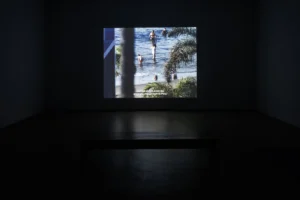
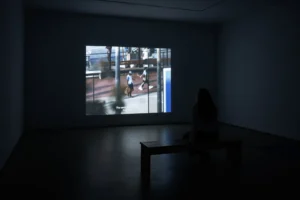
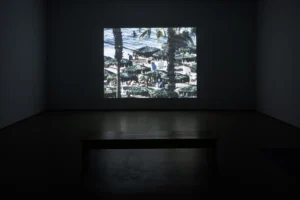
It’s a good idea to arrive with enough time to view the exhibition and take in the space. At Cathartes, Daniel Jacoby presents a video and five bronze sculptures that explore memory, classification, and exclusion; the installation itself, covered in blue raffia, breaks the neutrality of the gallery. This kind of project calls for more than just a quick visit: walking around, reading, pausing to consider the text, and letting the architecture become part of the experience.
Represented Artists
What to Do Nearby
After leaving MAISTERRA, there are endless artistic, botanical, cinematic, and culinary possibilities to explore between Atocha, Antón Martín, and the Barrio de las Letras. Nearby is CaixaForum Madrid, which in June 2026 will present *Somos naturaleza*(We Are Nature), an immersive audiovisual experience on biodiversity created in collaboration with the digital solutions company OASIS Immersive Studios and National Geographic. If you’re looking for a break from museums, the Royal Botanical Garden offers seasonal exhibitions and activities; in June, highlights include “Buenos Aires en flor ” and the self-guided tour “Discover the TRIGGER Universe.”
The Prado is within walking distance and offers a change of pace without straying from the cultural hub. In June 2026, the museum will host exhibitions such as “Prado: 21st Century,” “The Council of State,” and “The Prado Museum,” a journey through the portraits of some of the institution’s notable council members, offering a reinterpretation of political portraiture throughout its six centuries of history. Visitors can also see the exhibition on the Madrid-based sculptor Juan Muñoz, *Historias de Arte*. Muñoz was, in his own words, “a thief of all the techniques of the great masters, whom he studied compulsively during his countless visits to the Madrid museum, and with which he created one of the richest sculptural bodies of work of the final decades of the 20th century.” For a different kind of evening, the Cine Doré at the Spanish Film Archive remains one of the best ways to wrap up the tour: its June lineup includes series such as postwar British cinema and special screenings, with the Santa Isabel building itself adding to the appeal.
When it comes to dining, Antón Martín offers a relaxed atmosphere. The Antón Martín Market, at Santa Isabel 5, is home to a variety of food stalls and maintains that unique mix of market, dance school, locals, tourists, and quick-service tables—perfect for after an art exhibition. Inside the market, Sincio is the place to go for a quick, no-frills meal at the bar, featuring seasonal ingredients served in small portions. If you prefer a classic eatery, La Sanabresa, at Amor de Dios 12, stays true to the neighborhood tradition of a set menu and generous portions. For a more upscale dining experience featuring signature cuisine, Triciclo, at Santa María 28, is best reserved as a dedicated dining outing: it offers seasonal ingredients and a more elaborate menu—not just a quick stop after visiting the gallery.
If you're looking for a place to stay nearby, the Radisson RED Madrid is a good choice because of its location: it's just a few steps from Atocha, the Reina Sofía Museum, and the Prado area, and it features a terrace and dining options linked to Eneko Atxa. I wouldn’t choose it as a luxury destination in and of itself, but rather as a practical base for exploring museums, galleries, and train stations. MAISTERRA works well as part of a weekend that combines Hospital, Antón Martín, the Prado, CaixaForum, the Botanical Garden, and a screening at the Cine Doré—an area where Madrid blends institutions, markets, trains, neighborhoods, and conversation without requiring too much travel between them.


