
The Guillermo de Osma Gallery occupies a distinct niche in Madrid: it approaches the 20th century as a field of research, not as decorative nostalgia. Its program focuses on the European and Latin American avant-garde, Spanish abstraction, and the figurative movements that restored complexity to the image following the major modernist orthodoxies.
Gallery Profile
The Guillermo de Osma Gallery opened in Madrid in 1991 with an exhibition dedicated to Joaquín Torres-García and Rafael Barradas, the two most influential Uruguayan artists of the 20th century. That starting point defined the mission the gallery has upheld for decades: to explore modernity as a field with transatlantic connections, where Europe and Latin America are not viewed as separate entities. From the outset, it took on a complex challenge, as analyzing the 20th century requires knowledge, patience, and a serious commitment to research.
His specialization in historical avant-garde and art from the second half of the 20th century has taken shape through exhibitions that do not rely solely on the prestige of the artists’ names. Research carries weight. In a scene where the market can reduce modern art to pieces circulating in private hands, Guillermo de Osma insists on providing context: essays, chronologies, visual archives, and analyses that allow a work to be situated within a broader conversation.
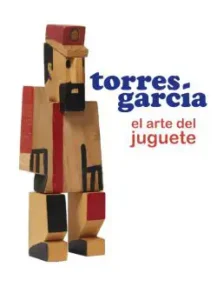
The gallery has worked with key artists of recent decades, such as Eduardo Chillida, Richard Serra, Antoni Tàpies, and the ever-controversial Christo, and has focused on essential figures of Spanish and Latin American modernism. It has also collaborated with museums and foundations, and its involvement in catalogs raisonnés—such as the one on Maruja Mallo’s oil paintings published in 2021—confirms a commitment that extends beyond the gallery space. This line of work resembles applied research more than mere intermediation.
The current exhibition on the 1980s reveals an important aspect of that stance. The gallery does not limit itself to the heroic avant-garde or established abstraction; it also delves into areas of recent history that still need to be sorted out. La Movida is usually recounted through the lens of music, film, and Madrid’s nightlife. Here, it is explored through painting, photography, and a group of artists who brought to light a cultural transition that was less straightforward than the narratives—celebratory or otherwise—would have us believe.
"The '80s begin in the '70s. This is true of music, but also of art.”
— Alaska, interview with Rafa Cervera for the exhibition catalog
*
* That phrase works well for understanding the gallery’s approach: not accepting overly convenient divisions. Guillermo de Osma works where an era needs to be reexamined with greater precision. That is why its significance lies not only in having brought together important works, but in having developed a way of seeing. Madrid changes around it, the art scene accelerates, trends return under different names. The gallery remains committed to a task that is less flashy but more necessary: teaching us to interpret the 20th century without oversimplifying it.
Why Go
It’s worth visiting because the gallery has a unique way of engaging with the recent past. It doesn’t turn modernity into a closed showcase. Instead, it studies it, reorganizes it, and brings it into circulation through exhibitions that are often accompanied by a catalog, an essay, and a clear commitment to documentation. This consistency sets it apart in a city where many galleries rely on the constant pursuit of novelty.
The program allows visitors to explore entire chapters of 20th-century art on a gallery scale: Torres-García and Barradas as a symbolic starting point; Maruja Mallo as a figure of sustained research; Canogar, Chirino, Rivera, Tàpies, and Chillida as points of reference for reexamining Spanish abstraction without reducing it to a school of art. The current exhibition on the 1980s opens up another front: Madrid after the Transition, figurative art, photography, and a scene that the musical narrative of the Movida has all too often oversimplified.
The visit will appeal to anyone who wants to view artworks, but also to understand their genealogies. Here, the names serve as chapters in a history of art that still needs to be discussed within the galleries.
What to Expect
Arriving at Claudio Coello sets the tone. There’s nothing flashy about it. The gallery is part of that side of Madrid with its understated doorways, upscale shops, and streets where luxury coexists with a more traditional sense of craftsmanship. Going up to the first floor changes the visitor’s experience. You leave behind the fast-paced rhythm of the street’s storefronts and enter a space that demands your attention. The scale isn’t intimidating; it focuses your attention. It’s best to arrive with plenty of time to spare, without expecting a quick tour.
Inside, the exhibition design is usually based on a clear interpretive framework. At Guillermo de Osma, the exhibitions work by making a particular era visible. The gallery space tends to organize relationships: one artist juxtaposed with another, a decade that resurfaces, a technique that helps us understand a historical tension. Visitors benefit by looking at each piece and then returning to the exhibition as a whole. The exhibition rarely reveals its full depth on the first viewing.
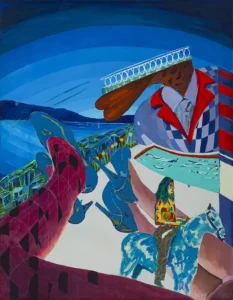
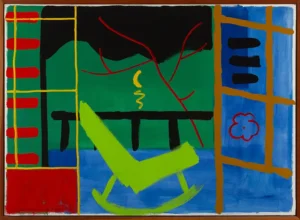
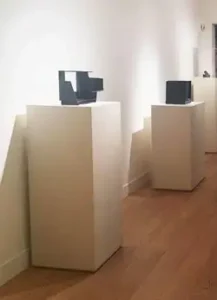
In the current exhibition, the 1980s appear less as Madrid folklore than as a contested visual landscape. Figurative painting, photography, and certain forms of irreverence enter the gallery carrying the weight of an era that is still often recounted through clichés. The selection reveals how the Movida was much more than music, nightlife, and pop culture. It was also an uncomfortable conversation with tradition, with recent politics, and with the spaces where a generation found its own image.
The experience ends with a rare sensation in the commercial art world: having visited an exhibition that could also stand on its own as a research project. The catalogs are part of that interpretation. Guillermo de Osma retains something more demanding: the willingness to look at the 20th century with patience, without turning it into a relic or a revived trend for quick consumption.
Represented Artists
What to Do Nearby
After leaving the gallery, I’d head down toward Serrano. Just a few minutes away are the National Archaeological Museum and the National Library, two buildings that help illustrate the institutional scale of Recoletos: stone, archives, official history, display cases, and grand staircases. If the exhibition left you wanting to see more, the MAPFRE Foundation on Paseo de Recoletos serves as a natural second stop, especially when the programming shifts toward photography or modern painting. The neighborhood makes this sequence possible—gallery, museum, exhibition hall, and tree-lined promenade—without having to force a specific route.
For those who love to read, the Pérgamo Bookstore on General Oraá embodies one of the most beautiful chapters in Madrid’s cultural history: a long-standing bookstore that has survived closures, generational transitions, and real estate pressure. For dining, Horcher across from the Retiro Park is almost a museum of fine dining: game, formal service, baumkuchen, and a sense of time that harmonizes well with a gallery dedicated to viewing the 20th century without anxiety. If you’re looking for something a little less formal, a sweet stop at Mallorca de Serrano before walking toward the Puerta de Alcalá brings the itinerary back to a more everyday pace.


