
Espacio Mínimo helps shed light on how Madrid established a contemporary art scene centered around Doctor Fourquet. Founded in Murcia in 1992 and based in Lavapiés since 2000, it has maintained an international program in which painting, installation, photography, video, and objects engage in an ongoing dialogue.
Gallery Profile
Espacio Mínimo was founded in Murcia in 1992, far from the hub where the Spanish contemporary art market seemed to dictate its hierarchies. That origin matters because it explains part of its character. From the very beginning, the gallery was compelled to build its own context, to work with young artists, and to venture out to global art fairs so as not to remain confined to a local scene that was insufficient for its vision. The name, born from a tiny room—a broom closet—ended up serving as a statement. The physical size did not determine the ambition of the plan conceived by its founders, partners, and couple Luis Valverde and José Martínez Calvo, nor their capacity for public and critical discourse.
The move to Madrid in 2000 was not merely a change of address. Doctor Fourquet did not yet have the density of galleries it would later achieve, but it already offered something decisive: its proximity to the Reina Sofía, a constant flow of enthusiastic visitors, and the opportunity for dialogue with other galleries. Espacio Mínimo arrived before the street was seen as an established art scene. In that sense, it didn’t just adapt to a cultural neighborhood; it helped shape how it was understood through the scale of its program and the continuity of its work.
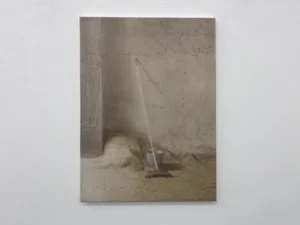
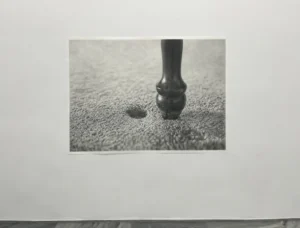
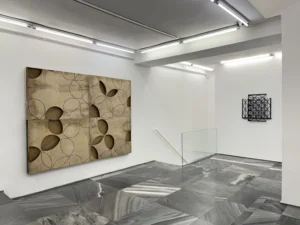
Its program has grown out of deep connections with artists from different generations. Manu Arregui, Nono Bandera, Bene Bergado, Miguel Ángel Gaüeca, Manu Muniategiandikoetxea, and the Argentine artist Liliana Porter are part of a legacy that the gallery continues to uphold. Other names, such as Ana Vidigal, Martí Cormand, Diana Larrea, Donna Conlon, and Elena Blasco, expand the scope to include other forms of narrative, archive, image, and format.
There is a subtle coherence in this breadth. Espacio Mínimo does not reduce the contemporary to a recognizable aesthetic, but rather to an attitude toward the work. Learning to pay attention to what unsettles, to that which lies beyond an immediate reading and requires time spent in the gallery. Its program can range from painting, installation, photography, video art, and objects because what unites them is not the medium, but the insistence that each exhibition pose a specific question and maintain a clear critical distance.
“For us , a gallery wasn’t a space but a project, ” explained its late co-founder, José Martínez Calvo, in an interview with ABC
Today, the gallery retains its value because it has not strayed from that definition. On a street where the art scene can devolve into a fast-paced consumption of openings, Espacio Mínimo maintains a demanding form of hospitality: enter, look, read, return to an image. Its history is understood as a whole as a method. A visit reveals a gallery that learned to grow without abandoning the scale from which it began to think, and that still understands its program as a stance—sometimes a very combative one—within today’s contemporary Madrid and within the sometimes complacent art scenes of the city.
To keep exploring this thread, visit our contemporary art coverage; you can also continue through the galleries setting the agenda.
Program
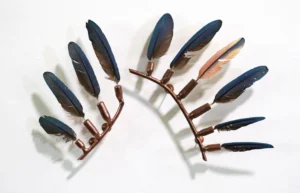
Listen to the Hummingbird de Donna Conlon · 28 Mar – 16 May 2026
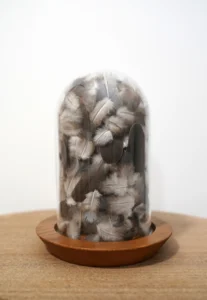
Fuera de lugar de Martí Cormand · 7 Feb – 21 Mar 2026
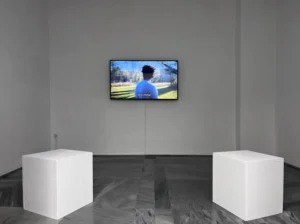
NAO ES TU, EZ DA ZU, NO ES TU de Manu Muniategiandikoetxea · 15 Nov 2025 – 31 Jan 2026
Why Go
It’s worth visiting Espacio Mínimo because its history allows us to see two scenes at once: that of a gallery that began far from Madrid’s art scene, and that of a street that eventually became one of the city’s most concentrated areas for galleries. Its program does not rely on a single aesthetic approach. It can range from the quiet paintings of Antonio Montalvo to the conceptual works of Juan Luis Moraza, from the critical gaze of Donna Conlon to the narrative precision of Liliana Porter, without losing sight of a fundamental idea: the work must pose a question, not merely occupy a wall.
The visit is noteworthy because the space retains the scale of a gallery that embraces intimacy as a method. It does not offer a monumental experience—which it does occasionally, such as in the recent exhibition by Manu Muniategui—but rather a leisurely exploration, almost like a cabinet of curiosities. At Doctor Fourquet, where contemporary art can sometimes become a superficial tour, Espacio Mínimo invites us to pause and observe how a career spanning more than three decades (it celebrates its 35th anniversary next year with a major exhibition in its original home of Murcia) continues to engage with the present without abandoning its memory, yet without a shred of complacency.
What to Expect
Doctor Fourquet has that neighborhood vibe where you know you’re being watched: gallery shutters, narrow sidewalks, visitors appearing and disappearing between one opening and the next. The gallery is best appreciated when you enter without expecting a spectacle. Its threshold fosters concentration; it leaves the noise of Lavapiés outside and places the visitor before a scale where each work requires a measured distance, almost like in a studio.
Inside, the visitor’s journey depends heavily on the current exhibition. The galleries allow for intimate installations, with a direct relationship between the walls, light, and silence. When the exhibition features paintings, the experience becomes almost like breathing: you move forward, step back, and examine the details. When installations, photography, or video appear, the space compels you to negotiate with your body (and perhaps descend some narrow stairs where the most interesting surprises are sometimes hidden) and with time. There is no excess of architecture; there is a useful neutrality, capable of supporting works that demand attention without becoming a stage set or distracting from the experience.
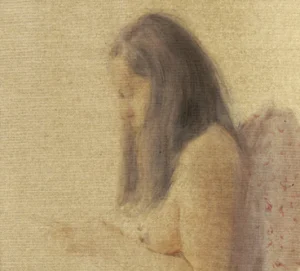
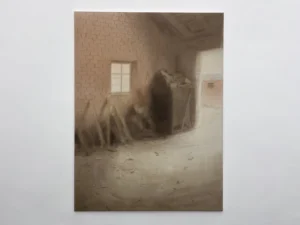
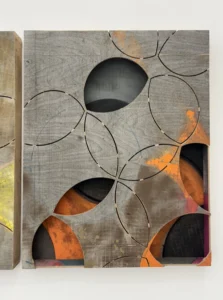
The gallery usually calls for a leisurely gaze. It’s not about stopping by to “see what’s there,” but rather about engaging with the language of each project: material, image, gesture, memory, humor, strangeness, or political commentary. That breadth is part of its substance. Espacio Mínimo functions as a workspace where artists from different generations experiment with ways to make visible that which cannot always be explained immediately or summed up in a single exhibition statement.
The exit brings visitors back to one of the busiest streets on Madrid’s art circuit. That’s why the visit is all the more rewarding when it’s not treated as a standalone stop. Espacio Mínimo can serve as the starting point for a gallery tour, wrap up a morning spent at the Reina Sofía, or provide a break between major institutions and smaller art scenes. Its scale allows for something valuable: a reminder that contemporary art doesn’t always need institutional clout to change the way we walk through a city and interpret its shared present or a future that art calls into question.
Represented Artists
What to Do Nearby
I wouldn’t head straight from Espacio Mínimo to the subway. Dr. Fourquet suggests a short detour: see which other galleries have their doors open, let one exhibition engage with another, and walk toward the Reina Sofía without turning the journey into a checklist. The proximity to Atocha and Lavapiés allows the route to combine a white cube, a major institution, and a lively street in just a few minutes. That mix is part of the point of visiting the gallery: art isn’t locked away; it blends with the neighborhood.
Afterward, you can head over to Argumosa for a casual coffee or bite to eat, or slow the pace down at La Casa Encendida if you still have the energy for another dose of culture. Doing the reverse works just as well: start at the museum, leave saturated with history, and end at Doctor Fourquet, where the galleries bring the present back to a more human scale. Espacio Mínimo is best enjoyed within this back-and-forth between institution, neighborhood, conversation, and a break.


